
Buying Guide Series — B05
Tractor Requirements for Square Hay Balers: HP, PTO & Hitch Guide
Connecting the wrong tractor to a square baler is one of the most expensive mistakes in hay equipment — either in baler damage from over-speeding or in chronic underperformance from insufficient power. This guide covers every compatibility dimension.
540 RPM
Required PTO speed
45 HP+
Min PTO HP (single chamber)
Cat. II
3-point hitch category
1-3/8″
PTO stub diameter, 6-spline
Tractor-baler compatibility is more specific than most equipment buyers expect going in. It’s not enough to have a tractor that’s “big enough” in general terms — the compatibility check involves PTO speed, PTO horsepower, hitch category, stub diameter and spline count, tractor weight, and in some cases hydraulic output. Getting any of these wrong results in either immediate equipment damage or a machine that runs below its performance specification for as long as you use it.
This guide covers each compatibility dimension systematically so you can verify your existing tractor against any square baler before purchase — or verify a prospective baler against a tractor you’re considering buying.
PTO Speed: The Non-Negotiable Constraint
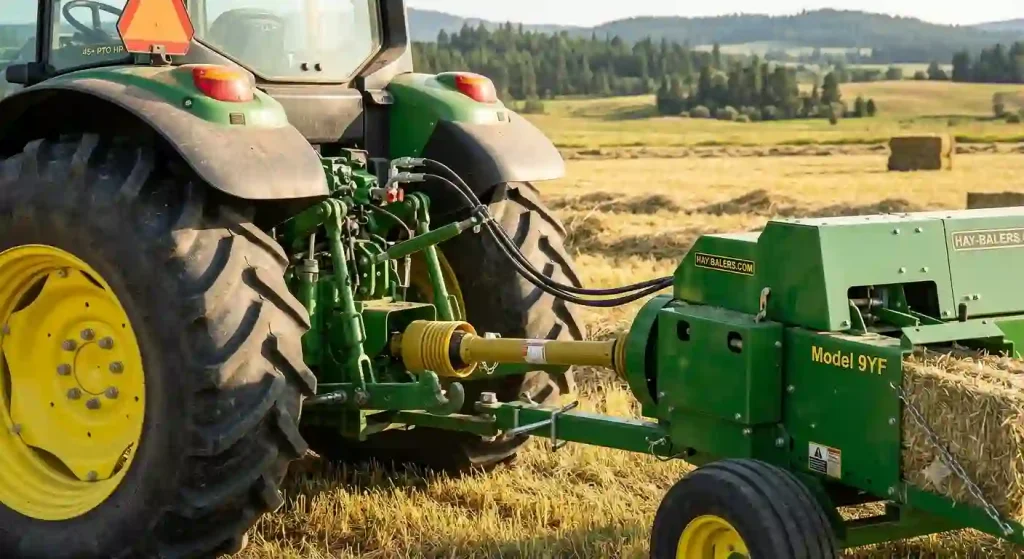
PTO speed is the single hardest compatibility requirement in baler selection. All square balers in our 9YF and 9YFS series are designed for 540 RPM PTO input. This is set by the baler’s internal gearbox design — it cannot be adjusted in the field or compensated for by changing tractor settings.
Critical Warning: PTO Speed Mismatch
Connecting a 1,000 RPM PTO tractor to a 540 RPM baler and engaging at full speed over-revs the baler’s internal mechanisms by 85%. This causes immediate and catastrophic damage to drive shafts, gearboxes, and the knotter system — damage that is not covered under warranty and that can write off the machine in a single use. Always confirm PTO speed before connecting any baler.
Many modern tractors offer both 540 and 1,000 RPM PTO on the same output shaft, with a separate engagement control selecting between them. Confirm which setting is engaged before operating. This verification should be a mandatory pre-operation check item every time the baler is connected to a different tractor.
The standard 540 RPM PTO stub is 1-3/8 inch diameter with 6 splines. Confirm your tractor’s PTO stub matches this specification before ordering the baler’s driveshaft. Non-standard stubs exist on some older or specialty tractors and require an adapter.
PTO Horsepower: Minimum vs Recommended
Baler HP specifications appear in two forms: minimum and recommended. Understanding the difference between these numbers is important for accurate matching.
Minimum HP is the power required to run the baler under ideal conditions — light windrows, flat terrain, moderate field speed, dry crop. Operating at minimum HP leaves no performance reserve for the difficult conditions that inevitably arise: dense windrows, wet crop, uneven terrain, pushing for higher field speed during a weather window.
Recommended HP includes the reserve needed for real-world conditions. Operating near the recommended figure means the tractor maintains consistent plunger speed and bale density under load variations without the engine lugging or the plunger stalling in heavy material.
| Model | Minimum PTO HP | Recommended PTO HP | Notes |
|---|---|---|---|
| 9YF-1700 / 1900 | 33 kW (45 HP) | 37–45 kW (50–60 HP) | Flat ground, standard hay crops |
| 9YF-2200 / 2200S | 37 kW (50 HP) | 45–55 kW (60–75 HP) | Wider pickup, heavier windrows |
| 9YFS-2.2 Twin Chamber | 45 kW (60 HP) | 55–75 kW (75–100 HP) | Dual chamber load, sustained output |
3-Point Hitch: Category and Compatibility
All 9YF and 9YFS series balers use a Category II 3-point hitch connection. This is the standard hitch category for tractors in the 45–120 HP range — the vast majority of farm tractors used in Canadian agricultural operations. Category II uses 28.7 mm (1-1/8 inch) lower link pin diameter and 7/8 inch upper link pin.
Category I tractors (typically under 45 HP) use smaller pin diameters and may not provide adequate structural support for a loaded square baler. Category III tractors (typically above 120 HP) use larger pins and will require adapter bushings to connect to Category II implement balls.
Note that balers are towed — not fully lifted — during field operation. The 3-point hitch provides the connection point and the draw load transfers through the hitch to ground. Confirm that your tractor’s lower link lift capacity is adequate for the baler’s static weight before transport operations.
Tractor Weight: More Critical on Slopes
The reciprocating plunger inside a square baler generates a characteristic fore-aft rocking motion as it cycles. On flat ground, this motion is absorbed by the tractor’s weight and forward momentum. On sloped ground, that same rocking motion can destabilise a light tractor, particularly when decelerating or turning on a grade.
As a practical guideline for Canadian farm terrain:
- Flat ground (under 5% grade): Minimum tractor weight of approximately 1,400 kg for single-chamber models. The plunger motion is manageable at this weight on level terrain.
- Moderate slope (5–10% grade): Increase tractor weight to 1,800–2,000 kg minimum. Consider rear wheel ballasting if your tractor is at the lower end of the weight range.
- Steep terrain (above 10% grade): Consult with us before operating. Steep slope baling requires specific tractor weight and stability assessment — flat-ground minimum weights are not adequate and stability incidents can cause serious equipment damage and safety risks.
Hydraulics: What the Baler Needs from Your Tractor
Square balers are primarily PTO-powered — the hydraulic demand is modest compared to many other implements. However, models equipped with a hydraulic bale ejector (standard on our lineup) require one hydraulic remote outlet on the tractor to operate the ejector cylinder.
Requirements:
- One single-acting or double-acting remote hydraulic outlet
- Flow rate: low demand — any tractor with a functional remote outlet will meet this requirement
- Standard 1/2 inch flat-face or Pioneer-style hydraulic couplers (specify when ordering to confirm coupling compatibility)
If your tractor does not have a hydraulic remote outlet, the ejector can be manually operated — but this slows field operation and requires the tractor driver to dismount for each ejection cycle. For any sustained baling operation, a tractor with at least one remote hydraulic outlet is strongly preferred.
Tractor Compatibility Checklist
Before connecting any baler to a tractor for the first time, work through this checklist:
PTO speed confirmed at 540 RPM (not 1,000 RPM)
PTO stub is 1-3/8 inch, 6-spline
PTO HP meets or exceeds recommended rating (not just minimum)
Hitch is Category II 3-point
Tractor weight meets minimum for terrain type
One hydraulic remote outlet available for ejector
PTO driveshaft guard intact and spinning freely
Safety chain attached to tractor frame
If you’re unsure about any item on this checklist for your specific tractor, contact our team at [email protected] before purchasing. We can confirm compatibility for your tractor make, model, and year based on published specifications. Full baler specifications are available at hay-balers.com/square-hay-balers.
Canada Hay-Balers Co., Ltd
10055 Hogarth Dr, Richmond, BC V7E 3Z9 | [email protected]
Editor:WM