
Commercial & Tractor Mowers for Serious Forage Operations
Sickle mowers, twin-blade mowers, and mower-conditioners — cutting widths from 2.5 m to 5.6 m — built for grass, alfalfa, clover, and reed crops at commercial scale.
Knowledge Base
What Are Commercial & Tractor Mowers?
A commercial tractor mower is a PTO-driven or tractor-towed implement designed to cut standing forage crops — grass, alfalfa, clover, mixed legumes, reeds — at the scale and speed that hand tools or light-duty equipment cannot match. Unlike residential or landscape mowers that cut for appearance, commercial forage mowers cut for crop quality: the precision of the cut, the stubble height left behind, and how cleanly the crop is laid for drying all determine the forage grade that enters the baler.
The first step in every hay or silage production chain is mowing. Done correctly, mowing at the right growth stage, at the right stubble height (typically 5–8 cm), leaves the sward intact for regrowth while maximising the dry matter yield and energy content of the cut crop. Done poorly — with a dull or incorrect cutter — the stems are crushed rather than cut, regrowth is slowed, and the cut crop takes longer to dry due to stem damage that traps moisture.
Commercial tractor mowers divide into two core categories: plain mowers (which cut and lay the crop) and mower-conditioners (which cut and immediately crimp or beat the stems to accelerate moisture loss). For operations working against narrow weather windows, a mower-conditioner that reduces field dry-down by 30–40% can be the difference between baling on time or losing a cut to rain.
Our range covers three distinct machine types to match different operation sizes, tractor availability, and crop requirements — from a compact 2.5 m trailed sickle mower suited to 30 hp tractors through to a heavy 3.2 m disc mower-conditioner requiring 110+ hp for commercial-scale alfalfa production.
Key Facts — Commercial Forage Mowers
- Position in the crop chain: First pass — before tedding, raking, or baling.
- Stubble height matters: 5–8 cm preserves growing points; lower cutting damages regrowth and increases soil contamination in the swath.
- Conditioning benefit: Impeller-tine or roller conditioning breaks the waxy stem cuticle, cutting field dry-down by 30–40% compared with mowing alone.
- Sickle vs disc: Sickle/reciprocating mowers run on 30–50 hp; disc mower-conditioners typically need 65–120+ hp but cut faster and handle heavier crops.
- Cutting width range: Commercial units range from 2.5 m (single-pass small farm) to 9+ m (large trailed disc mowers). Our range: 2.5 m – 5.6 m.
- Standards & certification: Our mowers comply with GB/T10940-2008 (Reciprocating Mower) and hold Agricultural Machinery Trial & Identification Certificates.
- Crop compatibility: Natural grassland, planted forage (alfalfa, clover, ryegrass), reeds, and mixed legumes on level to gently rolling terrain.
Commercial Tractor Mower Models — In Stock
Full technical datasheets, spare parts lists, container loading plans, and FOB pricing on request within 48 hours.
How Does a Commercial Tractor Mower Work?
Regardless of whether the cutter bar uses a reciprocating sickle, twin blades, or rotating discs, every tractor-mounted forage mower follows the same four-stage cutting cycle. Here is how each stage affects the crop that enters your baler.
Types of Commercial & Tractor Mowers — Explained
Three fundamentally different cutter designs are represented in our range, each with a distinct operating profile. Understanding the differences prevents the most common sourcing error: matching the wrong mower type to the tractor and crop conditions.
Trailed Sickle Mower
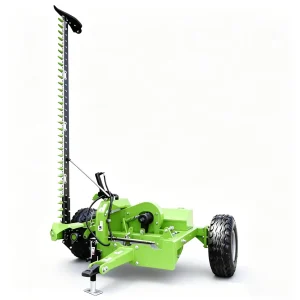
Uses a reciprocating cutter bar in which triangular blades move back and forth between fixed guard fingers — the same shearing action as barber's clippers. The design dates back to horse-drawn mowers and has been refined continuously. Key advantage: low horsepower requirement (from 30 hp) and precise, clean cuts that minimise stem damage and promote faster regrowth. Best suited to light-to-medium grass crops on relatively smooth terrain. Not the fastest design at field speeds, but the lowest-cost entry point for commercial forage cutting.
Trailed Twin-Blade Mower
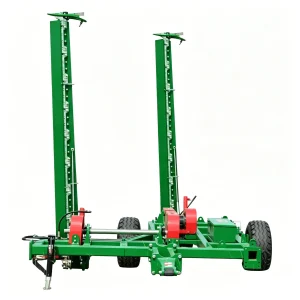
A scaled-up reciprocating design with two independent cutter bars operating in parallel, each driven by an offset crank-connecting-rod mechanism at up to 1,450 strokes/min. The twin-bar configuration delivers a 5.0–5.6 m combined cutting width — substantially wider than a single-bar sickle design — while keeping the tractor power requirement at 30–50 hp. Hydraulic lifting raises both bars simultaneously. Certified to GB/T10940-2008. The practical choice for large-acreage natural grassland or planted forage where field coverage per hour is the priority and a disc mower-conditioner's higher purchase and maintenance cost cannot be justified.
Side-Pull Mower-Conditioner
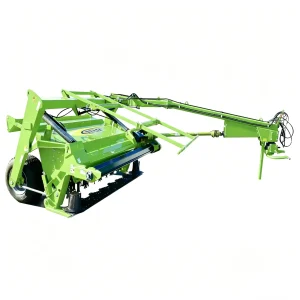
A disc rotary cutterbar (8 discs, 16 free-swinging blades on the 9GQY-3.2) cuts at high speed and feeds the crop directly into an impeller-tine conditioning unit that breaks stem cuticles to accelerate moisture loss by 30–40%. The side-pull trailed design offsets the machine to the tractor's right, cutting a clean 3.2 m swath outside the tractor wheelpath. Dual independent suspension lets the cutterbar and conditioning unit each follow ground contour separately; a super-float obstacle protection system auto-lifts over rocks or roots and resets without operator input. Requires 110+ hp. The machine of choice for alfalfa-intensive operations where drying speed directly determines how many cuts are achievable per season.
Commercial Tractor Mower Models — In Stock
Use this table to narrow down the right machine before requesting a quote. The three key variables are tractor horsepower, required cutting width, and whether conditioning is needed for your crop and weather window.
| Feature | 9GD-2.5 Sickle Mower | 9GS-5.0 Twin-Blade | 9GQY-3.2 Mower-Conditioner |
|---|---|---|---|
| Cutting Type | Reciprocating sickle bar | Dual reciprocating bars | 8-disc rotary cutterbar |
| Cutting Width | 2.5 m | 5.0 m / 5.6 m | 3.2 m |
| Minimum Tractor Power | ~30 hp | 30–50 hp | 110+ hp |
| Field Capacity | ~0.8–1.2 ha/h | 2.5–4.5 ha/h | ~1.9–4.8 ha/h |
| Conditioning Unit | — None | — None | ✓ Impeller-tine |
| Faster Dry-Down | — Standard | — Standard | ✓ 30–40% faster |
| Obstacle Protection | Manual reset | Manual reset | ✓ Super-float auto-reset |
| Hitch / Mount | Trailed (clevis) | Trailed (clevis) | Side-pull trailed |
| Best For | Small-medium grass fields, low-hp tractors | Large grassland, wide-area coverage | Alfalfa, commercial hay, tight weather windows |
| Standard / Cert. | GB/T10940-2008 | GB/T10940-2008 | Agricultural Machinery Certificate |
How to Choose the Right Commercial Mower for Your Operation
Four questions determine which machine fits. Work through these before contacting us and we can confirm the right model and configuration in a single exchange.
1 — What is your tractor's horsepower?
30–50 hp: 9GD-2.5 sickle or 9GS-5.0 twin-blade. 65–100 hp: contact us for configuration advice. 110 hp+: 9GQY-3.2 mower-conditioner is your benchmark machine. Never run a disc mower-conditioner below its rated power — the conditioning rolls stall at low PTO speed, defeating the drying benefit.
2 — How many hectares do you cut per season?
Under 100 ha/season: the 9GD-2.5 sickle at 0.8–1.2 ha/h covers this comfortably. 100–500 ha: the 9GS-5.0 twin-blade at 2.5–4.5 ha/h is the efficient choice. 500+ ha or multiple cuts of alfalfa: the 9GQY-3.2 mower-conditioner justifies its higher per-unit cost through reduced dry-down time per cut.
3 — Do you need conditioning?
If you grow alfalfa, thick-stemmed clover, or cut grass in climates where weather windows are narrow (3–5 fine days between cuts), a mower-conditioner's 30–40% dry-down acceleration is commercially significant. For dry climates with reliable post-cut weather, a plain mower and tedder combination is equally effective at lower machine cost.
4 — What is your terrain like?
All three models are rated for natural grassland and planted forage on level to gently sloping ground. The 9GQY-3.2's super-float obstacle protection makes it more resilient on rough or stony ground than a plain sickle mower. None of our current range is rated for paddy fields, waterlogged ground, or dense root obstructions.
Where Commercial & Tractor Mowers Are Used
Our mower range serves the full spectrum of commercial forage operations — from small farm hay production through to large-scale alfalfa contractor harvesting.
Frequently Asked Questions — Hay Rakes
What is the difference between a sickle mower and a disc mower-conditioner?
A sickle (reciprocating) mower uses blades that move back and forth between fixed guards to shear crop stems — low horsepower, lower cost, slower field speed. A disc mower-conditioner uses high-speed rotating discs to cut, then immediately passes the crop through a conditioning unit (roller or impeller-tine) that breaks stem cuticles to accelerate drying by 30–40%. The mower-conditioner is faster per hectare and reduces field dry-down time, but costs more and requires significantly more tractor power (110+ hp vs. 30–50 hp).
Can the 9GS-5.0 twin-blade mower handle alfalfa as well as grass?
Yes, with a caveat. The 9GS-5.0 will cut alfalfa cleanly, but it has no conditioning unit. Alfalfa’s waxy stem cuticle means it dries significantly slower than grass when left unconditioned. In climates with reliable post-cut weather, this is acceptable — tedding helps. For operations running multiple alfalfa cuts per season or working in climates with narrow dry windows, the 9GQY-3.2 mower-conditioner is the stronger choice due to its 30–40% dry-down acceleration on thick-stemmed crops.
What does "super-float obstacle protection" mean on the 9GQY-3.2?
It is an automatic cutterbar lift mechanism that triggers when the cutterbar contacts an obstruction — a rock, root mass, or hard soil mound. The bar lifts over the obstacle and returns to working depth without the operator stopping or leaving the cab. On fields with occasional stones or irregular terrain, this prevents blade or gearbox damage and removes the time cost of manual resets mid-field.
What PTO speed does the 9GQY-3.2 mower-conditioner require?
The 9GQY-3.2 runs on both 540 rpm and 1000 rpm PTO output — compatible with the widest range of modern large tractors. Confirm your tractor’s PTO spline count (6-spline for 540 rpm, 21-spline for 1000 rpm) and shaft diameter when ordering to ensure the correct PTO shaft coupling is supplied. The machine requires 110+ hp regardless of PTO speed setting.
Are spare blades and replacement sickle sections available separately?
Yes. Replacement blades, sickle sections, guard fingers, and disc mower knives are available as service parts independent of complete machine orders. We recommend including a spare blade/knife set with your initial order — especially for the 9GS-5.0 twin-blade and 9GQY-3.2 disc model — to avoid harvest-season downtime waiting for international shipment of wearing components.
What terrain is NOT suitable for these mowers?
None of our current commercial tractor mower range is rated for paddy fields, waterlogged or boggy ground, rocky terrain with dense surface stones, or dense forest undergrowth. All three models are rated for natural and planted forage grassland on level to gently rolling terrain. For slopes above approximately 15°, contact us to confirm suitability for your specific conditions before ordering.