Описание
Single-action reciprocating cutter bar | 20–50 HP tractor compatible | Built for natural grassland & forage hay
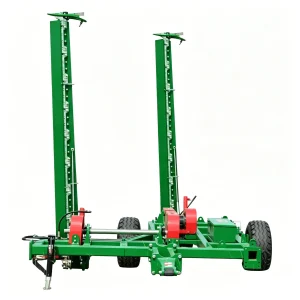
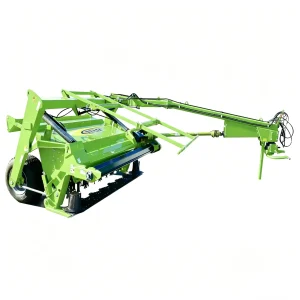
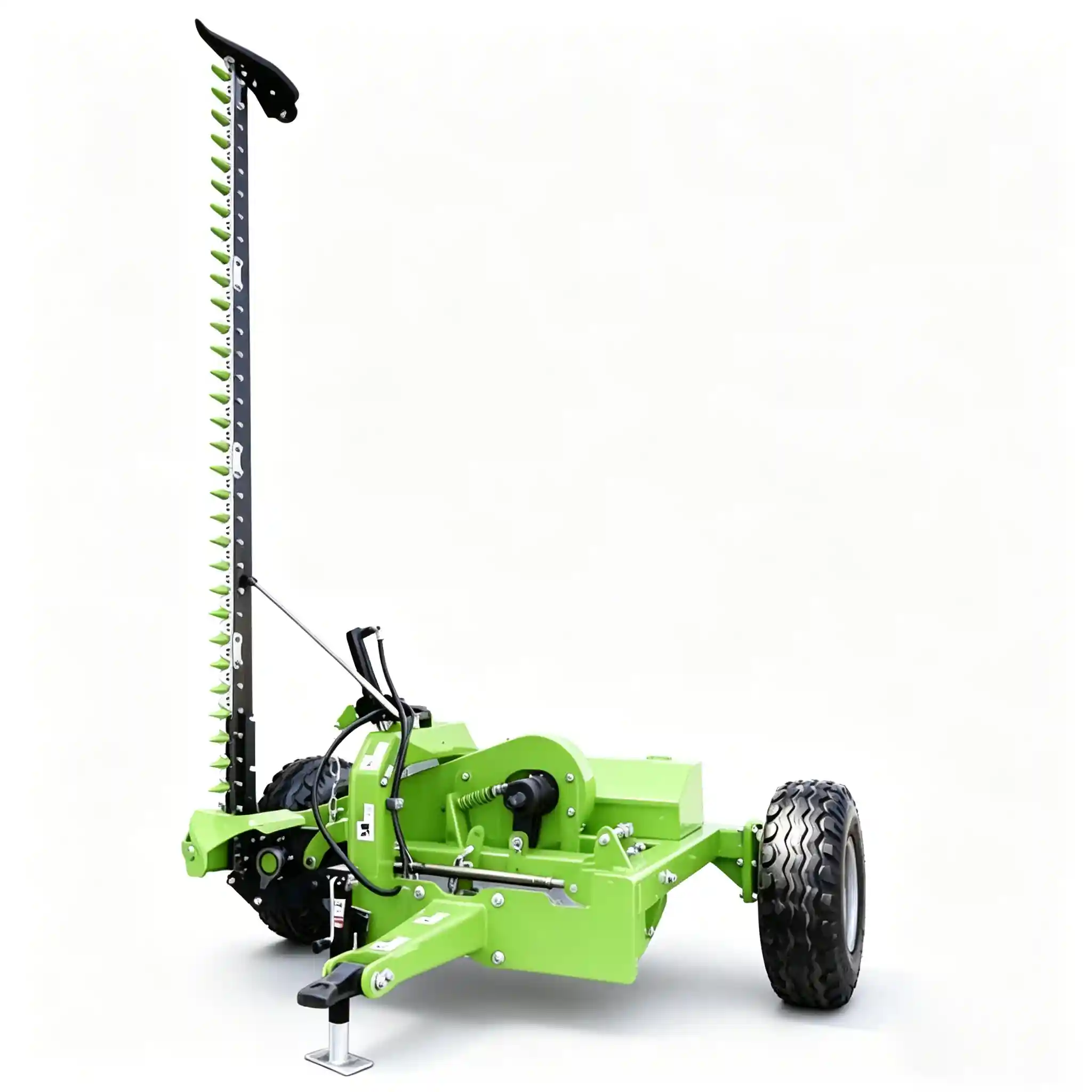
The 9GD-2.5 is a trailed Single-Action Cutter Bar mower built around a simple, dependable principle: a reciprocating blade with 34 individual cutting elements running across a 2.5 m bar. It’s pulled by tractors as small as 15 kW (20 HP) and works at 6–10 km/h, clearing 2–3 hectares per hour — sized for small-to-medium hay producers, contract mowers, and grassland operators who need a Low maintenance sickle mower for small farms without the price tag of disc-rotary equipment.
Where it differs from competing Pull-behind Sickle Mowers is the hydraulic cutter-bar lift. The operator raises the bar from inside the cab — for headland turns, road transport, or to clear obstacles — without leaving the tractor seat. Combined with single-operator setup and only 490 kg structural weight, it cuts setup time and fatigue across long workdays.
The 9GD-2.5 is built to the Chinese national standard GB/T 10940-2008 for reciprocating mowers and carries the official Agricultural Machinery Test Certificate. Designed for natural meadows, planted forage, alfalfa, and grass-family hay — not recommended for paddy fields, marshland, wooded plots, or stony/tussocky terrain where reciprocating cutter bars are vulnerable to damage. Honest specifications, honest field range.
Technical Specifications — 9GD-2.5 Trailed Sickle Mower
| No. | Parameter | Unit | Specification |
|---|---|---|---|
| 1 | Model | / | 9GD-2.5 Trailed Single-Blade Sickle Bar Mower |
| 2 | Hitch Type | / | Trailed (pull-behind) |
| 3 | Cutterbar Structure | / | Reciprocating (single-action) |
| 4 | Cutting Width | m | 2.5 |
| 5 | Required Tractor Power | kW | 15 – 35 (≈ 20 – 50 HP) |
| 6 | Working Speed | km/h | 6 – 10 |
| 7 | Number of Blades | pcs | 34 |
| 8 | Overall Dimensions (L × W × H) | mm | 2000 × 4300 × 950 |
| 9 | PTO Speed | r/min | 540 |
| 10 | Average Stubble Height | mm | 50 – 70 |
| 11 | Productivity | hm² / h | 2.0 – 3.0 |
| 12 | Operators Required | person | 1 |
| 13 | Structural Weight | kg | 490 |
Product Gallery of 9GD-2.5 Trailed Sickle Mower
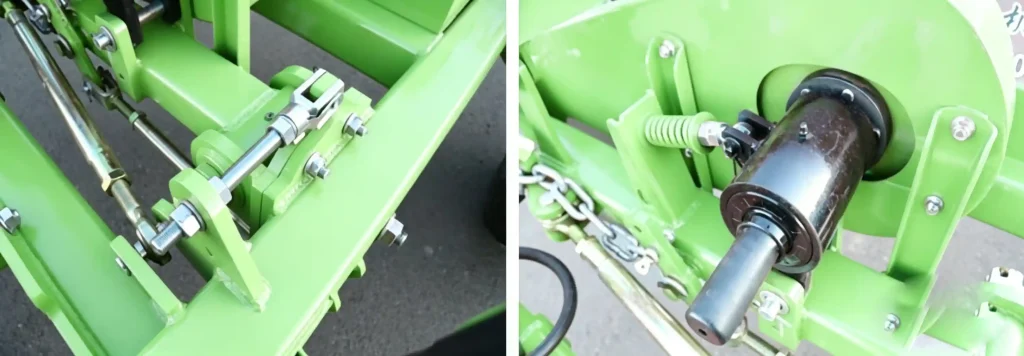
Key Features of the 9GD-2.5 Trailed Sickle Mower
Hydraulic Cutter-Bar Lift System
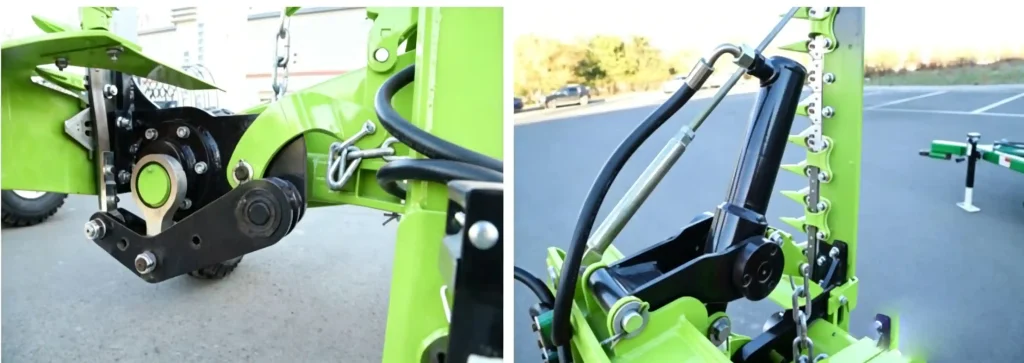
The cutter bar raises and lowers via tractor hydraulics — the operator never has to leave the cab to clear a fence line, cross a ditch, or transition between fields. This single feature is what separates the 9GD-2.5 trailed sickle mower from older mechanical-lift sickle mowers still common in the budget segment.
34-Blade Single-Action Cutter Bar
Thirty-four reciprocating blades shear the crop in a single forward stroke — clean cuts on stems up to about 12 mm thick with a stubble height adjustable from 50 to 70 mm. Conforms to GB/T 10940-2008 for reciprocating mowers, the Chinese national standard.
Low Power Demand: 15–35 kW (20–50 HP)
Most disc mower-conditioners require 80 HP or more. The 9GD-2.5 runs from 20 HP, which means a typical small-farm tractor — the kind already on the property — can pull it. No equipment upgrade, no second tractor, no extra fuel cost.
Upgraded Heavy-Duty Reciprocating Mower for Tractors
The frame, drive housing, and pitman arm have been reinforced over the previous generation to handle longer continuous workdays. Bearings are sealed, the drive shaft is chrome-plated, and wear plates on the cutter bar are field-replaceable in under 15 minutes.
Mechanically Simple — Lower Maintenance
Reciprocating sickle bars have far fewer moving parts than disc rotary cutterbars: no individual disc bearings, no gear-driven cutter housing. Routine maintenance is essentially blade sharpening, grease points, and pitman replacement — work any field mechanic can handle.
Single-Operator, Trailed Configuration
Pull-behind hookup with standard drawbar — one operator drives, hitches, mows, and unhitches. No mounting or 3-point lift system to wrestle with. Production rate of 2–3 ha/h means a 10-hectare grassland is finished in roughly 4 hours.
Where the Trailed Sickle Mower Performs Best
The 9GD-2.5 trailed sickle mower is purpose-built for grassland and forage mowing on small-to-medium farms. It’s not a one-size-fits-all machine — and being honest about that is part of why operators trust it.
✓ Recommended Applications
- Natural meadows and unmanaged grassland for animal feed
- Planted forage fields — alfalfa, ryegrass, clover, oat hay, timothy
- Small-to-medium hay producers (5–50 hectare operations)
- Custom mowing contractors serving rural smallholders
- Roadside vegetation control on flat to gently rolling terrain
- Distributors building entry-level Tractor Mounted Sickle Mower lines for emerging markets
✗ Not Recommended For
- Paddy fields or marshland — saturated soil damages drive components
- Forested or wooded areas with branches and ground litter
- Stony fields where the cutter bar is exposed to repeated rock impact
- Tussocky terrain — heavy raised mounds will lift the bar off ground contour
Why Choose Our 9GD-2.5 Trailed Sickle Mower Supplier
Certified Manufacturing
ISO 9001 quality system in place. Every unit goes through the same QC process before shipping — no skipped checks on bulk orders.
EU-Compliant Builds
CE certification available for European market entry. We handle the documentation requirements for distributors not used to import compliance.
Custom OEM Branding
Your paint, decals, manuals, and packaging. Minimum 20 units for full OEM orders. Sample units available for 1-piece testing.
Manufacturing Experience
Over 15 years specializing in hay & forage machinery. We don’t make 200 different products poorly — we make a focused line and we make it well.
Export-Tested Logistics
Shipped to 40+ countries. FOB, CIF, DAP, and door-to-door options. Container loading optimized — we fit 16+ units of the 9GD-2.5 per 40′ HQ.
English-Speaking Support
Technical inquiries, parts requests, troubleshooting — answered within 24 hours, in English, by people who actually know the product.
Frequently Asked Questions
Customer Reviews
We bought two of these for our family operation last season — about 18 hectares of natural pasture between us. Pulled by an old 35 HP tractor we already had on the place. The hydraulic lift saves real time across a workday — no jumping off the tractor every other turn. Cut quality on alfalfa is clean. For the price, hard to beat.
— Family Hay Producer, South Moravia, Czech Republic
My grandpa cut hay with a sickle mower behind a Ford 8N back in ’63. I cut hay with a sickle mower behind a Kubota in 2024. The fancy disc-mower guys at the co-op laugh at me — until they see my fuel bill. This 9GD-2.5 Trailed Sickle Mower sips diesel, the blades sharpen up fine on a Saturday morning, and I haven’t had to call a single dealer mechanic in three seasons. The disc-mower crowd’s still arguing with their warranty department. Y’all keep building ’em like this.
— Small-Acreage Hay Operator, Tennessee, USA
Build the Full Hay Harvesting Chain
The 9GD-2.5 Trailed Sickle Mower cuts cleanly, but it doesn’t condition the crop the way a disc mower-conditioner would. That actually makes downstream equipment more important for sickle-cut hay — particularly the tedder, which spreads the swath wide so air and sun can finish the job. Here’s the full workflow and why each step matters:
Step 1 — Mowing (9GD-2.5 Trailed Sickle Mower)
Cut standing crop at 50–70 mm stubble height. The hay falls flat behind the bar in a uniform swath.
Step 2 — Tedding (Rotary Tedder)
Critical for sickle-cut hay. Without a conditioning roller upstream, the swath needs aggressive spreading so the inner layer dries at the same rate as the outer. A tedder fluffs and spreads the cut crop across the field surface — typically saving 1–2 days of dry-down time.
Step 3 — Raking (Hay Rake)
Once dry, the spread crop is gathered into a single windrow sized to the baler’s pickup width. Wheel rakes are simpler; rotary rakes form a cleaner, more uniform windrow.
Step 4 — Baling (Round Baler)
The windrow is compressed into transportable round bales. For small-farm operations matching the 9GD-2.5 scale, mini round balers compatible with 25–40 HP tractors are an ideal pairing.
Step 5 — Wrapping & Handling (Wrapper / Bale Handler)
For haylage, bales are sealed in plastic film. For dry hay storage, a bale handler moves bales from field to stack. Either way, this step is what protects the value built up across the previous four.
Request a Quote on the 9GD-2.5 Trailed Sickle Mower
Sample units, container quotes, OEM customization, and dealer pricing — our team replies within 24 hours. Most orders ship in 20–30 days from confirmation.
More Agricultural Machinery from Our Factory
Distributors typically combine the 9GD-2.5 with related haymaking equipment in a single container — lower freight, fewer suppliers, simpler after-sales. Browse our other product series:
Mower Series
→
Hay Rake Series
→
Tedder Series
→
Round Baler Series
→
Bale Wrapper Series
→
Hydraulic Reversible Plow
→
Rotary Tiller Series
→
Disc Harrow Series
→
Building a haymaking dealer line for the upcoming season? Send us your full requirement list — we’ll put together a multi-product container quotation tailored to your market.