
Industry Application — Commercial Hay Production
Square Hay Balers for Commercial Hay Production & Export
Volume, consistency, and format discipline — the three factors that separate hay producers who sell reliably from those who struggle to move inventory at the price they need.
Featured Model
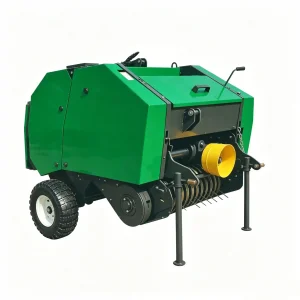
9YFS-2.2 Twin Chamber
Commercial hay production operates on different logic from on-farm forage management. The buyer is not your own livestock — it’s a feed store, an equestrian centre, a hay export broker, or a direct-delivery customer with consistent volume requirements. Meeting those buyers’ expectations consistently, week after week and cutting after cutting, is what determines whether your hay enterprise builds a customer base or stays a one-time transaction operation.
Small square bales are the format that most retail and export hay buyers want. They stack on pallets, fit in vans and cube trucks, price per-bale in a way consumers understand, and load into shipping containers for export at a density that round bales cannot match. The equipment decision — which baler, which configuration, what daily output target — flows directly from those market realities.
What Commercial Buyers Actually Require
Experienced hay buyers are more specific in their requirements than new producers often expect. The conversation rarely stops at “good-quality hay.” It extends to:
- Bale weight consistency: Feed stores and export buyers need predictable weight per bale for pricing and logistics. A spread of 18–28 kg across a pallet is a problem. Bales in the 20–23 kg range, consistently, is the target.
- Moisture certification: Many commercial buyers — particularly for export — require proof of baling moisture. Baling at 16% and documenting it builds buyer confidence and commands better prices.
- Twine integrity: Bales that arrive at a feed store with broken or loose twine get returned. Two solid, correctly tensioned knots per bale is the standard expectation.
- Visual cleanliness: Green colour retention, minimal dust, absence of weeds and soil — all visible on delivery and all forming part of the buyer’s quality assessment.
- Volume reliability: The buyer who orders 500 bales per month needs to know you can deliver 500 bales per month — not 300 in a good week and 150 the following week.
Meeting these requirements consistently requires both agronomic discipline — cutting timing, dry-down management, proper storage — and mechanical reliability from the baling equipment.

Daily Output: The Number That Drives the Business
For commercial producers, daily bale output is the constraint that determines how much volume you can commit to buyers, how many acres you can turn around in a hay window, and ultimately how profitable the operation is. A single-chamber square baler running optimally produces 80–140 bales per hour under good conditions. Factor in field turns, windrow re-alignment, and normal operational pauses, and effective day output over a 10-hour baling day is typically 600–900 bales.
For most small hay farms, that’s adequate. But commercial operations selling 10,000+ bales per cutting face a different calculation. Running a single machine through a narrow weather window — say, 4 days of good drying conditions in July — means a single-chamber baler caps the volume that can be captured. The choice is then between a second machine (and a second operator) or a twin-chamber model that doubles output from the same tractor and operator.
Estimated Output: 4-Day Hay Window, 10 Hours/Day
Single Chamber (9YF)
2,400–3,600
bales per window
Twin Chamber (9YFS-2.2)
4,800–7,200
bales per window
Estimates based on 60–90 bale/hour per chamber effective rate, accounting for field operations. Actual output varies with windrow density, field size, and bale length setting.
Export Market Considerations: Canada to Asia and the Middle East
Canadian alfalfa and timothy hay enjoy strong export demand in Japan, South Korea, China, and parts of the Middle East. The format preference in these markets is almost exclusively small square bales, for two reasons: container loading efficiency and end-user handling requirements.
A standard 20-foot shipping container holds approximately 400–500 small square bales depending on bale dimensions and stacking method. The same container physically cannot be loaded with round bales at comparable dry matter density. For export hay producers, square format is not optional — it is the market requirement.
Export buyers additionally specify:
- Maximum baling moisture of 14–16% (phytosanitary and mold prevention)
- Uniform bale dimensions — length tolerance typically ±5 cm
- No visible soil contamination on the outer bale surface
- CFIA-compliant documentation for international plant material movement
- Consistent species composition — timothy, alfalfa, or blends documented by cutting
Meeting these standards consistently across thousands of bales requires mechanical precision at the baling stage — a reliable knotter, repeatable bale length metering, and a pickup system that avoids soil contamination.
Storage Infrastructure for Commercial Scale
High-volume hay production creates a storage challenge that small on-farm operations never face. If you’re producing 5,000 bales per cutting and selling over a 3-month delivery window, you need to store what you produce and protect quality through that period.
Key storage considerations at commercial scale:
- Covered storage is non-negotiable for premium market. UV bleaching reduces the visual quality of hay that export buyers pay premiums for. Even one season of outdoor storage degrades the green colour that marks first-cut quality hay.
- Pallet stacking for air circulation. Stack on timber pallets or rails to allow air movement under the bottom tier. Concrete floor contact causes moisture wicking into the bottom layer.
- Batch documentation. At commercial scale, knowing which storage section holds which cutting’s bales — with documented moisture, date, and species composition — is worth maintaining. It enables accurate delivery commitments and supports any buyer certification requirements.
The Right Machine for Commercial Production
Commercial hay production with volume commitments to buyers points clearly toward the 9YFS-2.2 Twin Chamber Square Baler. The dual compression chambers operate simultaneously — each producing a complete, tied bale per cycle — doubling the output of a single-chamber machine from the same tractor and operator. For commercial producers whose profitability depends on clearing maximum acreage in a minimum weather window, this throughput advantage is the critical specification.
For producers at the transition point between on-farm use and commercial sales — where output requirements are growing but not yet at the level where a twin-chamber machine is clearly justified — the 9YF-2200 series provides the right capacity for mixed-use operations and allows scaling into hay sales without a large initial equipment investment.
Contact our team to discuss what output level and market type your operation is targeting — the right model depends on that context, and we’re happy to work through the specifics with you. Reach us at [email protected].
Canada Hay-Balers Co., Ltd
10055 Hogarth Dr, Richmond, BC V7E 3Z9 | [email protected]
Editor:WM