
Commercial Hay Rakes for Every Field Scale
Finger wheel, side delivery, and mower-rake combinations — working widths from 2.5 m to 9.0 m — designed for consistent windrow formation and low crop loss across grass, alfalfa, and mixed forage operations.
What Is a Hay Rake?
A hay rake is a tractor-mounted or tow-behind implement used between mowing and baling. Its job is to gather cut forage from the field and form it into a windrow — a long, narrow row of crop — so the hay dries evenly and can be picked up cleanly by a round baler, square baler, or forage harvester.
Raking is not simply about moving hay into a pile. A correctly set hay rake lifts the crop, turns it so the damp underside faces the sun and moving air, and deposits it in a consistent, airy windrow that dries faster than scattered or tightly packed hay. The width, density, and shape of the windrow directly determines how fast the baler can run and how uniform each bale’s moisture content will be.
Poor raking — rows that are too wide, too dense, uneven, or contaminated with soil — forces the baler to slow down, produces bales with uneven moisture, and raises the dry matter losses that cost forage value before the crop ever reaches the feed system. The hay rake is the single implement in the haymaking chain that most directly controls final forage quality.
Modern hay rakes range from simple ground-driven finger wheel units suited to small farms and tight budgets, through to wide-working trailed mower-rake combinations that cut and windrow in a single pass on large commercial operations.
- Position in the crop chain: After mowing / tedding, before baling.
- Primary output: A consistent windrow matched to the baler’s pickup width.
- Windrow quality impact: Research shows wheel rakes introduce measurably more soil ash into hay than rotary rakes — a variable that directly affects forage grade and equipment wear.
- Working widths: Commercial rakes range from 2.5 m (small farm) to 9.0 m+ (large arable or contract operation).
- Tractor requirement: Most rakes run from 30 hp (compact finger wheel) to 120+ hp (wide trailed mower-rake).
- Crops handled: Grass, alfalfa, clover, mixed legumes, straw, corn stover, and crop residues.
- Drive options: Ground-driven (no PTO) or PTO-driven (rotary, bar, and mower-rake types).
Full Product Range
6 Models — 2.5 m to 9.0 m Working Width
Choose the model that fits your farm scale — from small-hold kidney bean pulling to large-scale commercial operations covering 800+ acres per season.
-
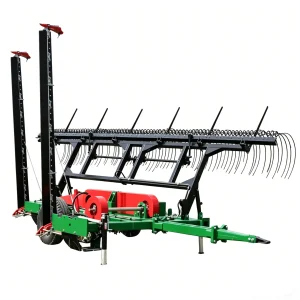
9GL-5.0/5.6 Trailed Mower-Rake — 2-in-1 Cut & Windrow for Large-Scale Hay Harvesting
-
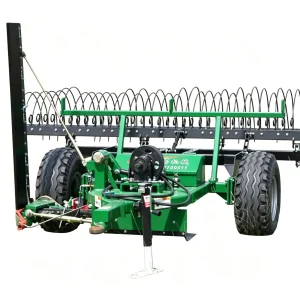
9GL-2.5/2.9 Mower Rake — Compact Trailed Windrower for Small to Mid-Scale Hay Farms
-
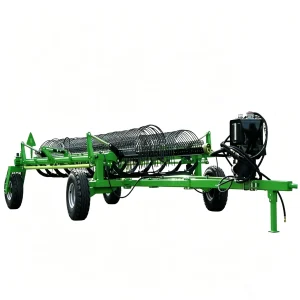
9LH-12 Side-Delivery Rake — 12 m Trailed Hay Rake for High-Output Forage Harvesting
-
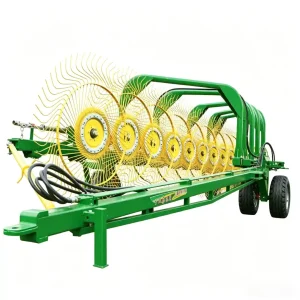
9LZY-9.0 Finger-Wheel Rake — 15-Wheel, 9 m Pull-Type Hay Rake for Large Grassland Operations
-
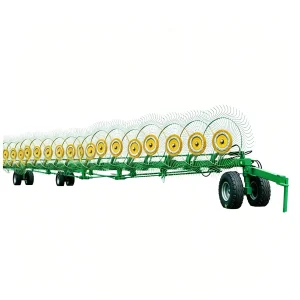
9LZD-9.0 High-Capacity Finger Wheel Hay Rake | Heavy-Duty Trailed Agricultural Raker
-
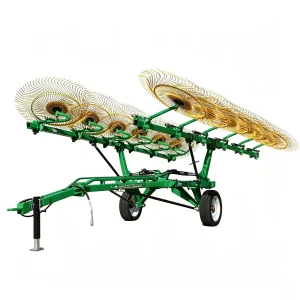
9LZ-6.0 High-Efficiency Finger Wheel Rake | 6.0m Working Width for Large Farms
How Does a Hay Rake Work?
All hay rakes follow the same four-stage operating logic, regardless of whether they are finger wheel, side delivery, or mower-rake designs. The mechanism that drives each stage varies by rake type — here is how the process works from tractor pass to formed windrow.
Bean Harvesters & Dry Bean Pullers
Choose the model that fits your farm scale — from small-hold kidney bean pulling to large-scale commercial operations covering 800+ acres per season.
| Rake Type | Best For | Dry Hay | Wet / Silage | PTO Required | Typical Width |
|---|---|---|---|---|---|
| Finger Wheel (V-Rake) | Large fields, dry crops, fast coverage | ✓ Excellent | — Limited | — Not required | 6.0–9.0 m |
| Side Delivery Rake | Wet crops, low-ash hay, varied conditions | ✓ Good | ✓ Good | ✓ Yes | 2.5–4.5 m |
| Mower-Rake Combination | Single-pass efficiency, large arable farms | ✓ Good | — Not ideal | ✓ Yes | 2.5–5.6 m |
| Trailed High-Capacity Rake | Commercial hay, contract operations | ✓ Excellent | — Limited | — Not required | 9.0 m+ |
Types of Hay Rake — Which Is Right for Your Operation?
The right hay rake depends on your crop type, field size, moisture at raking, and available tractor horsepower. Below is a practical breakdown of the main rake categories.
Finger Wheel Rake (V-Rake)
Uses multiple rotating wheels with spring-steel tines driven by ground contact — no PTO required. Two rows of angled wheels form a V-shape, gathering hay from both sides into a centre windrow. Low cost, simple maintenance, and fast field speeds (up to 12–15 km/h) make this the most widely used design globally. Best suited for dry hay and straw; less effective on wet, heavy, or tangled crops.
Side Delivery Rake
A powered bar or rotor rake that moves crop continuously to one side of the machine, forming a windrow on the left or right. Because the drive is independent of ground speed, side delivery rakes handle wet, heavy, or high-yield crops that would stall a ground-driven wheel rake. They introduce less soil contamination than wheel rakes, producing cleaner hay with lower ash content.
Mower-Rake Combination
Cuts and rakes in a single tractor pass — the mower disc cuts the standing crop and the integrated rake immediately forms the windrow behind it. Eliminates a separate raking pass, saving fuel and time. Particularly effective on large flat fields where two-pass operations add significant time overhead per hectare. Produces a good windrow quality at point of cut without waiting for the swath to wilt.
High-Efficiency Trailed Rake
Large-frame trailed rakes designed for high-capacity commercial operations, covering 9.0 m per pass with multiple finger wheel rotors on an articulated trailed chassis. The articulated frame follows ground contour independently of the tractor, maintaining consistent tine-to-ground pressure across uneven fields. One operator can rake the equivalent of 3–4 narrower-unit passes per hour.
Why Canada Hay-Balers
What B2B Buyers Get When They Source From Us
We supply hay rakes and forage equipment to distributors, dealers, and large farm operators across North America, Europe, Central Asia, and Africa. Here is what that means in practice.
Factory-Direct Structure
No trading company layer. You deal directly with the production source, which means shorter lead times, lower unit pricing, and faster resolution of technical queries.
Full Technical Package on Request
Every model comes with: technical drawings, spare parts list, container loading plan (FCL/LCL), and operation manual in English. Available within 48 hours of inquiry.
Matched to Your Tractor Range
Our sales team confirms PTO shaft spec, hydraulic port requirements, and hitch category compatibility before order placement — reducing the risk of specification mismatches on arrival.
Spare Parts Availability
Tines, bearings, and drive components are stocked independently of complete unit orders. Operators in remote markets can source replacement parts without waiting for full machine shipment lead times.
Frequently Asked Questions — Hay Rakes
What is the difference between a hay rake and a tedder?
A tedder spreads the freshly cut crop outward to expose maximum surface area to sun and air, speeding up initial dry-down. A hay rake comes after the tedder — it gathers the dried or semi-dried crop back into a windrow ready for the baler. On fast-drying crops in good weather, tedding is sometimes skipped and raking is done directly from the swath.
How do I match a hay rake working width to my baler?
The windrow the rake forms should match the baler pickup width — typically 1.4–2.0 m for most commercial round balers. A 6.0–9.0 m rake covers this in one or two swaths combined into a single windrow. If your baler has a 1.8 m pickup, set the rake to form a windrow of 1.6–1.8 m; wider windrows cause feeding issues and narrower ones leave crop behind.
Can finger wheel rakes handle wet or silage-moisture grass?
Finger wheel rakes are ground-driven — the wheels rely on crop or soil contact to rotate. In high-moisture or heavy crop conditions, the wheels can stall or push rather than lift the hay. For raking at silage moisture levels (above 35%), a PTO-driven side delivery rake or rotary rake is more reliable. Finger wheel designs work best at hay moisture below 25%.
Why Canada Hay-Balers
Since finger wheel rakes are ground-driven and require no PTO, the tractor only needs enough power to pull the implement through the crop at field speed. The 9LZD-9.0 and 9LZY-9.0 models are typically matched to tractors from 80–100 hp upward in standard grass conditions. Heavy or wet crop may require additional pulling power. Contact us to confirm your tractor’s suitability before ordering.
How do I choose between the 9LZD-9.0 and 9LZY-9.0 models?
Both cover 9.0 m per pass. The 9LZD-9.0 is designed for standard commercial hay operations, while the 9LZY-9.0 features a heavier-duty frame specification suited to higher-output operations and more demanding crop conditions. Request technical datasheets for both and our team can advise based on your crop type, field conditions, and baler pairing.
Do you supply spare tines and replacement parts for your hay rakes?
Yes. Replacement spring-steel tines, hub bearings, and frame components are available as service parts independent of full machine orders. When placing an initial order, we recommend including a spare parts set — especially tines — to avoid downtime during the harvest season when shipping lead times are less predictable.