
Why Getting the Winter Hay Calculation Right Is a Business Decision
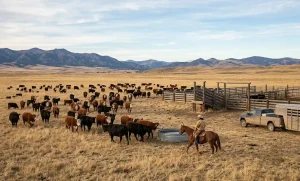
For beef cow-calf operations across the Canadian Prairies, Northern Ontario, and the BC Interior, the annual winter hay calculation is one of the most consequential planning exercises of the year. Under-estimate by 15 percent and you are purchasing expensive hay in February at peak shortage prices while competing against every other producer who ran short. Over-estimate by 20 percent and you are carrying surplus inventory through spring, tying up cash and barn space that could be used more productively. Getting the number right — then building in a defensible buffer — is both a nutritional and a financial discipline.
Step 1 — Establish Your Feeding Days
The number of days your herd requires full hay supplementation depends on your location, your pasture management approach, and the typical freeze-up and spring green-up dates for your specific operation. Historical averages for common Canadian beef regions:
| Region | Typical Winter Feeding Period | Feeding Days (Average) |
|---|---|---|
| Southern Alberta / Saskatchewan | Early November to late April | 150–180 days |
| Central Saskatchewan / Manitoba | Late October to mid-May | 180–200 days |
| Northern Alberta / BC Interior | Early October to late May | 200–230 days |
| Southern Ontario / BC Valleys | Mid-November to early April | 120–150 days |
Always use your own 10-year pasture history rather than regional averages alone. A late spring in 2024 caught many Prairie producers short because they planned to turnout by May 1 and did not see grass until May 18.
Step 2 — Calculate Daily Hay Requirement Per Animal Class
Different animal classes within a cow-calf operation have different forage requirements. Use body weight and physiological status as the foundation:
- Mature dry cows (600–700 kg): 2.0–2.2% of body weight in hay DM per day — approximately 12–15 kg as-fed hay at 88% DM.
- Cows in last trimester of pregnancy (600–700 kg): 2.2–2.5% of body weight — 13–17 kg as-fed hay, with protein supplementation if hay quality is below 10% CP.
- Cows nursing calves (650–750 kg): 2.5–3.0% of body weight — 16–22 kg as-fed hay, depending on milk production level and calf age.
- Replacement heifers (350–450 kg): 2.2–2.5% of body weight — 8–11 kg as-fed hay.
- Weaned calves (200–300 kg): 2.5–3.0% of body weight — 5–9 kg as-fed hay, typically supplemented with creep grain.
- Bulls (900–1,100 kg): 1.8–2.0% of body weight during non-breeding season — 16–22 kg as-fed hay.
Step 3 — Build Your Complete Herd Inventory Table
The example below shows the calculation structure for a 120-cow beef operation in central Saskatchewan with a 190-day feeding period:
| Animal Class | Head Count | Daily Hay (kg/head) | Feeding Days | Total (kg) |
|---|---|---|---|---|
| Dry cows | 30 | 13 | 90 | 35,100 |
| Late-gestation cows | 90 | 15 | 60 | 81,000 |
| Nursing cows | 90 | 18 | 40 | 64,800 |
| Replacement heifers | 20 | 9 | 190 | 34,200 |
| Bulls | 3 | 18 | 190 | 10,260 |
| Raw Total | — | — | — | 225,360 kg |
| With 15% Weather Buffer | — | — | — | 259,164 kg |
At an average round bale weight of 500 kg (dry grass/legume mix at 12% moisture), this operation needs approximately 518 bales for the season with buffer — or roughly 450 bales minimum without.
Step 4 — Apply the Weather Buffer
Canadian beef producers should never plan to the minimum calculated requirement. The weather buffer accounts for three real risks:
- Extended cold snaps: Cattle in temperatures below -20°C with windchill increase their maintenance energy requirement by up to 30 percent, consuming more hay per day than the baseline calculation assumes.
- Late spring turnout: A two-week delay in green-up adds 28 to 35 bales for every 100 cows — a gap that seems manageable until it happens in a year when hay prices peak.
- Storage losses: Outdoor ground-stored bales can lose 10 to 25 percent of their usable DM through weathering, mold, and soil contamination — losses that must be replaced from inventory, not from the original calculation.
A minimum 15 percent weather buffer is recommended for all operations. For Northern Alberta and the BC Peace River region, where late springs are more frequent and cold events more severe, a 20 to 25 percent buffer is prudent planning.
Adjusting for Hay Quality Differences
Not all hay is equal, and the calculations above assume reasonable quality grass-legume mix hay testing at approximately 10 to 12 percent CP and 55 to 60 percent TDN. If your hay tests below 9 percent CP, you will need either:
- A protein supplement (range cubes, canola meal blocks) to meet the nutritional gap for late-gestation and nursing cows — typically adding 0.5 to 1.0 kg per cow per day of additional feed cost.
- A higher-quality hay component purchased to blend with the lower-quality base inventory, bringing the blended ration closer to the target protein level.
Straw can substitute for a portion of the hay ration in dry cow feeding if adequate protein supplementation is provided, at a ratio typically not exceeding 30 to 40 percent of the total forage volume. Straw stretches hay inventory but reduces ration energy density, so body condition score monitoring becomes more important when straw is part of the winter diet.
Translating Your Hay Requirement Into a Baling Target
Once you have your total hay requirement in kilograms, you can work backwards to establish your summer baling target. Key variables:
- Bale weight: Varies by crop type, moisture at baling, and bale diameter. A well-formed 5×4 ft grass bale at 12% moisture typically weighs 450–550 kg. Always weigh a sample of bales from each cutting rather than relying on estimates.
- Expected storage loss: Subtract your anticipated storage loss percentage before calculating total bale count needed going into storage.
- Carry-in inventory: Credit any quality bales remaining from the prior season, discounted for their age and nutritional value if they have been stored for more than 12 months outdoors.
For the 120-cow Prairie operation in the example above, a baling target of 520 to 560 bales per season is a defensible planning number. At typical yield levels of 3.5 to 4.0 bales per acre per cutting across two cuttings, this requires 70 to 80 acres of productive tame hay land or equivalent cropped forage area.
Choosing the Right Baler for Beef Cow-Calf Operations
Beef operations on the Prairies typically value baler durability and field reliability over maximum throughput speed, since most operations have one or two productive cuttings per season rather than the three to four cuttings common in Eastern Canada. The baler should be matched to tractor capacity and field conditions — rocky terrain in the BC Interior and Alberta foothills calls for a more robust pickup system than the flat, stone-free fields common in Saskatchewan.
The 9YG-2.24D Round Hay Baler is well suited to the typical Prairie beef operation producing 400 to 700 bales per season, with a chamber design that handles the coarser grass and brome hay common to dryland ranching country. For smaller cow-calf operations under 60 head, the 9YG-1.0 Round Baler Machine provides a practical and cost-efficient solution that pairs well with utility tractors common on smaller acreages.
Reliable power delivery from tractor to baler is essential during the concentrated harvest window. A quality PTO drive shaft rated to the baler peak torque demand prevents mid-field failures that halt baling during the narrow window between dew-dry morning conditions and afternoon thunderstorms — a scenario Prairie beef producers know well.
Practical Tips From Canadian Beef Producers
- Start your winter hay calculation in June, before the first cutting, not in September after you have already baled.
- Build your calving dates into the calculation — cows calving in January or February in cold housing have lower additional hay needs than cows calving in March on pasture.
- Weigh 10 to 15 bales from each field and each cutting separately — do not apply an average weight to the whole season inventory.
- Take a forage test from at least one bale per cutting and per field. A $40 test that reveals low-quality hay worth $8 per bale instead of $18 protects both ration adequacy and your negotiating position if purchasing additional hay.
- Track actual consumption by recording bale counts fed per week rather than relying on estimates at the end of the season.
Baling Equipment for Canadian Beef Producers
Canada Hay-Balers Co., Ltd works with cow-calf producers across the Canadian Prairies, BC Interior, and Northern Ontario. Our round balers are matched to the tractor sizes, crop types, and field conditions typical of beef-focused forage operations. Contact us with your herd size and regional location for a specific product recommendation.
Canada Hay-Balers Co., Ltd
10055 Hogarth Dr, Richmond, BC V7E 3Z9, Canada
[email protected]