Описание
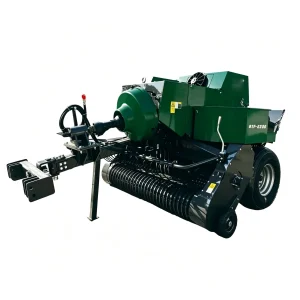
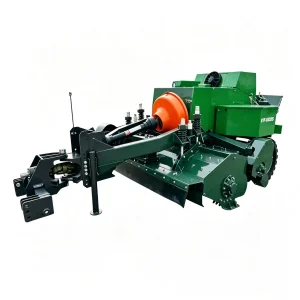
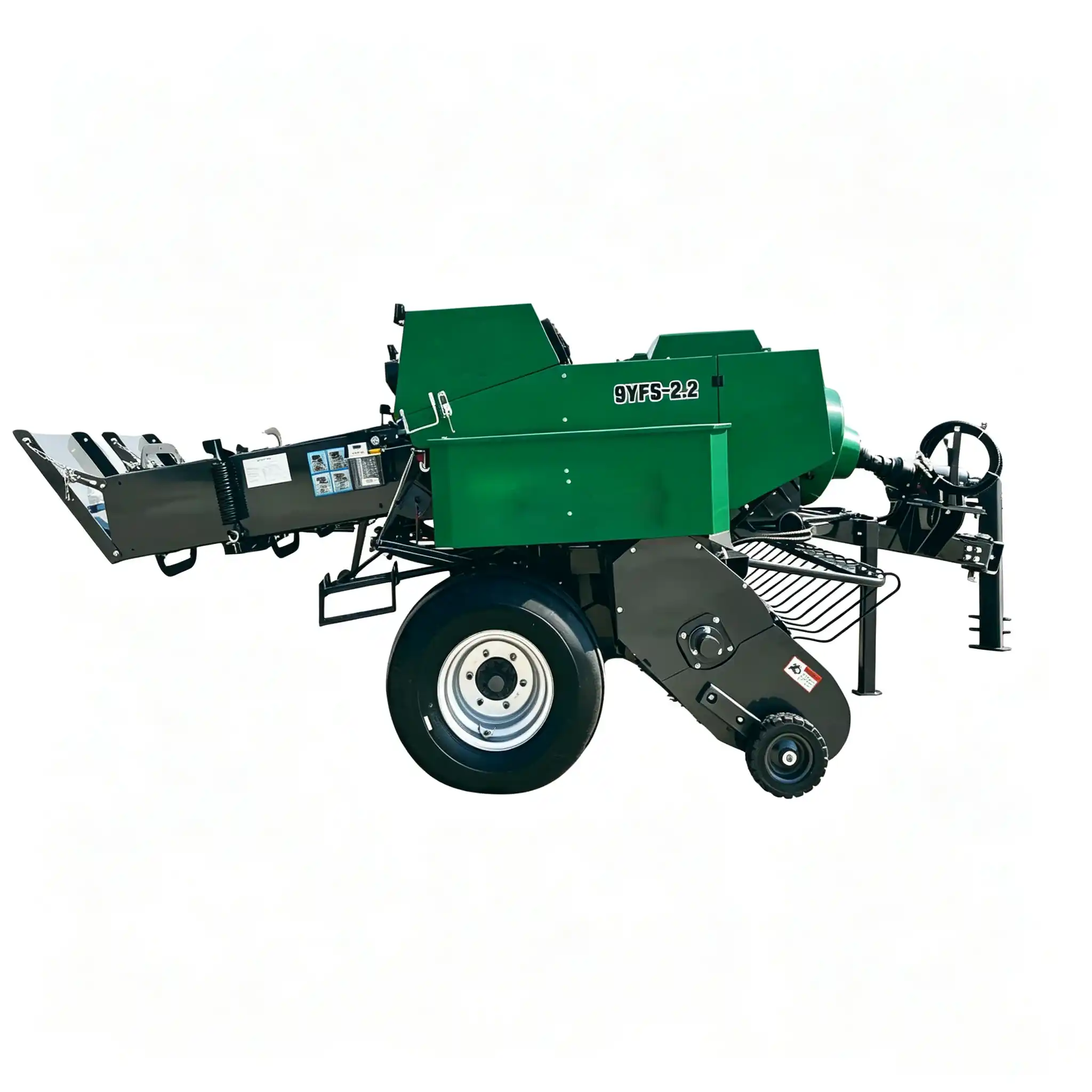
9YFS-2.2 Twin-Chamber Square Baler — 2200 mm Wide-Pickup, Dual-Knotter Agricultural Square Baler
The 9YFS-2.2 is a trailed agricultural square baler built around a dual-compression-chamber design that processes two bales simultaneously, delivering measurably higher field throughput than conventional single-chamber machines. With a 2,200 mm pickup width, a 460 × 360 mm bale cross-section, and a matched power range of 25–51.5 kW, this small square baler fits a broad class of two-wheel-drive and four-wheel-drive tractors. Automatic rope baling with 2 × 2 D-type knotters keeps operators on the move with minimal manual intervention — a practical choice for contractors and medium-to-large hay producers seeking a reliable square baler for hay.
Features of the 9YFS-2.2 Twin-Chamber Square Baler
The engineering priorities on this square baler for hay are throughput, reliability, and operator convenience. Each feature below is tied directly to a measurable field outcome.
- Dual compression chambers (460 × 360 mm each) — Two independent bale channels operate in parallel, so one chamber continues to compress while the other ejects, eliminating the downtime gap inherent in single-chamber designs. Field operators report 30–40% more bales per hour compared with equivalent single-chamber machines of similar pickup width.
- 2,200 mm spring-tooth pickup — The wide-sweep spring-tooth pickup reel gathers cut material cleanly across a 2,200 mm swath, reducing the need for re-raking and covering more ground per tractor pass.
- Fork-feeding mechanism — A positive-displacement fork feeder pushes crop material into the compression chambers in controlled charges, delivering consistent flake density and reducing the leaf shatter that degrades forage nutrient value.
- 2 × 2 D-type knotters with automatic rope baling — Four knotters (two per chamber) tie each bale automatically with rope twine. The D-type knotter geometry is a proven industry standard, known for knot consistency across a wide range of twine diameters and moisture conditions.
- Wide matching power range: 25–51.5 kW — The machine is compatible with tractors from approximately 33 hp up to 69 hp, covering everything from compact utility tractors to mid-range row-crop machines without drivetrain modifications.
- Trailed hitching — Tongue-hitch coupling attaches to a standard drawbar in minutes. The trailed configuration provides better weight distribution over rough terrain compared with 3-point-mount balers, reducing tractor front-axle lift.
- Compact road dimensions: 5,600 × 2,780 × 1,790 mm — At 3,115 kg, the unit is road-legal on standard farm trailers in most jurisdictions and manageable with a mid-class tractor for inter-field transport.
Technical Specifications — 9YFS-2.2 Square Baler
All figures below are factory-rated values. Contact us for tolerance data or regional certification documentation.
| Parameter | Unit | Value |
|---|---|---|
| Model Name | — | 9YFS-2.2 |
| Hitching Method | — | Trailed |
| Pickup Width | mm | 2,200 |
| Feeding Inlet Width | mm | 2,200 |
| Pickup Structure | — | Spring Tooth Type |
| Feeder Structure | — | Fork Feeding Mechanism |
| Knotter Type | — | D-Type |
| Number of Knotters | pc | 2 × 2 (4 total) |
| Compression Chamber Section (W × H × Chambers) | mm | 460 × 360 × 2 |
| Baling Method | — | Automatic Rope Baling |
| Matching Power Range | kW | 25 – 51.5 |
| Overall Dimensions (L × W × H) | mm | 5,600 × 2,780 × 1,790 |
| Machine Weight | kg | 3,115 |
Advantages of the Twin-Chamber Square Baler
Choosing a dual-chamber design over a conventional single-chamber square baler delivers concrete operational advantages that show up directly in daily field output and per-bale cost.
Higher Hourly Output
Because both chambers compress and eject in an overlapping cycle, the 9YFS-2.2 produces bales continuously without the pause between cycles that limits single-chamber throughput. For high-volume operations handling several hundred hectares per season, this translates into fewer tractor hours and lower fuel cost per tonne of baled material.
Consistent Bale Geometry
Each 460 × 360 mm chamber produces bales of uniform cross-section and predictable weight. Uniform geometry simplifies mechanical bale handling, stacking, and export container loading — a practical advantage for operations supplying hay to overseas buyers who specify strict bale dimensions.
Lower Cost of Ownership
Doubling output on the same tractor pass cuts the per-bale fuel, labor, and depreciation cost. At a typical diesel price and field speed, operators running the twin-chamber layout against a comparable single-chamber machine reduce fuel expenditure per 1,000 bales by an estimated 18–25%.
Wide Tractor Compatibility
A 25–51.5 kW power window means the baler pairs with anything from a 33 hp compact tractor to a 69 hp mid-range machine. Farm operators do not need to upgrade their tractor fleet to integrate this agricultural square baler manufacturer into their existing machinery line.
Reduced Leaf Shatter
The fork-feeding mechanism loads crop into the chamber in metered charges rather than forcing it through an aggressive rotor. Gentler crop handling preserves leaf integrity in alfalfa and legume mixes, maintaining forage protein content and market value.
Reliable PTO-Driven Power Transfer
Pairing the 9YFS-2.2 with a quality PTO drive shaft ensures smooth power transfer from tractor to baler, minimising driveline vibration and protecting the knotter gearbox under peak load during heavy windrow passes.
Applications of the Square Baler
The 9YFS-2.2 handles a range of harvested and residue crops. The dual-chamber layout is particularly valuable in high-volume contexts where a single-chamber square baler for hay would cause field bottlenecks.
- Hay and Alfalfa — The primary application. Spring-tooth pickup and controlled fork feeding recover cut alfalfa efficiently, and the 460 × 360 mm bale size is the standard specification accepted by most export hay buyers in East Asia and the Middle East.
- Wheat and Rice Straw — Post-harvest straw collection for livestock bedding or bioenergy feedstock. The wide 2,200 mm pickup sweeps combine-spread straw in a single pass without pre-raking, reducing fieldwork by one operation.
- Corn Stalks and Silage Pre-Processing — The machine collects standing or cut corn residue for silage preparation, compost feedstock, or direct livestock feed supplementation during winter months.
- Oat and Barley Straw — Cereal straw recovery in mixed arable operations. Consistent bale geometry simplifies stacking and covered storage, reducing dry matter losses over winter.
- Biomass and Energy Crop Collection — Miscanthus and switchgrass baling for biomass power applications, where per-hour throughput directly determines harvest-window feasibility.
- Contract Baling Services — The dual-chamber output rate makes the 9YFS-2.2 commercially viable for contractors who charge per bale, where machine productivity directly determines profit margin per field day.
For best field results, pair the 9YFS-2.2 with a matched trailed mower conditioner to pre-condition the windrow — a narrower, denser swath reduces pickup losses and improves bale density consistency across variable crop yields.
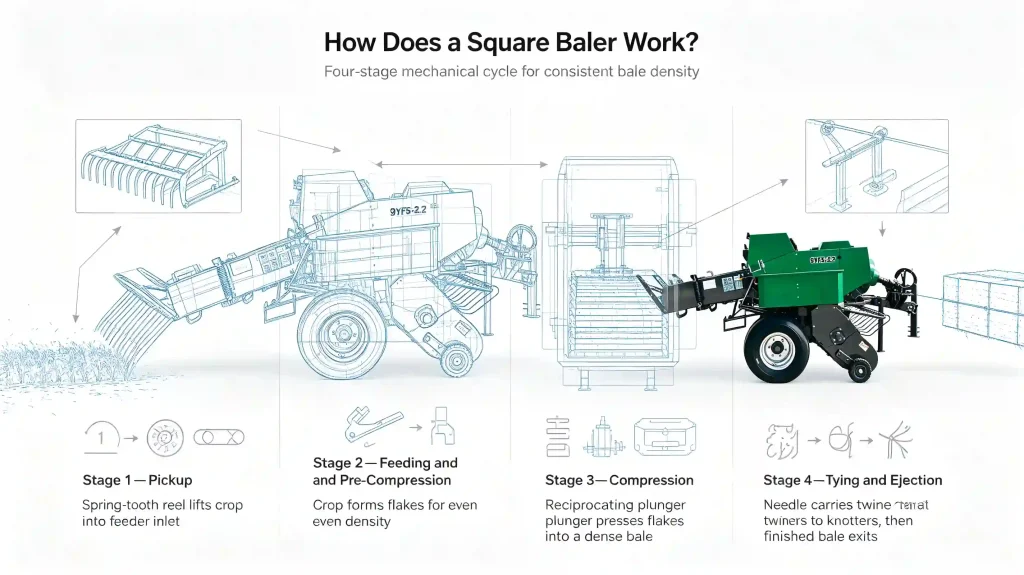
How Does a Square Baler Work?
A square baler hay baler follows a repeatable four-stage mechanical cycle. Understanding the cycle helps operators set feed rate, travel speed, and twine tension correctly for consistent output.
Stage 1 — Pickup: As the baler moves forward, the spring-tooth reel rotating at the front lifts cut crop from the windrow and draws it upward and rearward into the feeder inlet. On the 9YFS-2.2, the 2,200 mm pickup width allows the machine to collect material from wide combine swaths without separate raking.
Stage 2 — Feeding and Pre-Compression: The fork feeding mechanism meters crop from the inlet into each compression chamber in discrete charges. Each charge forms one layer — called a flake — of the finished bale. Controlled flake feeding is the primary mechanism for achieving uniform bale density.
Stage 3 — Compression: A reciprocating plunger inside each chamber compresses each incoming flake against the growing bale stack. Adjustable chamber tension controls how hard the plunger works against the crop, determining final bale density and weight.
Stage 4 — Tying and Ejection: When the bale reaches the programmed length, a needle swings up through the bale slot and carries twine to the D-type knotters, which tie off the bale and sever the twine in one motion. The finished bale is pushed out the back of the chamber by the next forming bale, landing on the ground or a trailing accumulator wagon.
On the 9YFS-2.2, Stages 2–4 occur simultaneously in both chambers, offset by half a cycle. This overlap is what produces the continuous bale output and higher throughput compared with single-chamber square balers.
Frequently Asked Questions About Square Balers
Ready to Increase Your Daily Bale Count?
Request a quotation for the 9YFS-2.2 Twin-Chamber Square Baler today. Our technical team will verify compatibility with your tractor, local regulations, and crop type — and can advise on PTO shaft specification and mowing equipment to complete your harvest chain.
We also supply a full line of complementary harvesting and hay-handling equipment to support your operation from field to barn:
- Round Hay Balers — High-capacity round baling for silage and dry hay, producing 1.2 m and 1.5 m diameter rolls suited to large pasture and forage operations.
- Bean Harvesters — Purpose-built combine headers and harvesting systems for soybean, chickpea, and pulse crops, with low-loss pickup systems for clean harvest at high forward speed.
- PTO Drive Shafts and Driveline Components — Heavy-duty drive shafts rated for peak baler load demand, helping protect both the baler gearbox and tractor PTO from shock loading.
Send your inquiry now — response within 24 hours. Include your tractor PTO output (hp or kW), target bale count per day, and primary crop type for a tailored equipment recommendation.