
Agricultural residue baling turns a cost into a revenue stream. Energy crop baling takes the concept a step further — it converts marginal or underperforming farmland into a purpose-grown biomass production system. Switchgrass, miscanthus, giant reed, short-rotation willow, and kenaf are among the dedicated energy crops being grown commercially in North America and Europe, specifically for biomass fuel, biogas feedstock, and advanced bio-based materials. These crops represent the frontier of agricultural diversification, and the round baler is the machine that makes the system economically viable.

This article is written for two audiences: landowners and farmers considering converting marginal acreage to dedicated energy crop production, and biomass cooperatives and energy companies sourcing baling equipment for contract growing programs. Both groups need to understand the specific agronomic, mechanical, and logistical requirements that distinguish energy crop baling from conventional hay or residue operations.
The Case for Dedicated Energy Crops: Why Not Just Bale Straw?
Agricultural straw is an opportunistic biomass source — it’s available when grain is harvested, but availability fluctuates with crop mix, weather, and competing markets (bedding, feed). Dedicated energy crops offer fundamentally different production economics:
Predictable Annual Yield
Established switchgrass or miscanthus plantings produce consistent 8–15 tonnes/ha/year after the third establishment year, with minimal year-to-year variability versus grain crops. This predictability is essential for biomass supply contracts.
Marginal Land Utilization
Energy crops thrive on soils too poor, wet, or sloped for grain. Switchgrass in particular is adapted to drought-prone Prairie soils and degraded agricultural land that would otherwise lie idle or require expensive restoration.
Lower Annual Input Costs
After establishment, perennial energy crops require no replanting, minimal tillage, and significantly lower fertilizer inputs than grain crops. Operating costs per tonne of dry biomass are substantially lower than annual crop residue collection once the stand is established.
Carbon Sequestration Value
Perennial energy crops build soil carbon through deep root systems. Switchgrass root biomass can exceed 10 tonnes/ha. Under evolving carbon protocols in BC and Alberta, this root carbon represents an additional verified income stream distinct from biomass sale.
The trade-off is the establishment period — switchgrass requires 2–3 years before full yield is achieved, and miscanthus may take 3–4 years. This capital deployment and patience requirement means energy crops are best suited to operations with a 10–20 year planning horizon and access to committed biomass offtake contracts before planting.
Key Energy Crops and Their Baling Characteristics
Each dedicated energy crop presents different harvest timing, moisture management, and mechanical requirements. Understanding these differences is essential to selecting the right baling equipment:
| Crop | Harvest Season | Moisture at Harvest | Typical Yield | Baling Notes |
|---|---|---|---|---|
| Switchgrass | Late fall / winter (after frost) | 12–18% (naturally dried by frost kill) | 6–15 t/ha/yr | Harvests dry; standard spring-tooth pickup performs well; bales naturally at low moisture |
| Miscanthus | Late winter / early spring | 12–20% (winter-dried standing crop) | 10–25 t/ha/yr | Tall, woody stems require conditioner or heavy pickup; high throughput demand on baler |
| Giant Reed (Arundo) | Late summer / fall | 40–60% — requires field drying | 15–35 t/ha/yr (irrigated) | High moisture management; used primarily in warmer US regions; not common in Canada |
| Short-Rotation Willow | Winter (3-year rotation) | 40–55% — chip-harvested, not baled | 8–12 t/ha/yr (dry) | Not suitable for round baling — requires specialist chip harvester |
| Kenaf | Fall (after frost) | 20–35% | 6–14 t/ha/yr | Coarse stems similar to corn stover; hammer-claw or knife pickup required for efficient baling |
For Canadian operations, switchgrass and miscanthus are the most commercially viable energy crops. Switchgrass is prairie-native, drought-tolerant, and well-suited to western Canadian marginal lands. Miscanthus is a higher-yield option on Ontario and BC farmland with milder winters, though it requires winter hardening management for establishment in colder zones.
Switchgrass Baling in Practice: The Fall Harvest Protocol
Switchgrass is the most operationally straightforward energy crop from a baling standpoint. The strategic harvest decision for switchgrass biomass quality is timing:
- Harvest after the first killing frost (when plant is fully dormant and internal moisture has dropped to 15–20%). This reduces field drying time to near-zero and produces bales well within biomass moisture specifications without any waiting period. In Southern Saskatchewan and Manitoba, this typically means late October through November.
- Do not harvest green switchgrass. Green-stage switchgrass at 50–65% moisture would require extended field drying — during which significant leaf drop and dry matter losses occur. Delaying to the dormant stage avoids these losses entirely.
- Mow and let lie for 48 hours before raking and baling. Even frost-killed switchgrass can accumulate surface dew. A short field lie-time after mowing allows any surface moisture to evaporate before pickup.
- Use a spring-tooth pickup in good condition. Switchgrass stems are fine, flexible, and behave similarly to grass hay. A standard spring-tooth pickup on a round baler handles switchgrass efficiently without the clogging issues seen in corn stover or miscanthus.
- Target bale density >110 kg/m³. Lower-density switchgrass bales are less economic to transport. Adjust baler chamber pressure settings for maximum compression. Net wrap is preferred to maintain bale geometry on transport.
Miscanthus Baling: Managing the High-Yield, High-Demand Crop
Miscanthus is one of the highest-yielding biomass crops achievable in Canada, with mature stands in southern Ontario capable of producing 15–22 tonnes/ha of dry matter annually. This high yield creates correspondingly high demands on baling equipment — more mass through the machine per acre, stiffer stems than switchgrass, and a longer harvest window extending into late winter.
Key operational considerations for miscanthus baling:
- Time harvest to late February–March in Southern Ontario for lowest moisture content. Miscanthus stems continue to dry through winter, reaching 12–18% moisture by late winter — significantly below the 25% maximum for most biomass buyers. Earlier winter harvests at 25–35% moisture are acceptable for AD/biogas markets.
- Use a conditioner or flail mower before baling. Miscanthus stem diameters can reach 10–15 mm — too stiff for some pickup systems to handle efficiently without conditioning. A flail-conditioning pass before baling reduces stem rigidity and improves bale density.
- Select a high-torque baler. Miscanthus at peak yield creates very high throughput demand. The 9YG-1.25 cylindrical baler, with its heavy-duty chamber and high PTO requirement, is better matched to miscanthus than lighter compact balers.
- Plan for high bale volumes per acre. At 15+ t/ha yield, a 25-acre miscanthus field may produce 300–400 bales in a single harvest. Storage logistics must be planned before harvest, not after.
- Net wrap is non-negotiable on miscanthus bales. The stem spring-back in miscanthus is significant — even more so than corn stover. Net wrap is the only reliable system for maintaining miscanthus bale integrity through transport and extended outdoor storage.
Equipment Selection for Energy Crop Baling
Energy crop baling requirements sit between light hay and heavy stover in terms of machine demands. The following Canada Hay-Balers Co. machines are best suited to commercial energy crop operations:
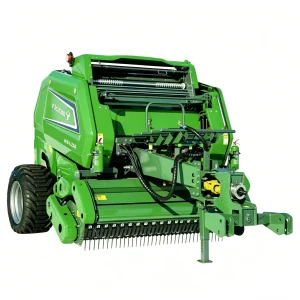
9YG-1.25A Round Baler — Versatile Energy Crop Standard
The 9YG-1.25A multi-crop round baler with net wrap handles switchgrass, kenaf, and fine-stemmed energy crops with its standard spring-tooth pickup and 1.25 m bale chamber. At 55–75 HP PTO demand, it runs efficiently on modern utility tractors common on diversified farms transitioning marginal acres into biomass production. Produces 1.25 m bales well within biomass buyer intake specifications.
- Multi-crop capable — switchgrass, alfalfa, corn stalk in the same season
- Net wrap standard — maintains bale geometry on high-spring-back crops
- 55–75 HP requirement — compatible with common farm tractors
- 1.25 m bale diameter — accepted by most biomass and pellet facility intake systems
Before You Plant: Checklist for Entering Dedicated Energy Crop Production
PRE-INVESTMENT CHECKLIST
- ✅ Identify a committed offtake buyer before planting — biomass spot markets are thin. Contract security for 5+ years is the baseline for sound economics.
- ✅ Assess land suitability: switchgrass performs on poor, sandy, or drought-prone soils; miscanthus needs better drainage and winter protection in cold zones. Get soil tests and drainage assessment.
- ✅ Calculate the full establishment cost: seed (switchgrass) or rhizome (miscanthus) cost, site preparation, establishment weed control, and 2–3 years of non-productive land carrying cost.
- ✅ Model transport logistics: energy crop biomass economics are logistics-sensitive. Calculate the distance to your buyer’s facility — at distances beyond 150 km by truck, biomass economics become challenging without rail access.
- ✅ Confirm carbon credit eligibility: under BC’s Low Carbon Fuel Standard or Alberta’s TIER system, dedicated energy crops may generate verifiable carbon credits. Get a pre-registration assessment from your provincial authority.
- ✅ Match baling equipment to contract volume: confirm your baler’s annual capacity meets your contracted supply obligation before the contract is signed.
- ✅ Plan bale storage before harvest: energy crops typically produce 100–400+ bales/acre/year. Storage yard design, site preparation, and access road capacity must be in place before the first harvest.
Frequently Asked Questions — Energy Crop Baling
Q: What is the minimum acreage to make switchgrass energy crop production viable?
With a direct supply contract to a nearby biomass facility (<80 km), 50–100 acres of established switchgrass producing 8–12 t/ha can generate sufficient volume for a small contract while remaining manageable for a single-machine baling operation. Below 50 acres, the establishment and logistics costs typically do not produce a positive economic return without premium carbon credit stacking.
Q: Can the same baler be used for both switchgrass and conventional hay?
Yes — the baling mechanics are essentially the same. Switchgrass harvested after dormancy behaves similarly to mature grass hay. The 9YG-1.25A multi-crop baler is specifically designed for this type of operation, covering forage hay from June through August and energy crop biomass from October onward in a single machine.
Q: How long does a switchgrass stand last before replanting is needed?
Established switchgrass stands are productive for 10–15 years with proper management. Annual inputs are minimal — some nitrogen supplementation after year 3, and weed competition control during establishment. The multi-decade productive life is a key economic advantage over annual crops.
Q: Is miscanthus legal to grow in Canada?
Sterile miscanthus varieties (Miscanthus × giganteus) are legal and commercially available in Canada. Fertile varieties are regulated under the federal Seeds Act due to potential invasiveness. Confirm your seed source is certified sterile before planting, and check provincial regulations — Ontario has the most developed miscanthus regulatory framework in Canada.
Q: What price should I expect for switchgrass biomass bales?
Switchgrass contracted to biomass power facilities in Ontario and BC typically prices at CAD $35–55/tonne delivered. Farm-gate prices are lower at $22–38/tonne depending on proximity. Premium pricing is available for switchgrass certified under quality and sustainability standards used for European biomass export markets.
Q: Do I need special permits to grow dedicated energy crops on agricultural land?
In most provinces, dedicated energy crops on existing farmland do not require special permits beyond normal agricultural registration. Farms receiving agricultural support payments should confirm that switching acreage from grain to energy crops does not affect their program eligibility under applicable provincial programs (e.g., Agri-Stability, crop insurance).
Ready to Bale Switchgrass, Miscanthus, or Other Energy Crops?
Canada Hay-Balers Co. supplies ISO 9001-certified round balers for dedicated energy crop production — from 100-acre switchgrass plots to utility-scale miscanthus plantings. Our team can match you to the right machine for your crop, acreage, biomass buyer’s specifications, and tractor HP.
Get a free B2B quote: [email protected] · 10055 Hogarth Dr, Richmond, BC, Canada · Ships Worldwide