الوصف
9FZ-2.0 Rotary Hay Tedder — 3-Wheel Finger Rotor, 2 m Working Width, Hydraulic Fold, JB/T7766-2011 Certified
Product Overview: 9FZ-2.0 Rotary Hay Tedder
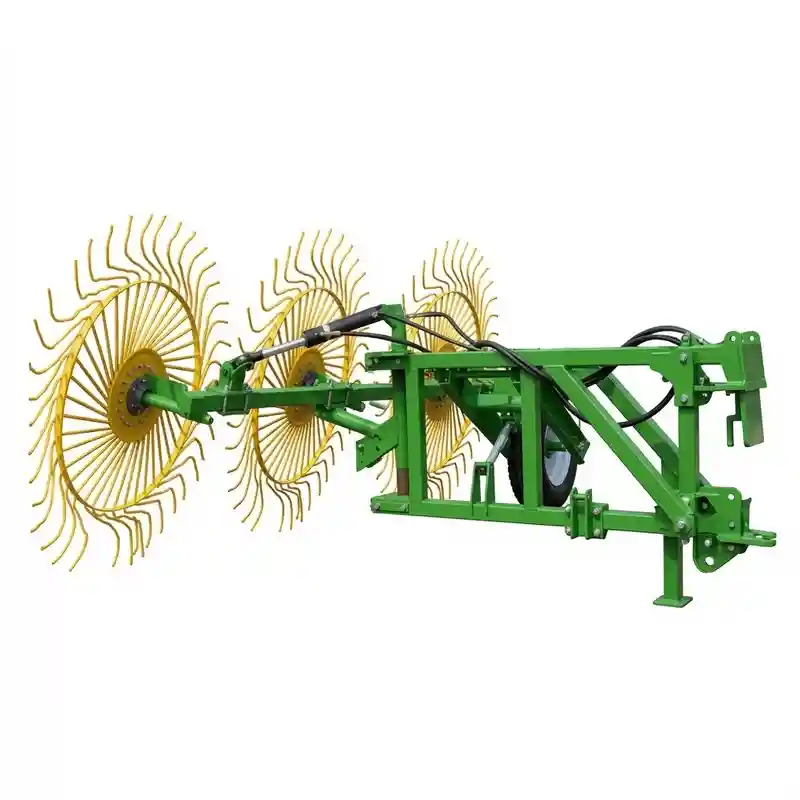
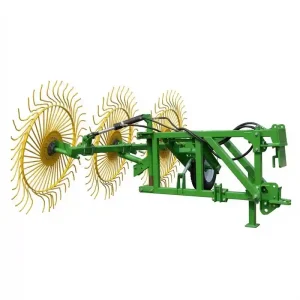
The 9FZ-2.0 is a 3-rotor finger-wheel rotary hay tedder designed for mounted operation on tractors producing ≥25.73 kW (≥35 hp). It turns and aerates cut forage across a 2-metre working swath at field speeds of 7–10 km/h, accelerating field drying to reach target moisture content for baling or storage. Total machine weight is 372 kg. Manufactured and tested to the Chinese agricultural machinery standard JB/T7766-2011, the unit covers the full specification chain from rotor geometry to tine material grade.
Three finger rotors — each carrying 40 spring-steel tines, totalling 120 tines across the 2 m width — lift, turn, and scatter swathed grass or legume crops in a single pass. Each rotor wheel is Φ1,500 mm in diameter, giving the tine tips sufficient circumferential speed at tractor PTO and ground speed to generate consistent forage throw without bunching. The hydraulic fold mechanism compresses the working width for road transit and headland turning, reaching a transport footprint of 3,500 × 3,500 × 1,500 mm.
As a wheel-type hay tedder with a 3-rotor configuration, the 9FZ-2.0 suits small-to-mid-scale hay operations — including mixed livestock farms, fodder contractors, and cooperative field operations — where a single tractor handles the full cutting, tedding, and raking sequence across 20–80 hectares per season.
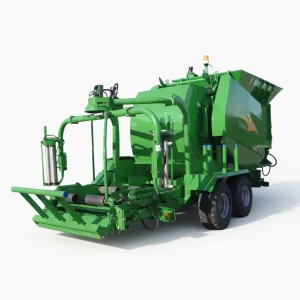
9JYY-2.5 Round Bale Picker & Transporter
Technical Specifications of the 9FZ-2.0 Hay Turning Machine
All figures are factory-rated values for the standard 9FZ-2.0 configuration. Contact us for multi-rotor extended-width variants or alternative tine specifications.
| # | Parameter | Unit | Specification |
|---|---|---|---|
| 1 | Product Name | — | Finger-Wheel Rotary Hay Tedder |
| 2 | Model | — | 9FZ-2.0 |
| 3 | Hitch Type | — | 3-point mounted (Category I / II) |
| 4 | Folding Mechanism | — | Hydraulic fold |
| 5 | Number of Rotors (Finger Wheels) | — | 3 rotors |
| 6 | Total Tine Count | — | 120 (40 tines/rotor × 3 rotors) |
| 7 | Finger Wheel Diameter | mm | Φ 1,500 |
| 8 | Working Width | m | 2.0 |
| 9 | Required Tractor Power | kW | ≥ 25.73 (≥ 35 hp) |
| 10 | Working Speed | km/h | 7 – 10 |
| 11 | Working Dimensions (L × W × H) | mm | 3,500 × 3,500 × 1,500 |
| 12 | Machine Weight | kg | 372 |
| 13 | Product Standard | — | JB/T7766-2011 |
Efficiency and Performance: Optimal Speed and Working Width
At a recommended field speed of 7–10 km/h, the 9FZ-2.0 covers between 1.4 and 2.0 hectares per hour (net, excluding headland turns) on a 2-metre swath width. That output is sufficient to re-ted a full morning’s mowing cut — typically 4–6 ha on a compact utility tractor operation — within a 3–4 hour afternoon window, keeping the drying programme on schedule when weather windows are narrow.
40 tines per rotor across 3 rotors. High tine density ensures thorough crop inversion on each pass without leaving unturned pockets in the swath.
Large-diameter finger wheels generate the tine tip speed needed for effective forage scatter at 7–10 km/h field speed, without requiring elevated PTO input.
Matched to the swath width of most disc and drum mowers in the 1.65–2.1 m cutting range. Tedded swath aligns directly with downstream rake and baler pick-up width.
Light enough for the rear 3-point linkage of a 35 hp tractor to handle within rated lift capacity. No ballast or front-axle weighting required in standard configurations.
Why Choose Our Mounted Rotary Hay Tedder?
There are several finger-wheel tedder designs on the market. The 9FZ-2.0’s specification decisions are worth understanding directly — not as marketing language, but as engineering trade-offs relevant to your purchasing decision:
- 3-rotor vs 2-rotor layout: A 3-rotor arrangement at 2 m working width spaces each Φ1,500 mm rotor more tightly than a 2-rotor design achieving the same width. Closer rotor spacing reduces the untreated strip between rotor paths, improving evenness of tedding particularly on thick-stemmed grass crops.
- Hydraulic fold as standard: Unlike mechanical pin-fold variants that require the operator to dismount, the hydraulic fold on the 9FZ-2.0 folds and deploys from the tractor cab. At headlands and on road transit, this saves roughly 2–4 minutes per fold cycle. Over a full hay season, this compounds into measurable saved time on multi-field operations.
- 3-point mounted, not trailed: Mounted configuration transfers a portion of the machine weight to the tractor’s rear axle, improving traction on slopes and reducing the turning radius versus a trailed hay rake and tedder combination. The trade-off is that the tractor’s rear lift capacity must meet or exceed 372 kg at the lower link ball — well within range for any tractor at the 35 hp threshold.
- Spring-steel tine grade: Tines are the primary wear component on any rotary tedder. The 9FZ-2.0 tines are heat-treated spring steel, dimensioned for standard European tine-replacement compatibility. Tine replacement is a single-bolt operation per tine — no special tooling required in the field.
- Working speed floor of 7 km/h: Below 7 km/h, rotor tip speed drops and forage scatter becomes uneven. The 7–10 km/h working band is the correct operating range for most grass and legume crops at standard cutting heights. Avoid operation below 7 km/h to prevent crop bunching at rotor exit.
Quality Assurance: Manufactured to JB/T7766-2011 Standards
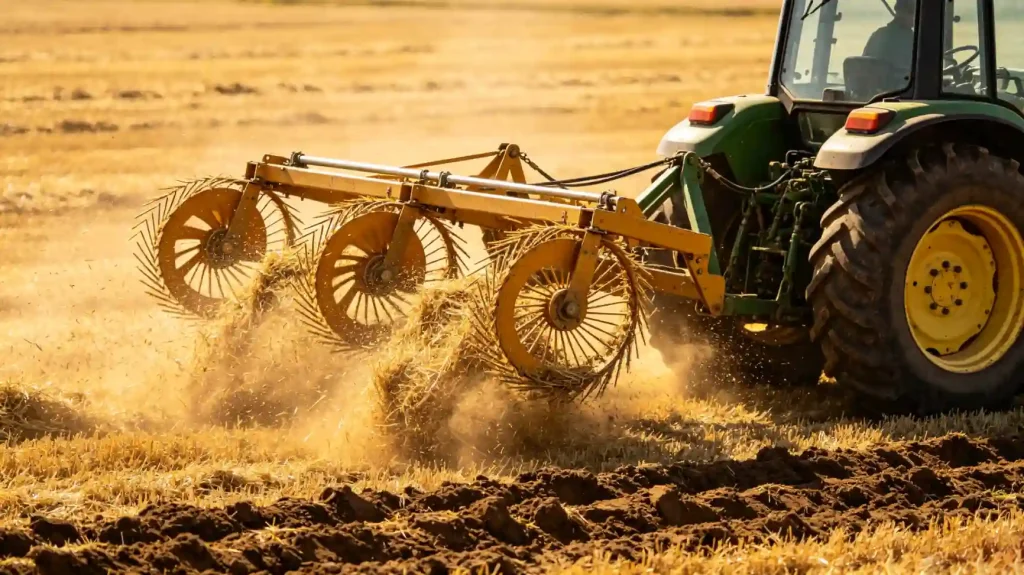
JB/T7766-2011 is the Chinese Ministry of Industry and Information Technology mechanical industry standard for finger-wheel hay tedders. It specifies dimensional tolerances, material grades, tine attachment strength, hydraulic circuit pressure ratings, and safety guard requirements. Compliance is verified by type-test inspection — not self-declaration.
Structural steel and tine spring material grades are documented to standard. Material test certificates available on OEM/dealer request.
The fold circuit is rated and tested to the pressure threshold defined in JB/T7766-2011 — no under-spec components in the hydraulic fold assembly.
Standard mandates minimum tine-to-carrier pull-out force. Each batch undergoes sampling inspection before shipment to verify tine retention meets specification.
PTO and rotor guarding dimensioned to JB/T7766-2011 and compatible with CE machinery directive guard geometry for export markets.
Frequently Asked Questions
The Complete Hay Harvest Chain: Mowing to Transport
The 9FZ-2.0 tedder operates at step two of a five-machine field cycle. Understanding where it fits helps you specify the right equipment at each stage and avoid bottlenecks between cutting and storage:
Cuts standing forage and lays it in a swath. Tractor power ≥25.73 kW. Cutting width should match or slightly exceed the tedder’s 2 m working width to avoid uncut strips.
3-rotor finger-wheel tedder. 120 tines. 2 m width. 7–10 km/h. Turns and aerates the swath to accelerate field drying. One to two passes to reach target moisture.
After tedding reaches target moisture, a hay rake consolidates the scattered crop into a clean, even windrow at the baler’s pick-up width. Reduces baler losses and improves bale density consistency.
Picks up the windrow and forms net-wrapped or twine-wrapped round bales at 1,000–1,500 mm length — the size range accepted by the companion 9JYY-2.5 bale transporter.
Hydraulic self-loading wagon. 2,500 kg rated payload. Picks up bales from the field and transports at up to 40 km/h. Single operator, field to barn in one pass per load.
All five machines in this chain are available from our range. Contact us to configure a matched equipment set for your farm scale and annual tonnage target.
Specify the Right Tedder for Your Operation
Send us your tractor model, annual cut area (ha), crop type, and target moisture — we’ll confirm 9FZ-2.0 compatibility and provide a full dimensional drawing, tine specification sheet, and FOB pricing. OEM, distributor, and contractor-fleet enquiries handled with priority lead times.
Also Available in Our Range:
We supply individual machines and matched equipment sets to commercial farms, agricultural contractors, and OEM importers. Full technical documentation, CE-compatible safety compliance data, and spare parts support available on all products.