
Horse Hay Is Not Cattle Hay: Why the Production Standards Differ
Canadian horse owners are among the most discerning hay buyers in the agricultural market. Unlike beef cattle, which can tolerate and productively use lower-quality roughage through rumen buffering, horses have a relatively simple foregut digestive system that is acutely sensitive to mold, dust, mycotoxins, and fermentation byproducts present in poorly cured hay. A single mold-contaminated bale fed to a performance horse can trigger respiratory irritation, colic, or laminitis — conditions that result in substantial veterinary costs and lost performance time. For hay producers supplying equine customers, this means that quality standards at every stage — cutting timing, conditioning, curing, and baling — must exceed what is typically acceptable for cattle markets.
Choosing the Right Forage Species for Horse Hay
Not all hay crops are equally well suited for premium horse hay production in Canada. Forage species selection should be matched to your region, soil type, irrigation access, and target market.
- Timothy (Phleum pratense): The gold standard premium horse hay in Eastern and Central Canada. High palatability, moderate protein (8–11% when mature), soft texture that reduces dental wear, and low sugar profile suited to horses with metabolic concerns. Commands the highest per-bale premiums in Ontario and Quebec equine markets.
- Orchard Grass (Dactylis glomerata): Widely grown in BC and increasingly popular in Alberta for horse hay. Higher yield per acre than timothy, slightly higher protein, and very palatable. Less dusty than mature alfalfa and preferred by many horse owners over straight legume hay.
- Alfalfa (pure or blended): High-protein alfalfa is suitable for growing horses, performance horses with high energy demands, and lactating mares, but must be very well cured and stored to prevent the dust and mold issues that make some horse owners cautious. Alfalfa-grass blends (50/50) are widely accepted and reduce the risk of digestive upset associated with high-legume diets in idle horses.
- Brome Grass (Bromus inermis): Common in the Prairie provinces, higher-yielding but coarser textured than timothy. Acceptable for mature pleasure horses but not preferred by performance horse owners who seek finer, leafier hay.
- Mixed grass-legume stands: Blends of timothy, orchard grass, and alfalfa or clover represent a practical, high-quality all-around option that suits the broadest equine customer base in Canadian markets.
Cutting Timing: Balancing Quality, Yield, and Stand Longevity
For premium horse hay, cutting timing is a quality decision first and a yield decision second. The quality arc of most forage species moves in one direction — downward — once the plant transitions from vegetative to reproductive growth. The table below shows the cutting-stage quality relationship for the most common Canadian horse hay species:
| Species | Premium Cut Stage | CP at Premium Stage | Quality Loss if Cut 10 Days Late |
|---|---|---|---|
| Timothy | Boot stage (pre-head emergence) | 10–13% | RFV falls 25–35 points; texture coarsens |
| Orchard Grass | Early head, pre-pollen | 12–16% | Rapid stemming, significant quality reduction |
| Alfalfa | Early bud to 10% bloom | 20–24% | CP falls 3–5%; ADF rises significantly |
| Brome Grass | Boot to early head | 9–12% | Moderate quality reduction; palatability reduction |
Monitoring your fields weekly from the point when 50 percent of stands break dormancy allows you to time the cutting decision with precision. In BC and Ontario, first-cut timothy windows can be extremely compressed — sometimes as short as 5 to 7 days between optimal cutting quality and over-maturity.
Mowing and Conditioning: Fast Drying Without Leaf Loss
The goal in mowing for horse hay is to cut cleanly at a uniform height, condition stems adequately to accelerate drying, and lay the cut crop in a swath width that promotes rapid moisture release without excessive soil pickup. For premium horse hay:
- Cutting height: Maintain a stubble height of 7 to 10 cm. Lower stubble heights increase yield per cut but introduce more soil contamination, which elevates ash content and reduces feed value.
- Conditioning intensity: Set roll pressure to crimp stems adequately — typically a 20 to 30 percent reduction in stem diameter — without shattering leaf tissue. Over-conditioning causes leaf loss from grass species and is a common cause of quality reduction from the conditioning stage.
- Swath width: A wider swath spread (80 to 90 percent of the cutting width) accelerates solar drying but requires more careful raking to avoid ground contact during windrow formation. In wetter BC climates, maximizing swath spread is critical to achieving field drying within the weather window.
A well-maintained trailed mower-conditioner with properly adjusted conditioning rolls delivers the combination of clean-cutting and uniform conditioning needed for premium horse hay production. Roll alignment and surface condition should be checked at the start of each cutting season, as worn rolls reduce conditioning effectiveness and increase stem drying time.

Field Curing: Managing Moisture Through the Drying Period
The field drying period is where the most quality losses in premium horse hay occur. Rain events after cutting are the primary enemy — even a light shower on partially cured hay can leach soluble carbohydrates and increase mold risk in the finished bale. Practical field curing management for Canadian producers:
- Check the 5-day weather forecast before cutting — this seems obvious but is often ignored in the urgency of a cutting window. A 90 percent probability of dry weather over 4 days is the minimum acceptable threshold for initiating a first-cut operation in Eastern Canada or BC.
- Tedding: Tedding partially-cured swaths can accelerate drying by 12 to 24 hours in humid conditions, but tedding when the crop is too dry or at midday in hot weather causes excessive leaf shatter. Ted in the morning when leaves are slightly pliable from residual humidity.
- Test moisture before raking: Use a forage probe or electronic moisture meter rather than feel-based estimates. Raking grass hay below 30 to 35 percent moisture causes significant leaf shatter. Raking above 55 percent moisture forms windrows that dry unevenly and may have high-moisture cores.
- Rake timing: Early morning raking, when stem moisture has equilibrated overnight, produces more uniform windrows and better leaf retention than afternoon raking when the upper leaf layer is over-dry relative to the stem base.
Baling Moisture Targets for Premium Horse Round Bales
Horse hay requires more stringent moisture targets at time of baling than the standard cattle hay benchmarks. This reflects both the lower mold tolerance of horses and the premium buyers in equine markets who often request forage test results before purchasing.
| Baling Moisture | Storage Risk | Premium Horse Market Acceptability |
|---|---|---|
| Below 12% | Very low | Ideal — but risk of excessive brittleness and leaf loss |
| 12–15% | Low | Preferred range for premium horse hay |
| 15–18% | Moderate | Acceptable with good ventilated storage |
| 18–20% | High | Not acceptable for premium horse market without propionic acid treatment |
| Above 20% | Severe | Not suitable for dry horse hay under any circumstances |
Selecting the Right Baler for Premium Horse Hay Production
The round baler selected for premium horse hay production must be able to form consistent, tight bales that minimize air pockets and maintain shape integrity through months of barn storage. Bale shape consistency is particularly important in horse hay because:
- Deformed or barrel-shaped bales stack unevenly in barn storage, reducing airflow and increasing pressure points where mold can develop.
- Premium hay buyers at horse shows and auction barns assess bale shape visually before purchasing — a well-formed, tight bale commands a higher price than a loose, irregular one of equivalent forage quality.
- Consistent bale weight simplifies rationing for horse owners who feed a fixed number of flakes or bale portions per day.
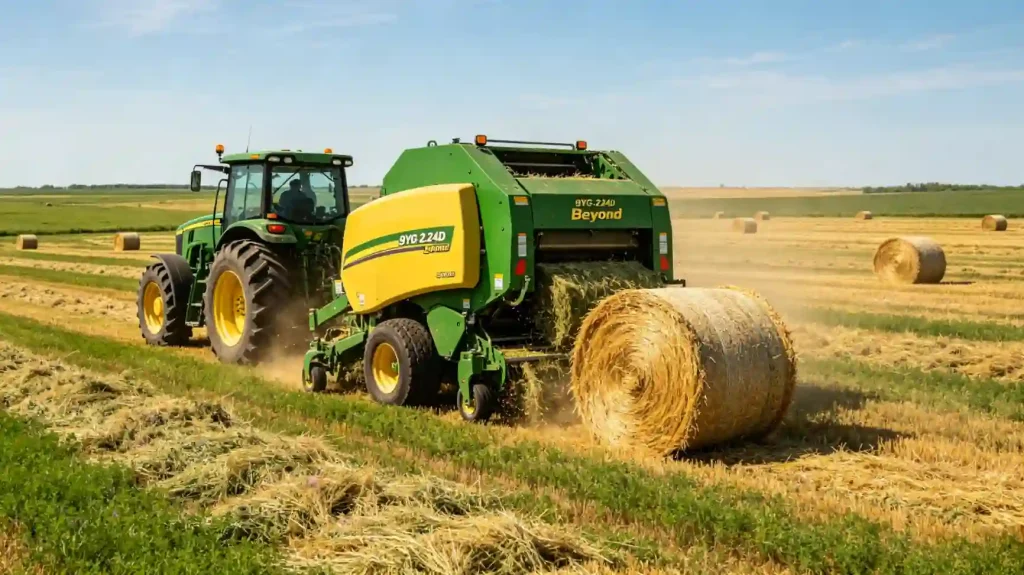
The 9YG-2.24D Round Hay Baler delivers the consistent chamber pressure and roller geometry needed to produce uniform, market-ready horse hay bales. Its net wrap system completes binding efficiently, minimizing the open-chamber phase where leaf shatter can occur — a critical advantage when baling dry timothy or orchard grass at the lower moisture levels required for premium horse hay.
For smaller equine operations producing 200 to 400 bales per season, the 9YG-1.25A Round Baler provides the compact size and tractor compatibility needed for family farm scale production, while still producing bales of the density and shape required for equine market presentation.
Barn Storage Best Practices for Horse Hay
Premium horse hay should be stored in covered, ventilated barn or shed storage wherever possible. Horse owners paying top-of-market prices for quality hay will return to their supplier season after season when hay consistently arrives clean, dust-free, and mold-free. Barn storage protects this reputation:
- Allow new bales to sweat before stacking: Even correctly baled hay at 14 percent moisture will undergo some internal heating in the first 2 to 3 weeks after baling as residual plant respiration occurs. Loose-stacking new bales for the first 21 days allows this heat to dissipate before tighter barn stacking is applied.
- Arrange barn rows for FIFO access: First-in, first-out feeding management ensures older inventory is consumed before newer hay, reducing the risk of keeping hay in barn storage for more than 12 months.
- Monitor temperature with a probe thermometer: Newly baled hay above 16 percent moisture that peaks above 55°C internally has undergone heat damage that reduces protein availability even when the external bale appearance is normal.
Forage Testing for the Horse Hay Market
Premium horse hay producers who routinely provide forage test results to buyers establish a level of trust and professionalism that justifies price premiums. Request a test from a certified forage laboratory — Agri-Food Laboratories in Ontario, Discovery Seed Labs in Saskatchewan, and A&L Canada are all well-regarded options — covering at minimum: moisture, CP, ADF, NDF, TDN, and non-structural carbohydrates (NSC or WSC) for buyers managing horses with metabolic syndrome or insulin dysregulation.
A forage test costs approximately $35 to $60 per sample and should represent each cutting separately, as nutrient profiles can vary significantly between first, second, and third cuts from the same field.
Baling Equipment for Premium Horse Hay Producers
Canada Hay-Balers Co., Ltd supports equine hay producers across British Columbia, Ontario, Alberta, and Quebec with round baler equipment suited to the quality standards and bale presentation requirements of the Canadian horse hay market. Reach out to discuss equipment options for your forage species, field size, and target market.
Canada Hay-Balers Co., Ltd
10055 Hogarth Dr, Richmond, BC V7E 3Z9, Canada
[email protected]