
Miscanthus in Canada: A High-Yield Energy Crop Worth Knowing
Miscanthus — specifically Miscanthus x giganteus, the sterile hybrid commonly planted for energy production — is one of the most productive perennial biomass crops available to Canadian producers in temperate regions. A well-established stand can produce 10 to 20 tonnes of dry matter per hectare annually with minimal agronomic inputs after the establishment year, and it does so from the same roots for 15 to 25 years without replanting. For producers in Southern Ontario, the BC Lower Mainland, and choose inland BC valleys, miscanthus offers a compelling long-term land use opportunity for marginal, poorly-drained, or low-productivity acres that do not justify annual crop production costs.
This article covers the establishment requirements, management calendar, baling specifications, and biomass market pathway for miscanthus production in Canada — with a focus on the practical baling decisions that determine whether the harvested product meets the quality standards required by Canadian pellet mills, district heating operators, and other biomass energy buyers.
Why Miscanthus Works Well as a Biomass Crop in Canada
Several characteristics make miscanthus particularly well-suited to the Canadian biomass context:
- Spring-harvested low-moisture biomass: Unlike cereal straw or corn stover, miscanthus is harvested in late winter or early spring (February to April) after the standing crop has dried naturally on the stem through the winter. Typical moisture at harvest is 12 to 18 percent — close to or within the specification range for direct biomass processing without pre-drying.
- High calorific value: Dried miscanthus has a gross calorific value of 17.5 to 19.0 MJ/kg — comparable to the upper range of cereal straw — and a low ash content of 2 to 4 percent, which is significantly below cereal straw and more compatible with a wider range of combustion equipment.
- Minimal nutrient requirements: Established miscanthus stands require only modest nitrogen and potassium inputs after the second year. The nutrient cycling from fallen leaves back to the soil reduces the net fertilizer requirement substantially compared to annual crops.
- No weed competition after establishment: A dense miscanthus canopy suppresses weeds effectively from year 3 onward, reducing the management inputs that add cost to annual crop systems.
- Perennial revenue stream: After the one-time establishment cost, a healthy miscanthus stand generates biomass revenue annually for 15 to 25 years with minimal ongoing capital investment.
Canadian Hardiness and Regional Suitability
Miscanthus x giganteus has demonstrated reliable winter survival in USDA Hardiness Zone 5 equivalent climates, which in Canada corresponds to Southern Ontario (south of Barrie), the BC Lower Mainland, Southern Vancouver Island, and protected valley locations in BC and parts of the Niagara Peninsula.
In colder zones (Zone 4 and below), including most of the Prairie provinces and Northern Ontario, Miscanthus x giganteus survival is marginal to poor. Research at the University of Guelph and Agriculture and Agri-Food Canada has examined cold-tolerant miscanthus varieties, but as of 2024, commercially available planting material for Zone 4 and colder is not widely accessible in Canada. Producers in these zones should monitor variety development through provincial extension services before committing land to miscanthus establishment.
Establishment: The Critical First Two Years
Miscanthus establishment is the most capital-intensive phase of the production cycle and the phase with the highest variability in outcome. Poor establishment — whether from late planting, inadequate rhizome quality, drought in the first season, or weed competition — can delay first full harvest by 1 to 2 years and permanently reduce stand productivity.
- Planting material: Miscanthus is planted from rhizome divisions — underground stem sections containing 2 to 4 nodes — at a spacing of 0.9 to 1.2 m in-row and 0.9 to 1.5 m between rows. Plant counts of 10,000 to 15,000 rhizomes per hectare are standard. Rhizome sourcing from reputable Canadian or US suppliers with documented survival rates is essential.
- Planting timing: In Ontario and BC, late April to late May planting allows soil temperatures to reach 8 to 10°C at rhizome depth — the threshold for reliable sprouting. Earlier planting risks rhizome rot in cold wet soils; later planting shortens the establishment growing season and increases weed competition risk.
- Weed control in year 1: Pre-emergence herbicide application immediately after planting is the most effective strategy. A grass-targeted herbicide combined with a broadleaf control product timed to the early miscanthus emergence period reduces first-year weed pressure. In year 2, the miscanthus canopy typically closes enough to provide significant weed suppression without intervention.
- Irrigation: In BC dry belt locations (Okanagan, Thompson), irrigation during the first growing season substantially improves establishment rates. In Ontario and the BC Lower Mainland, natural rainfall is generally adequate for establishment in most years.
Annual Management Calendar for Established Stands
Once a miscanthus stand reaches full production (typically year 3 in Ontario, year 3 to 4 in slower-growing BC upland locations), the annual management calendar is simple compared to annual crop production:
| Period | Management Activity | Notes |
|---|---|---|
| Spring (February–April) | Harvest — cut and bale standing dried stems | Target moisture 12–18%; wait for frost to exit soil to reduce compaction |
| April–May | Spring emergence monitoring; fertilizer application if required | 50–80 kg N/ha on productive stands; potassium replacement if soil tests indicate |
| May–September | Active growth — minimal intervention needed in established stands | Monitor for aphid populations in high-density plantings; irrigation if dry in critical establishment zone only |
| October–January | Standing crop dries naturally; leaves shed back to soil surface | No intervention needed; leaf litter adds organic matter and reduces winter soil exposure |
Harvesting Miscanthus: Cutting, Conditioning, and Windrow Formation
Miscanthus at spring harvest is typically 1.8 to 3.5 m tall (depending on growing season length) and has a hollow, bamboo-like stem structure. Harvesting requires a mower capable of handling the standing crop height and stem stiffness — a standard disc mower or drum mower set for maximum cutting height clearance is appropriate. Some producers use a forage harvester for simultaneous cut-and-chop, but this produces material requiring further processing before baling and is more common in larger-scale dedicated biomass operations than in the on-farm baling context.
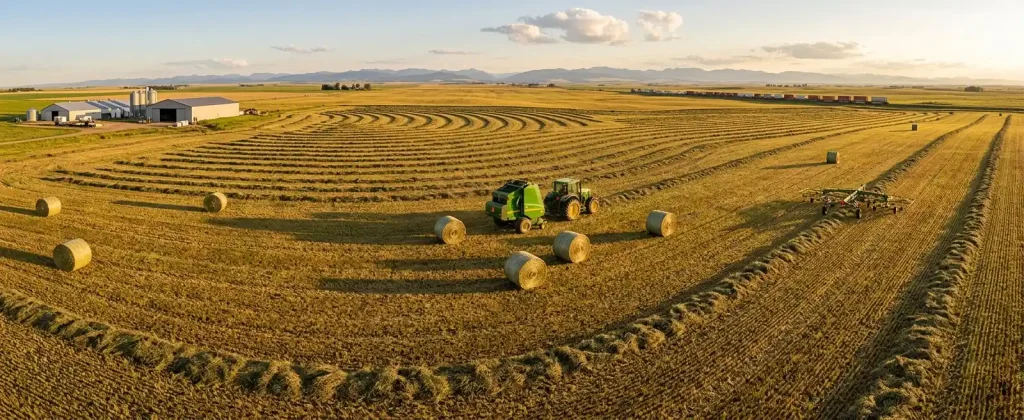
After cutting, miscanthus stems form a flat, uniform swath that is well-suited to direct baling without a separate raking step — a significant labor and equipment cost saving compared to hay production. In wet springs where ground conditions delay field access, the standing dried crop has already acted as its own storage system, maintaining quality as long as snow loading has not broken significant numbers of stems flat to the ground.
Baling Miscanthus: Equipment and Settings
Miscanthus presents specific baling challenges due to its hollow stem structure, high bulk density when compressed, and relatively high length-to-diameter ratio compared to grasses and legumes:
- Stem length management: Full-length miscanthus stems (1.5 to 2.5 m) do not feed uniformly into a round baler pickup and can cause chamber blockages. Operating the combine or mower to lay stems across the direction of travel, or using a stem shredder prior to baling, significantly improves pickup performance and bale density uniformity.
- High-capacity baler requirement: The yield per hectare from mature miscanthus stands is 3 to 5 times higher than typical hay yields, meaning total bale production per field is substantial. A high-capacity baler reduces field time during the spring harvest window when soil conditions may be limiting. The 9YG-2.24D S9000 Beyond Round Baler offers the chamber capacity and throughput rate suited to high-yield biomass crop harvesting.
- Twine over net wrap: As with cereal straw for biomass markets, twine binding is preferred by pellet mill operators to reduce the risk of net wrap fragment contamination in the processing line.
- PTO driveline maintenance: The high-torque, high-stem-mass feed rate of miscanthus baling puts significant peak load on the PTO drive shaft. Ensure the driveline is rated to the baler peak torque demand and that shear bolt protection is set to the correct specification to prevent drive shaft damage during chamber overload events.
Economic Analysis: Does Miscanthus Make Sense for Your Farm?
A realistic economic assessment for a 20-hectare miscanthus field in Southern Ontario at full production (year 3 onward):
- Establishment cost (year 1): $2,500 to $4,000 per hectare — the largest single cost item, driven primarily by rhizome purchase price and planting labor.
- Annual production cost (year 3+): $250 to $450 per hectare, covering fertilizer, harvesting, and baling costs.
- Annual yield at full production: 12 to 18 tonnes DM per hectare in Ontario conditions.
- At-field biomass price: $60 to $90 per tonne DM for contract supply to pellet or district heating operations.
- Gross annual revenue per hectare: $720 to $1,620 per hectare at full production.
- Net annual return (after production costs): $270 to $1,170 per hectare annually — a range that reflects significant variability in yield, price, and cost, but with a central estimate meaningfully above the return available from renting the same marginal land to annual crop producers.
Next Steps for Canadian Producers Considering Miscanthus
- Contact Ontario Ministry of Agriculture, Food and Rural Affairs (OMAFRA) or BC Ministry of Agriculture for current variety performance trial data and regional suitability maps.
- Identify a biomass buyer or pellet mill within 80 to 120 km of the planned planting site before committing land to establishment — market access is the critical enabling factor for miscanthus economics.
- Start with a small trial plot of 1 to 3 hectares in the first year to assess stand establishment on your soil type before scaling to a full field commitment.
- Plan the baling equipment decision at the same time as the establishment plan — a high-capacity baler matched to your expected full-production yield ensures the harvest phase does not become the bottleneck after 3 years of establishment investment.
High-Capacity Baling Equipment for Energy Crop Producers
Canada Hay-Balers Co., Ltd can advise Canadian miscanthus and biomass crop producers on round baler selection, chamber configuration, and PTO power requirements for high-yield energy crop harvesting. Contact our equipment team with your planned acreage and target market to receive a specific product recommendation.
Canada Hay-Balers Co., Ltd
10055 Hogarth Dr, Richmond, BC V7E 3Z9, Canada
[email protected]