
Few decisions in an international machinery purchase shape the final price as much as choosing between Incoterms. For buyers comparing quotations side by side, the difference between CIF vs. FOB for agricultural machinery is not just a matter of who books the ship — it changes the duty base, the insurance coverage, the documentation control, and the realistic landed cost. This guide is the practical, no-jargon walkthrough every farm equipment importer should read before signing a purchase contract.
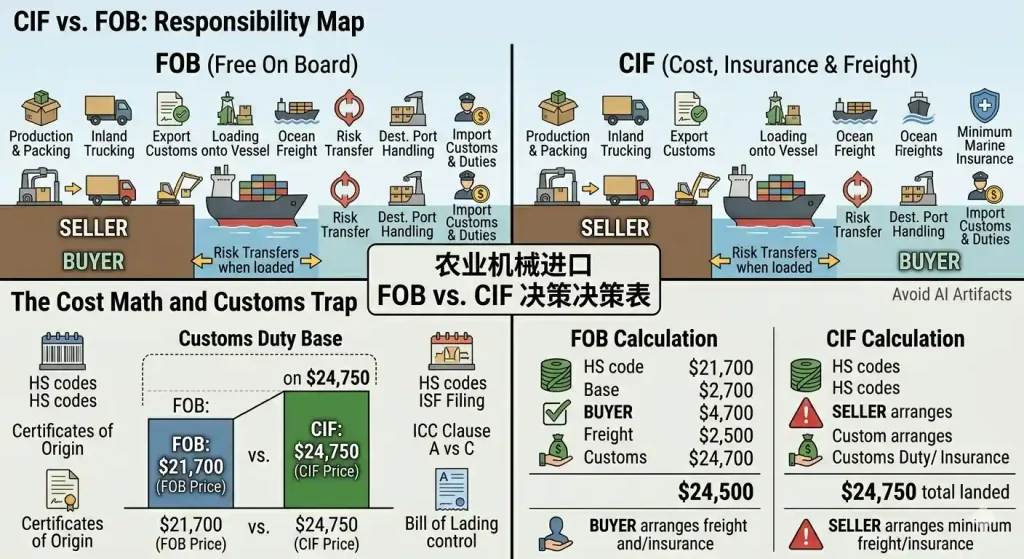
1. What Are FOB and CIF, Exactly?
FOB and CIF are two of the eleven Incoterms® rules published by the International Chamber of Commerce. The current version is Incoterms® 2020, effective January 1, 2020 — and as of 2026, no newer version has been released. Both rules are designed for sea or inland waterway transport (not air freight or pure container ramp-to-ramp).
FOB — Free On Board
The seller is responsible for delivering and loading the goods on board the vessel at the named port of shipment. Once the cargo crosses the ship’s rail, both the cost and the risk transfer to the buyer.
CIF — Cost, Insurance and Freight
The seller arranges and pays for ocean freight and minimum-level marine insurance to the named port of destination. However, the risk of loss still transfers when the goods are loaded onto the vessel at the origin port — the seller is paying for transit cost, but the buyer carries the risk during ocean transit.
2. The Side-by-Side Responsibility Map
| Activity | FOB | CIF |
|---|---|---|
| Production / packing | Seller | Seller |
| Inland trucking to origin port | Seller | Seller |
| Export customs clearance | Seller | Seller |
| Loading onto vessel | Seller | Seller |
| Ocean freight | Buyer | Seller |
| Minimum marine insurance | Buyer (optional) | Seller (mandatory minimum) |
| Risk during ocean transit | Buyer | Buyer |
| Destination port handling | Buyer | Buyer |
| Import customs & duties | Buyer | Buyer |
| Inland trucking to final site | Buyer | Buyer |
3. The Cost Math — A Worked Example
Suppose you are importing a $20,000 agricultural machine. Inland trucking and origin port handling total $1,700.
FOB calculation
- Goods: $20,000
- Inland + port handling: $1,700
- FOB price: $21,700
- Buyer arranges ocean freight: $2,500
- Buyer arranges insurance: $300
- Landed at destination port: $24,500
CIF calculation
- Goods: $20,000
- Inland + port handling: $1,700
- Ocean freight: $2,800 (seller’s rate)
- Minimum insurance: $250
- CIF price: $24,750
- Same landing point, but seller controls freight
The numbers will look close, but real-world differences emerge in three places: the freight rate the seller can negotiate vs. yours, the duty base in your country, and the level of insurance coverage.
4. The Customs Duty Trap (and It’s a Big One)
This is the single most under-discussed difference between CIF and FOB:
- Most countries assess import duty on the CIF value of imported goods — including freight and insurance
- If you import under CIF terms at $24,750, your duty base is $24,750
- If you import under FOB terms at $21,700, your duty base is typically $21,700 (with freight and insurance handled separately under your own contract)
- At a 5% duty rate, that’s $152 of duty saved on this single shipment by choosing FOB
- At a 15% duty rate (some countries on agricultural equipment), the saving is $457 per shipment
For repeat importers, this difference compounds quickly. A buyer importing 10 containers a year of agricultural machinery — including primary-tillage equipment such as a 90-240HP hydraulic reversible plow — can save thousands of dollars per year purely by selecting FOB and unbundling freight from the dutiable invoice.
5. Bill of Lading Control and ISF Filing
Bill of Lading control under CIF
Under CIF, the seller books the vessel and is named on the master bill of lading. The consignee on the document may be the seller’s freight agent — meaning, in the worst-case dispute scenario, the seller has document control over your cargo. Resolving disputes about document release, demurrage, or routing is harder when you are not the contracting party with the carrier.
ISF filing for U.S. importers
U.S. importers are required to file an Importer Security Filing (ISF) at least 24 hours before cargo is loaded at origin. Under CIF, the seller controls vessel booking and may delay providing vessel details — an ISF filing failure can incur penalties of $5,000–$10,000 per violation. FOB makes ISF compliance far more manageable because you, as the buyer, control the booking timeline.
6. When CIF Is the Right Choice
Despite the duty and control disadvantages, CIF makes sense in several real situations:
- You are a first-time importer. Without an established freight forwarder relationship, sorting out booking, insurance, and origin handling is a heavy lift. CIF gets your first shipment to your port without that learning curve.
- You are placing a small or trial order. The administrative cost of arranging your own freight on a single piece of equipment can outweigh the duty saving.
- You have a long-standing trust relationship with the seller. If you and the seller have been transacting for years and the seller has reliable freight partnerships, CIF reduces operational burden with minimal added risk.
- You need a single point of accountability. One invoice, one contact through to port arrival.
- Your freight market is congested. When ocean carriers are overbooked and rates are spiking, an established exporter may have better access to space than a new buyer.
7. When FOB Is the Right Choice
- You import regularly. Repeat shippers build forwarder relationships that produce better freight rates than most sellers can match.
- You want lower customs duty exposure. The unbundled invoice keeps freight and insurance out of the dutiable value (in most jurisdictions).
- You want to control insurance coverage. Comprehensive ICC Clause A coverage is meaningfully different from the minimum Clause C the seller is obliged to buy under CIF.
- You are concerned about Bill of Lading control. FOB makes you the contracting party with the carrier.
- Your purchase volume is high. Once you can fill a 40-foot container regularly, you have leverage with carriers that will outperform a typical seller’s rates.
8. Other Incoterms Worth Knowing
FOB and CIF dominate machinery trade, but two others come up:
- EXW (Ex Works): the buyer takes responsibility from the seller’s factory gate, including export clearance. Maximum control, maximum complexity. Generally not recommended unless you have strong on-the-ground logistics in the seller’s country.
- DAP / DDP (Delivered At Place / Delivered Duty Paid): the seller delivers to your door, with DDP also including import duties. Convenient but typically the most expensive option, and uncommon for large agricultural machinery.
- FCA (Free Carrier) and CIP (Carriage and Insurance Paid To): the modern Incoterms-recommended choices for containerized shipments, including most agricultural machinery moved in 20-ft or 40-ft containers. FCA is increasingly preferred over FOB for container traffic.
A note on technically correct usage: Strictly speaking, FOB and CIF were designed for break-bulk and non-containerized cargo. For container shipments, the ICC recommends FCA (the container equivalent of FOB) and CIP (the container equivalent of CIF). In practice, most agricultural machinery transactions still use FOB and CIF terminology — but the modern container-friendly equivalents are worth knowing.
9. The Negotiating Reality — Both Are Tools
Smart agricultural exporters and importers don’t ask “Which Incoterm is best?” — they ask “Which term helps this transaction close?” A few practical patterns:
- Sellers often offer both FOB and CIF quotes. Ask for both — the spread tells you about the seller’s freight cost and margin.
- If the CIF freight quote is more than 15% higher than your forwarder’s rate, the seller is either overpaying or marking up freight. Push back.
- Many established equipment suppliers — including hay-equipment specialists who routinely ship a 9YG-2.24D S9000 Beyond round baler internationally — are happy to flex between FOB, CIF, and even DDP based on the buyer’s profile, because flexibility closes more deals.
- Always confirm: who is the named consignee on the bill of lading; who pays demurrage if the cargo is held at the destination port; who insures during transit; what is the latest acceptable arrival window.
10. The Documentation Checklist for Either Term
Whether your shipment moves under FOB or CIF, demand a complete document set:
- Commercial invoice — itemized, with HS code and country of origin
- Packing list — package count, dimensions, gross and net weight
- Bill of lading — original copies if required for release
- Certificate of origin — required for trade-agreement preferential duty
- Marine insurance certificate — verify coverage level and named insured
- Inspection certificates — biosecurity, fumigation, or pre-shipment inspection as required by destination
- Export licenses — required for some equipment categories
- Manuals and warranty documents — should travel with the cargo, not separately
11. Common Importer Mistakes
- Comparing FOB and CIF quotes on price alone. Always compare landed cost including duty.
- Accepting the seller’s minimum CIF insurance as adequate. For machinery, supplement with your own ICC Clause A coverage.
- Ignoring vessel details. Old or poorly rated carriers cost more in delays and damage than the freight savings.
- Not coordinating ISF/customs filing windows. Late filings are expensive.
- Failing to inspect at port. Damage discovered after the cargo leaves the port is much harder to claim.
Need an Equipment Quote with Both FOB and CIF Pricing?
We provide transparent FOB and CIF quotes for every order, plus a documentation checklist tailored to your destination country. Email [email protected].
Frequently Asked Questions
Is FOB always cheaper than CIF?
The FOB invoice is always lower because it excludes ocean freight and insurance. The total landed cost depends on your own freight rate and the duty rate in your country. For most repeat importers, FOB is cheaper end-to-end.
Can the buyer insist on CIF when the seller prefers FOB (or vice versa)?
Either party can request either term, but the contract has to be agreed by both. Most professional sellers offer both options.
Do FOB and CIF apply to air freight?
No — FOB and CIF are designed for sea and inland waterway transport. For air freight, the Incoterms equivalents are FCA and CIP.
What is the difference between CIF and CIP?
CIF applies only to sea/inland waterway shipments where goods cross the vessel rail. CIP applies to any mode of transport (including container, rail, and air) and transfers risk when the goods are handed to the first carrier — typically a more accurate fit for modern containerized shipments.
Who is responsible for damage during ocean transit under CIF?
Risk transfers to the buyer when goods are loaded at the origin port — even though the seller is paying for the freight and minimum insurance. Damage in transit is the buyer’s claim, against the insurance policy purchased by the seller.
Related Product Recommendations
1. Power & Traction Equipment: Tractors
The most essential partner for a baler is the tractor. The tractor not only provides the necessary traction but—more importantly—supplies power to the baler’s compaction and feeding mechanisms via the Power Take-Off (PTO) shaft.
2. Pre-Baling Equipment: Mowers and Rakes
Prior to baling, crops must be cut and gathered; these two types of machinery serve as the “advance team” for the baling operation.
3. Post-processing Equipment: Net Wrappers / Film Wrappers
For silage with high moisture content, effective sealing after baling is absolutely critical.
4. Logistics and Stacking Equipment: Bale Grabs and Bale Transporters
Baled forage is extremely heavy (particularly round bales, which can weigh up to several hundred kilograms), making manual handling virtually impossible.
Send Your Technical Requirements
Sample units, container quotes, OEM customization, and dealer pricing — our team replies within 24 hours. Most orders ship in 20–30 days from confirmation.
editor:WM