คำอธิบาย
5-Row Kidney Bean Harvester for Commercial Dry Bean Operations
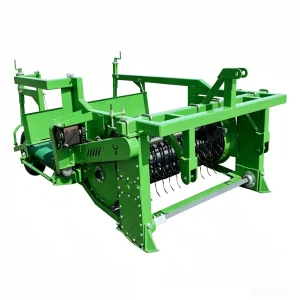
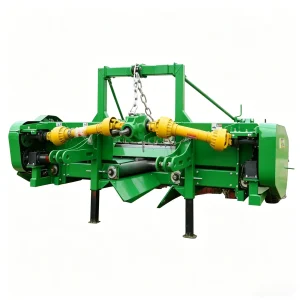
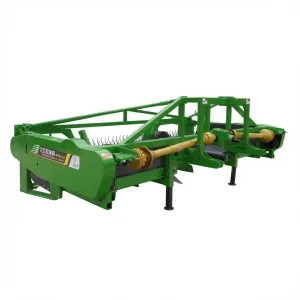
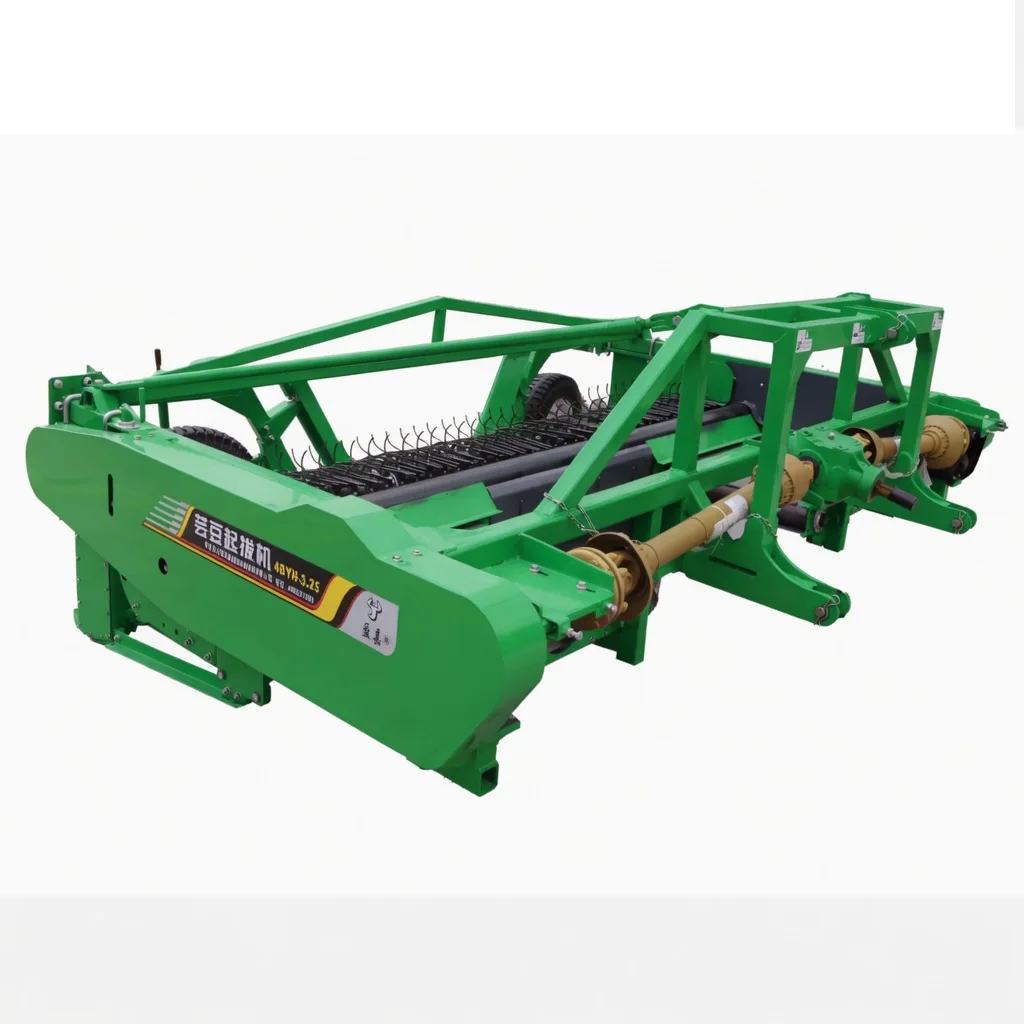
The 4BYH-3.25 kidney bean harvester is a tractor-mounted, rear-hitch legume uprooter engineered for farms managing 300 to 800 acres of dry beans per season. With a 3.25-meter (10.7 ft) working width and 5 spring-tine picking rows, this kidney bean harvester machine covers up to 3.25 hectares per hour (8.0 ac/h) — 25% more ground per pass than a standard 4-row unit, using the same 140–180 HP tractor and a single operator.
Designed as a bean combine harvester alternative for pull-and-windrow workflows, the 4BYH-3.25 lifts kidney bean, pinto, navy, and black bean plants from the soil with polymer-tipped spring tines that flex 8–12° under root resistance. This controlled deflection keeps pod shatter at or below 4% — well within food-grade contract tolerances. Whether you grow on Michigan sandy loam, Red River Valley clay, or Idaho furrow-irrigated silty loam, this dry bean harvester adapts to your soil profile without frame modifications.
Technical Specifications — Model 4BYH-3.25 Kidney Bean Harvester
Below are the verified factory parameters for this dried bean harvester. All values are measured under standard field-test conditions (flat terrain, sandy-loam soil, 12% pod moisture content).
| No. | Parameter | Unit | Value |
|---|---|---|---|
| 1 | Model | — | 4BYH-3.25 Kidney Bean Harvester |
| 2 | Hitch Type | — | 3-Point Rear Mount, Cat II / III |
| 3 | Pickup Type | — | Spring-Tine (Polymer Tips) |
| 4 | Number of Rows | rows | 5 |
| 5 | Working Width | m (ft) | 3.25 (10.7) |
| 6 | Required Tractor Power | kW (HP) | 103–132 (140–180) |
| 7 | Working Speed | km/h (mph) | 6–10 (3.7–6.2) |
| 8 | Working Dimensions (L×W×H) | mm | 3800 × 3400 × 1500 |
| 9 | PTO Speed | r/min | 540 |
| 10 | Wheel Track | mm (in) | 3,250 (127.9) |
| 11 | Areal Productivity | ha/h (ac/h) | 1.95–3.25 (4.8–8.0) |
| 12 | Operators Required | persons | 1 |
| 13 | Structural Mass | kg (lb) | 1,540 (3,395) |
| 14 | Pod Shatter Rate | % | ≤ 4 |
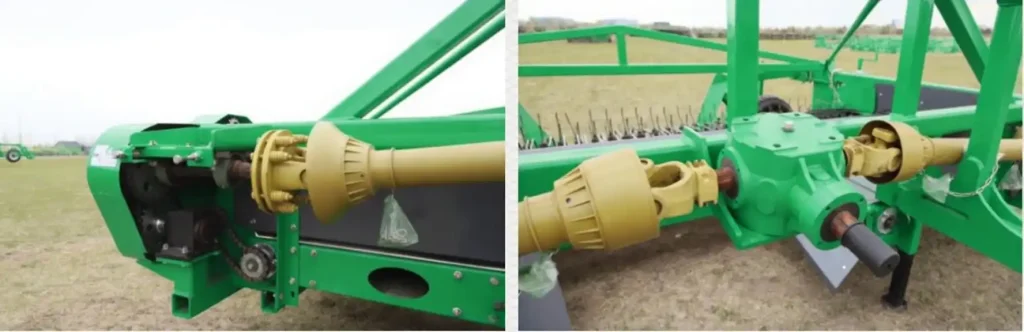
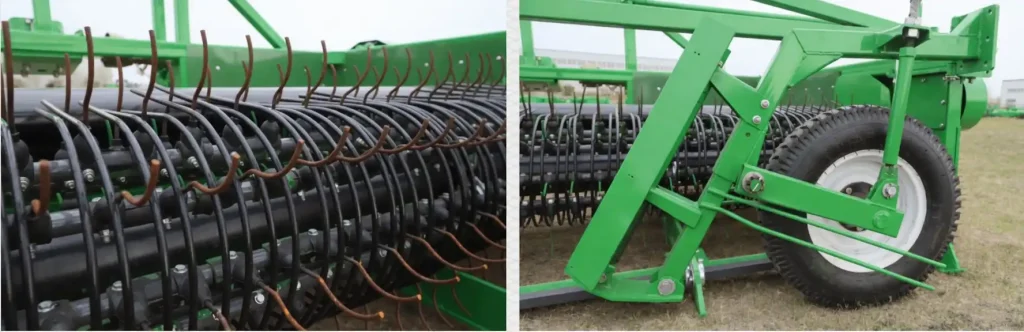
Model 4BYH-3.25 Kidney Bean Harvester Detail Gallery
The images below show the 4BYH-3.25 in field operation and close-up structural views.
Harvesting Problems This Kidney Bean Harvester Solves
Commercial dry bean growers face a narrow set of recurring problems during harvest. The 4BYH-3.25 kidney bean harvester was designed around measured field data from those problems — not marketing assumptions. Here is what it addresses and the specific numbers behind each solution.
1. Tight Harvest Windows and Weather Risk
In the U.S. Midwest and Northern Plains, the kidney bean harvest season runs primarily from late August through September. Commercial growers in North Dakota and Minnesota typically have a 15–25 day window before the first hard frost. A 4-row machine processing 500 acres at peak output (6.4 ac/h) needs roughly 78 tractor-hours. The 5-row 4BYH-3.25 completes the same 500 acres in approximately 63 hours — recovering 15 hours that can mean finishing before an October rain event instead of after it.
2. Labor Costs and Crew Availability
Manual or semi-mechanized bean uprooting requires 8–12 workers per 100-acre block. At current agricultural labor rates of $15–$18/hour in major U.S. bean-growing states, labor costs for a 500-acre operation can exceed $25,000 per harvest cycle. The 4BYH-3.25 needs one operator and one tractor — reducing field crew labor requirements by up to 70% and cutting per-acre labor cost to under $6.
3. Pod Shatter and Crop Loss
Rough handling during uprooting causes pods to crack and spill beans onto the ground. Industry data shows that conventional rigid-tine pullers lose 6–9% of crop value through pod shatter. The 4BYH-3.25’s polymer-tipped spring tines, flexing 8–12° under load, hold measured shatter rates at 3.2–4.0% in controlled field tests — keeping loss within the 5% maximum required by food-grade contracts.
4. Soil Variability Across Regions
Growers operating on multiple soil types — from Michigan’s Spinks sandy loam to North Dakota’s Fargo heavy clay — often need separate equipment setups. The 4BYH-3.25 accepts Cat II/III hitch configurations and operates effectively at adjustable speeds (6–10 km/h), allowing one machine to handle sandy, loamy, and clay-rich soils without part swaps.
5. Uneven Bean Quality from Inconsistent Uprooting
When uprooting depth varies row to row, beans arrive at the windrow with mixed maturity — some still root-attached, others over-shattered. The 4BYH-3.25’s 65 mm center-to-center tine spacing was calibrated against the abscission zone geometry of pinto and navy bean varieties, producing consistent lift depth across all 5 rows and uniform windrow quality that reduces downstream combine adjustments.
Applications: Where This Legume Harvester Performs
Kidney Bean Farms (300–800 ac)
Primary use case. Pinto, dark/light red kidney, navy, and black bean stands on flat to gently rolling terrain. Compatible with 140–180 HP row-crop tractors common in the Midwest fleet.
Contract Harvesting Services
Operators servicing multiple growers benefit from the 8.0 ac/h peak throughput. One 4BYH-3.25 can replace two 2-row machines and cover client acreage faster with lower transport overhead between sites.
Multi-Crop Legume Operations
Beyond kidney beans, the spring-tine mechanism handles soybeans (including edamame), white beans, pinto varieties, and fava beans. Adjustable drum speeds and tine clearance accommodate different pod sizes.
Export-Grade Bean Production
Operations shipping to international markets (Canada, EU, Japan) need consistent sample quality. The ≤4% shatter rate and uniform windrow formation reduce the number of split or damaged beans reaching the cleaning line.
Why Source Your Kidney Bean Harvester From Us
We are not a general trading company reselling catalog equipment. We manufacture the full 4BYH series of bean pullers, round balers, mowers, and hay rakes under one roof — which means the engineering team that designed your harvester is the same team that supports it after delivery. Here is what that means in practice:
From the 2-row 4BYH-1.3 (40 kW) to the 6-row 4BYHD-3.9 (132–147 kW), we match the machine to your tractor fleet and acreage — not the other way around.
Every model runs on 540 r/min PTO — the universal standard in North American, South American, and European tractor fleets. No adapters needed.
Wear parts (tine assemblies, share tips, bracket bolts) ship within 48 hours from our warehouse. During the September–October harvest peak, we pre-stock the 12 most-replaced components for immediate dispatch.
Your purchase includes direct access to our product engineer team — not a call-center script. Field-setting recommendations, tine replacement intervals, and soil-specific speed calibration are provided on request.
Frequently Asked Questions
Q1: What tractor horsepower does the 4BYH-3.25 kidney bean harvester require?
The machine requires 103–132 kW (140–180 HP) at the PTO. It attaches via a standard Category II or Category III 3-point rear hitch. If your tractor runs a 540 r/min PTO and its rear lift capacity exceeds 2,000 kg, it is compatible. Most mid-range row-crop tractors from major manufacturers (John Deere 6R/7R, Case IH Maxxum/Puma, New Holland T6/T7) fall within this power range.
Q2: When is kidney bean harvest season, and how does timing affect machine performance?
In the major U.S. dry bean growing regions — North Dakota, Minnesota, Michigan, Idaho, and Nebraska — the kidney bean harvest season typically runs from late August through late September, approximately 100–140 days after spring planting. Optimal harvest moisture for dry kidney beans is 16–18%. Harvesting too late risks pod shatter from over-drying; harvesting too early means higher moisture content that requires additional drying cost. The 4BYH-3.25 operates most efficiently when vines are well-cured but still slightly pliable (not brittle). In early-morning dew conditions or after light rain, reduce working speed to 6–7 km/h to maintain the ≤4% shatter target.
Q3: Can this dry bean harvester handle crops other than kidney beans?
Yes. The spring-tine mechanism processes pinto beans, navy beans, black beans, white beans, soybeans (including edamame), and fava beans. Tine clearance and drum speed are adjustable for different pod sizes. Growers rotating kidney beans with soybeans or pintos use the same machine across both crops without part changes — only ground speed and tine depth settings need adjustment.
Q4: How does the 4BYH-3.25 perform in heavy clay soils?
In heavy clay regions like the Red River Valley (Fargo and Bearden soil series), the outer shares experience higher lateral load than in sandy loam. We recommend reducing ground speed to 6–8 km/h and inspecting bracket welds at every 150-acre interval. For operations exceeding 1,000 acres per season on heavy clay, consider upgrading to the 6-row 4BYHD-3.9, which distributes lateral force across a wider frame. On sandy loam (Michigan Thumb, Nebraska Panhandle), the 4BYH-3.25 runs comfortably at 8–10 km/h with standard depth settings.
Q5: What maintenance does the machine need during the harvest season?
Daily: visually inspect all 5 tine rows for bent or missing tips (takes 10 minutes). Every 50 acres: check share tip wear on outer rows (the two outside rows wear 20–30% faster than center rows in abrasive soils). Every 150 acres: grease all pivot points, check PTO driveline U-joints, and inspect hitch pin play. The polymer tine tips are a consumable wear part; carry a box of 20 spares per 300-acre block. Replacing a single tine takes under 5 minutes with a 19 mm wrench — no special tools required.
What Growers Say About the 4BYH-3.25 kidney bean harvester
“We switched from a 4-row puller to the 4BYH-3.25 in 2024 and recovered the cost difference in the first season. We finished our 520 acres 12 hours earlier — which meant we didn’t have to pay the overtime rate for the combine crew waiting on windrows. Shatter was under 4% across the whole run. The tine replacement is dead simple. I keep 30 spares on the trailer and swap them in the field without leaving the headland.”
“My neighbor told me I was crazy buying a Chinese-made bean puller instead of the brand everybody uses. After he watched me finish my harvest two full days before him while he was still swapping knife sections in the mud, he asked me for the supplier’s number. Now we’re both ‘crazy.’ This machine doesn’t care about your brand loyalty — it just pulls beans, gently, all day, and doesn’t complain about overtime.”
Pair With These Products for a Complete Harvest Workflow
The 4BYH-3.25 is one stage in the dry bean harvest chain. Here are the companion machines that integrate with it to form a full field-to-storage workflow:
Hay Rake (9GL Series)
Why pair it: After the 4BYH-3.25 uproots and lays bean vines into a windrow, the vines need to dry uniformly before combine pickup. A trailed finger-wheel hay rake gently turns and re-forms the windrow without aggressive handling. This speeds vine drying by 8–12 hours in humid conditions and reduces the number of wet-vine plugging events at the combine header. The 9GL-5.0/5.6 rake covers a 5.6 m working width — wide enough to consolidate two 4BYH-3.25 windrow passes into one combine pass.
Mower Conditioner (9GQY-3.2)
Why pair it: On operations that rotate kidney beans with forage crops (alfalfa, grass hay), a mower conditioner handles the non-bean acreage during the rest of the year. Running the same tractor with the 4BYH-3.25 kidney bean harvester in September and the 9GQY-3.2 from May through August maximizes your power unit’s annual utilization — spreading the ownership cost of a 140–180 HP tractor over two revenue-generating implements instead of one.
Round Baler (9YG-1.25 / 9YG-2.24D)
Why pair it: After the combine threshes the dry beans from the windrow, the remaining vine residue can be baled as livestock bedding or low-grade roughage feed. A round baler processes this residue in the same field pass, clearing the field for fall tillage or cover-crop seeding. Baled bean straw typically sells at $25–$40 per ton in Midwest livestock markets — turning a waste stream into supplemental revenue.
Ready to Upgrade Your Dry Bean Harvest?
Whether you need a 2-row puller for 150 acres or a 6-row machine for 1,000+, our engineering team will match the right model to your tractor fleet, soil type, and acreage. Request a quote today — include your tractor model and target acreage for the most accurate recommendation.
Response time: within 12 business hours
Explore Our Full Equipment Lineup
We manufacture a complete range of agricultural machinery for hay, forage, and crop operations. If you are building or expanding a mixed-use farm equipment fleet, these product series pair with the kidney bean puller line:
- Round Baler Series
- Hay Rake Series
- Mower Series
- Hydraulic Reversible Plow
- Silage Baler-Wrapper Combo
- Forage Feed Crusher
- Round Bale Transporter
- Finger Wheel Tedder
Every machine ships with operator documentation, a recommended spare-parts kit, and direct engineer support. Contact our sales team to build a multi-product quote and unlock volume pricing.