คำอธิบาย
Product Brief of 9YG-2.24D Round Hay Baler
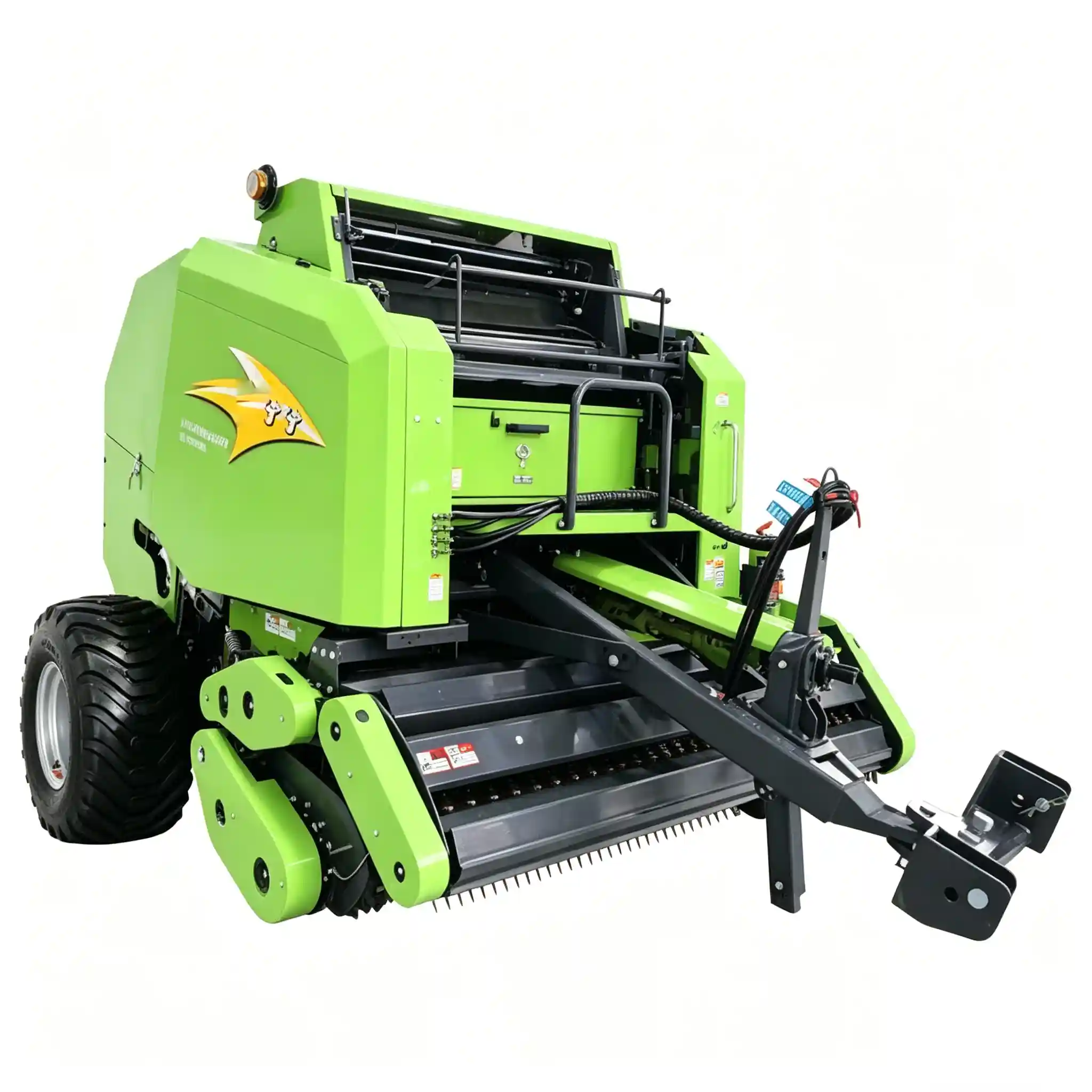
The 9YG-2.24D Round Hay Baler is the latest mid-class trailed round baler in our 9YG series, engineered specifically for crop residue and forage operations across corn, rice, wheat, soybean, and grass forage. With a 2,240 mm spring-tooth pickup, 18-roller fixed-chamber compression system, and the patented axial-flow semi-forced feeding mechanism developed and protected by our R&D team, this is a hay baling machine built for high-volume professional operators.
What separates the 9YG-2.24D from generic round hay balers in the same power class is the elimination of the cam-and-guard pickup system used in traditional designs. The axial-flow feeder pushes material along the rotation axis rather than perpendicular to it — the practical effect is roughly 2× the field efficiency per unit of tractor horsepower compared with conventional balers, lower power consumption per bale, and a markedly reduced rate of clogging in dense or moist crop windrows.
For B2B buyers searching round hay baler manufacturers with proven engineering and direct factory pricing, the 9YG-2.24D produces 100–200 kg/m³ density bales (φ1,300 × 1,400 mm) at 40–100 bales/hour, with sensor-controlled regulation that holds output uniform across the run. It pairs cleanly with 75–135 HP tractors — the broadest segment of the world’s working farm fleet.
9YG-2.24D Round Hay Baler Technical Specifications
Factory-verified parameters for the 9YG-2.24D trailed round hay baler.
| Parameter | Specification |
|---|---|
| Model | 9YG-2.24D Round Baler |
| Hitch Type | Trailed |
| Pickup Width | 2,240 mm |
| Pickup Type | Spring-tooth (cam-less, no-guard) |
| Feeding System | Axial-flow tine roller + drum (patented) |
| Bale Chamber Type | Roller (fixed-chamber) |
| Chamber Width | 1,400 mm |
| Chamber Diameter | φ 1,200 mm |
| Compression Rollers | 18 rollers, φ 222 mm each |
| Binding System | Net wrap |
| Required Tractor Power | 55–100 kW (75–135 HP) |
| Net Weight | 3,922 kg |
| PTO Speed | 720 r/min |
| Overall Dimensions (L×W×H) | 4,110 × 3,010 × 2,450 mm (working state) |
| Density Control | Sensor-regulated |
| Bale Size (Diameter × Width) | φ 1,300 × 1,400 mm |
| Bale Density Range | 100–200 kg/m³ |
| Productivity | 40–100 bales / hour |
| Wheel Track | 2,600 mm |
| Working Speed | 5–35 km/h |
| Net-Wrap Spec (L × W per bale) | 2,000 × 1.4 m / bale |
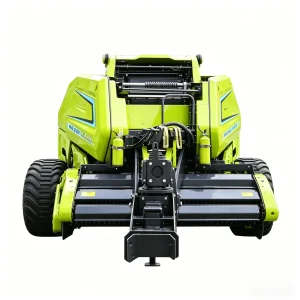
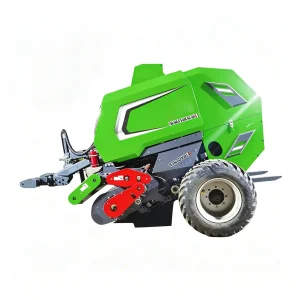
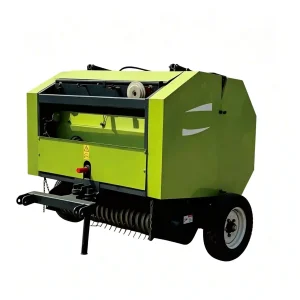
Product Gallery of 9YG-2.24D Round Hay Baler
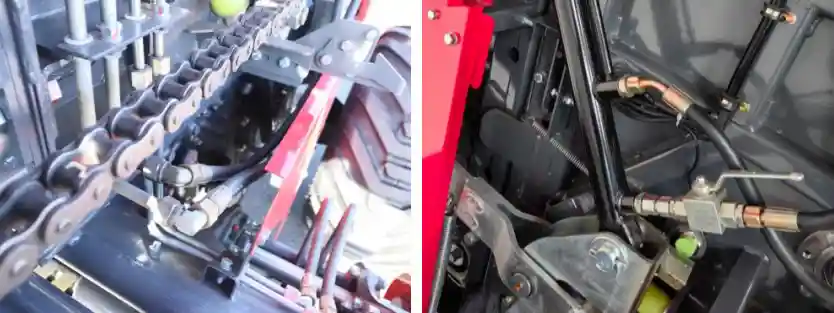
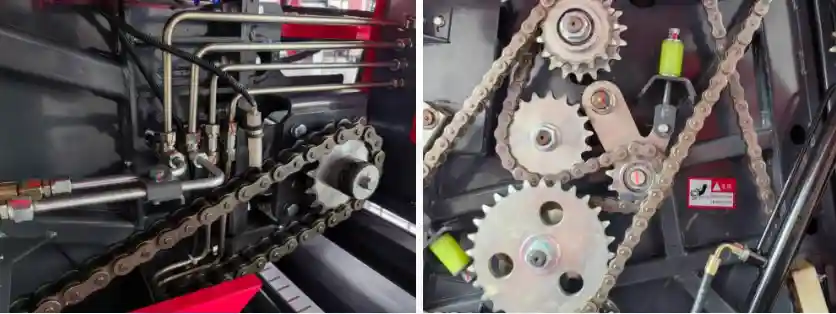
Field Applications
The 9YG-2.24D round hay baler hits the sweet spot of the global tractor market — most working tractors fall in the 75–135 HP range. With 5–35 km/h working speed, near-doubled efficiency from the axial-flow feeder, and bale weight up to 380 kg per unit, the addressable applications are wide:
Wheat & Cereal Straw
PTO-driven round straw baler machine for wheat straw is one of the highest-volume use cases. The cam-less pickup runs over windrowed straw cleanly without dragging stones into the chamber.
Corn Stover Recovery
Pre-windrowed corn stover bales at densities up to 200 kg/m³ for biomass and bedding markets. Soybean residue handles equally well thanks to the no-bridging feeder.
Rice Straw & Paddy
2,600 mm wheel track distributes load evenly on soft paddy soil. Lighter chassis (3,922 kg) leaves shallower tracks than heavy 120 HP-class units.
Alfalfa & Lucerne Hay
Axial-flow feeding produces minimal leaf shatter — protein-grade hay markets reward this consistency. Bale density set at 130–150 kg/m³ for premium dairy hay.
Grass Forage & Silage
Density at 100–115 kg/m³ produces silage-grade bales. Pair with a wrapper for fermentation-ready haylage. Net-wrap binding seals shape under stretch film.
Contract Baling Services
Wide tractor-power compatibility (55–100 kW) opens the addressable contractor market. Higher field efficiency per fuel unit improves margin per bale.
Features of Round Hay Balers
These are the engineering choices that distinguish the 9YG-2.24D from generic round hay balers in the same price tier:
- A
Patented Axial-Flow Feeder
Material flows along the tine roller’s rotation axis — not perpendicular to it. This eliminates the cam-and-guard system of traditional balers, reduces power demand, and increases feed rate. Independent IP of our R&D team.
- B
~2× Field Efficiency
Comparative trials against conventional cam-pickup balers showed roughly 2× throughput per unit of tractor power. Translation: more billable acres per fuel tank, fewer days in the field per harvest cycle.
- C
Reduced Clogging Probability
The semi-forced feeding action keeps material moving forward into the chamber, eliminating bridging and choke-points that plague traditional balers in dense or moist windrows. Fewer chamber stops = more bales per hour.
- D
18-Roller Compression Chamber
18 rollers at φ222 mm distribute compression evenly across the bale circumference. Outer shell density blocks weather damage; inner core stays breathable to prevent silage hot-spots.
- E
5–35 km/h Working Speed Range
Wide speed band lets the operator match field pace to crop density — slow on heavy lucerne windrows, fast on light cereal straw — without losing bale shape consistency.
- F
Sensor-Regulated Density
Pressure sensors monitor compression in real time. Operators set a target density on the controller (100–200 kg/m³); the system holds output uniform across the run regardless of moisture or crop variation.
Automatic String Tie vs Net-Wrap Round Baler
The 9YG-2.24D ships with net-wrap binding as standard. Comparing both technologies side-by-side on the points that matter for production output:
| Performance Metric | String Tie (Twine) | ★ Net Wrap (Standard) |
|---|---|---|
| Wrap Time per Bale | 25–30 seconds | 6–8 seconds |
| Consumable Cost / Bale | ~$0.30 (sisal twine) | ~$0.60–$0.80 (UV net) |
| Bale Shape Retention | Moderate (sag in storage) | High (mesh hugs cylinder) |
| Leaf Retention | Lower (more rotations) | Higher (fewer rotations) |
| Outdoor Storage Resistance | Limited (moisture wicks in) | Strong (UV-stable mesh) |
| Best Use Case | Smaller-volume, indoor storage, biodegradable preference | Volume operations, outdoor storage, silage prep |
Bottom line: Net wrap costs an extra $0.40 per bale on average but saves 22 seconds per cycle. At 100 bales/hour throughput that’s 37 extra minutes of baling time recovered every working hour — payback within the first season for any commercial operation.
Why Choose Our Round Hay Baler Supplier
▸ Patented IP
Proprietary Axial-Flow Design
The axial-flow feeder is our independent intellectual property. You won’t find this technology on generic balers from trading-company resellers.
▸ Direct Factory
No Middle-Man Margin
As one of the established round hay baler manufacturers in our region, we ship factory-to-customer. Wholesale and single-unit pricing both follow the same factory schedule.
▸ Certification
CE & ISO 9001
Every unit ships with QC records, CE marking, and certificate of origin. Our trade team handles export documentation for any destination country.
▸ Lead Time
15–20 Day Build
Standard customization (color, decals, logo) is built into the production cycle. Sea freight to most ports adds 25–40 days. Air-freight on parts is available.
▸ Warranty
12-Month Coverage
Full warranty on driveline, gearbox, structural welds, and chamber components. Same-day technical support via WhatsApp and email on weekdays.
▸ Global Reach
30+ Country Footprint
Our balers are deployed across Russia, Mongolia, Australia, EU markets, Southeast Asia, and Latin America. Established export references on request.
Frequently Asked Questions
Q1. Is this the best round straw baler for small tractors (25-50 HP)?
The 9YG-2.24D requires 55-100 kW tractors and is not suited for the 25-50 HP range. For small tractors, ask about our compact 9YG-1.0 series or mini-baler line. We will match the correct baler to your tractor model — send us your tractor specs.
Q2. What does industrial round straw baler maintenance and spare parts coverage look like?
Routine maintenance covers daily greasing of pickup bearings, weekly chain tension checks, and seasonal gearbox oil changes. We stock genuine spare parts (claws, bearings, belts, net-wrap rolls) with worldwide air-freight available for harvest emergencies.
Q3. What tractor specifications are required?
A tractor with 55–100 kW (75–135 HP) at the PTO and a standard 540 RPM PTO output. Compatible models include John Deere 6M, Case IH Maxxum, New Holland T6, Massey Ferguson 5700, Kubota M-series, Mahindra Arjun, and equivalent. Hydraulic outputs are required for the rear-gate cylinder.
Q4. How does the axial-flow feeder differ from a traditional cam pickup?
Traditional balers use a cam-and-guard system that lifts crop perpendicular to the tine roller axis — this creates choke-points and consumes power. The axial-flow design moves material along the rotation axis, eliminating the cam mechanism, lowering power demand, and roughly doubling field efficiency.
Q5. How heavy is each finished bale?
A φ 1,300 × 1,400 mm bale at 100 kg/m³ density weighs approximately 186 kg (silage-grade). At 200 kg/m³ density it reaches around 372 kg (dry hay or straw). Density target is set on the sensor controller before each run.
Customer Feedback
We pulled it behind a 95 HP Case IH on 220 hectares of wheat straw. Field efficiency was visibly higher than our previous baler — net-wrap cycles completed faster and the chamber stayed clean even on the dustier cuts. Density readings held steady at 175 kg/m³.
— Andriy K., Wheat Operation, Poltava 🇺🇦
Salesman said “axial-flow.” I said, “fancy word, just give me bales.” Now my field is bales, my barn is bales, my neighbor’s field is bales because I bought too much net-wrap and got bored. My old baler is currently in the shed reading the want ads. Five stars and a tip of the hat.
— Hank R., Cattle & Hay, Wyoming 🇺🇸
Our co-op runs the 9YG-2.24D across five member farms. The wide tractor compatibility (we have everything from 80 to 130 HP) means it pairs without modification. Throughput at full pace is 90+ bales/hour on cereal straw — meaningfully higher than our previous unit.
— Pavel V., Farming Co-op, Plzeň Region 🇨🇿
Equipment That Pairs With the 9YG-2.24D
A round baler is one stage in a five-step forage and crop-residue workflow. Skip a stage or mismatch widths and the baler ends up waiting on the slowest tool. Here is the proven sequence:
Mower
Cuts standing forage at field-edge moisture. Sets the foundation for clean drying.
Tedder
Spreads cut hay for even drying. Cuts dry-down time 30–40%.
★ Round Baler
9YG-2.24D — compresses and net-wraps into 186–372 kg bales.
Wrapper / Handler
Wraps silage bales for fermentation, or moves bales to storage.
Pairing logic: The 9YG-2.24D’s 2,240 mm pickup is sized for windrows formed by mid-frame rakes. For silage bale production, pair with a wrapper — wet silage at 50%+ moisture must be wrapped within 2–4 hours of baling. Buying matched-capacity equipment in one purchase order keeps the workflow bottleneck-free across all five stages.