
Operation & Maintenance Series — U02
How to Operate a Square Hay Baler: Field Speed, Pickup Height & Bale Density Settings
The decisions you make in the first ten minutes in the field — speed, pickup height, density — determine the quality of every bale you produce that day. Here’s how to get each setting right for your crop and conditions.
Experienced baler operators adjust their field settings instinctively — they watch the windrow, listen to the machine, and feel through the tractor seat whether the baler is working within its design parameters. New operators don’t have that instinct yet, and the gap shows up in inconsistent bale density, knotter failures, and windrow losses that better technique would prevent.
This guide translates the instinct of experienced operators into adjustable parameters — field speed, pickup height, bale density — so you can set the machine correctly from the first pass and adjust systematically when conditions change.
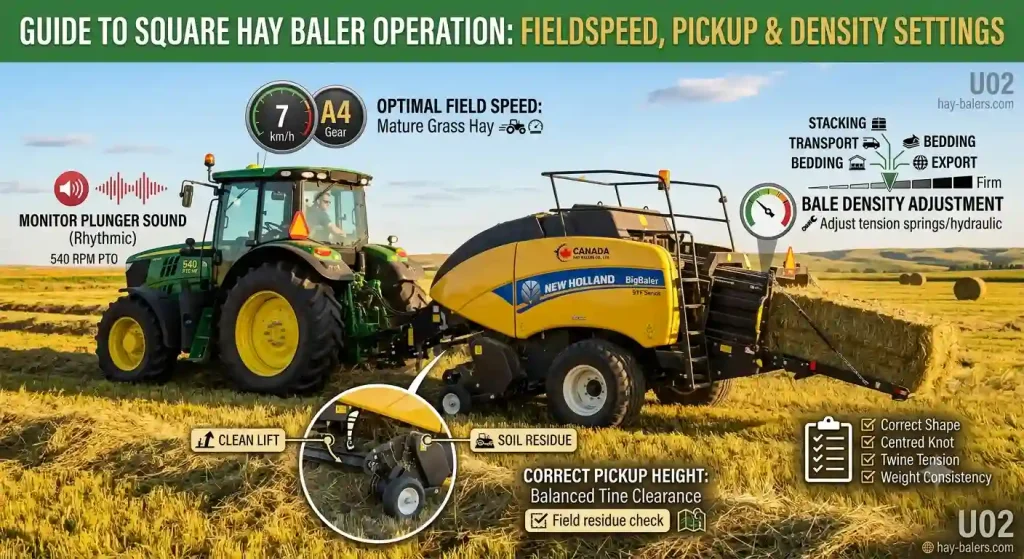
Before Entering the Field: Starting PTO and Speed
Start the baler’s PTO before you enter the windrow, not after. Engaging the PTO into a cold drive train with crop already in the pickup creates an instant overload condition — the plunger must compress whatever is already in the chamber plus the sudden drive engagement. Bring the PTO to 540 RPM in an open area, confirm the machine sounds normal, then drive into the windrow at a controlled entry speed.
Maintain a consistent engine speed throughout the baling run. The plunger’s compression force and the knotter’s timing are designed for a specific PTO speed range around 540 RPM. Allowing engine speed to drop under load — which happens when operators try to maintain ground speed through heavy material with an underpowered setup — produces inconsistent bale density and increased knotter stress.
Field Speed: The Primary Control Variable
Ground speed controls how much crop enters the baler per unit of time. Too fast, and the feed system overloads — material bunches in the auger, plunger load spikes, and the risk of a blocked feed channel rises. Too slow, and the bale chamber underfills per plunger stroke, producing loose, low-density bales that don’t hold their shape in storage or transport.
Recommended field speed ranges by crop type and condition:
| Crop / Condition | Recommended Speed | Notes |
|---|---|---|
| Mature grass hay, light windrow | 7–9 km/h | Standard operating range — machine well within capacity |
| Grass hay, heavy or consolidated windrow | 5–7 km/h | Reduce speed to avoid feed system overload |
| Alfalfa, early to full bud | 5–6 km/h | Slower speed critical for leaf retention |
| Wheat / barley straw, dry | 6–8 km/h | Straw feeds more evenly than hay — slightly higher speed feasible |
| Wet or recently rained crop | 3–5 km/h | Slow significantly — wet crop blocks easily and strains the feed system |
The practical indicator of correct field speed is the sound of the plunger. A baler running at the right speed in the right crop produces a steady, rhythmic compression sound at consistent intervals. Irregular intervals — fast then slow — indicate the feed volume is uneven and speed should be reduced. A continuous heavy laboured sound indicates the machine is working at or beyond its capacity and speed must come down.
Pickup Height: Getting It Right for Your Field
Pickup height — the clearance between the pickup tine tips and the soil surface — is adjusted using the gauge wheels or skid shoes that support the front of the pickup reel. It controls two things simultaneously: how completely the pickup lifts the windrow, and how much soil contamination enters the bale.
The correct height is a balance between these two factors:
- Too low: Tines contact the soil, digging in on soft ground or frost heaves. This picks up soil and rocks into the bale, contaminating hay with sand and grit. For equine hay, soil contamination is a critical quality defect. For baler longevity, rocks through the pickup are a damage risk.
- Too high: Tines miss the lower portion of the windrow, leaving hay on the field. In alfalfa, this disproportionately means leaving the leaf fraction — which settled to the bottom of the windrow during curing — on the ground. Loss of leaf fraction is a direct loss of nutritional value.
The profile-wheel ground-following design on our 9YF series helps maintain consistent pickup height across uneven terrain without constant operator adjustment — the wheels follow ground contour changes and the pickup floats relative to the surface rather than being set at a fixed height. On the first pass through a new field, run at a conservative height setting and adjust based on what’s left on the ground behind the machine.
Field Check for Correct Pickup Height
After the first few passes, stop and walk back 20–30 metres along the row you just baled. Look at the ground: if there’s visible hay residue remaining in the wheel tracks and on the soil surface between tracks, the pickup is running too high. If you see soil streaks or the tines are leaving marks in the ground, it’s running too low. Adjust one setting and re-check.
Bale Density: Adjusting for Your End Use
Bale density — how tightly the crop is compressed — is controlled by the tension setting on the bale chamber spring or hydraulic tension system. Higher tension produces denser, firmer bales; lower tension produces lighter, softer bales.
The right density setting depends on what you’re doing with the bales:
Hand-fed livestock hay
Medium-firm density
Bale should hold its shape when stacked, but flakes should separate cleanly when the twine is cut. A bale that’s too dense is difficult to break open at the feeding point.
Transport and commercial sale
Firm density
Bales moving on trucks and through distribution need to hold their shape under stacking load and movement. Firm density reduces dimensional variability and improves stack stability.
Bedding straw
Medium density
Straw for bedding doesn’t need to hold its nutritional structure — it needs to spread easily when opened. Overly dense straw bales are harder to open and distribute in barn bedding operations.
Export market
High density
Export buyers loading containers want maximum dry matter per shipping unit. High-density bales allow more tonnes per container and reduce per-tonne freight cost — a key factor in export market competitiveness.
Reading the Bale: In-Field Quality Check
Every bale that comes out of the machine tells you something about how the machine is performing. Check the first 10–15 bales from a new field entry before settling into a full-speed run:
- Consistent shape: Square corners and flat sides indicate even plunger loading. Tapered or barrel-shaped bales indicate uneven feed — one side of the chamber loading more than the other.
- Knot position: Knots should sit centred on each face of the bale, equidistant from top and bottom. Knots pulled to one side indicate the needle stroke is misaligned or the twine disc is not feeding correctly.
- Twine tension: Press the twine with your finger at the midpoint of each face. Correct tension feels firm — the string doesn’t deflect more than 10–15 mm under moderate hand pressure. Loose twine indicates under-tensioned knotters.
- Weight consistency: Lift consecutive bales and compare. A significant weight variation between adjacent bales indicates uneven windrow feeding or a density setting that’s too sensitive to windrow variation.
For product support and to view our full range of square balers, visit hay-balers.com/square-hay-balers. Technical questions about field settings and adjustments can be directed to [email protected].
Canada Hay-Balers Co., Ltd
10055 Hogarth Dr, Richmond, BC V7E 3Z9 | [email protected]
Editor:WM