Beskrivning
Model: 9LH-12 |
Type: Trailed, Transverse Side-Delivery |
Power: 25–44 kW (35–60 hp) |
Working Width: 12 m |
Productivity: 6–12 hm²/h
What Is the 9LH-12 Trailed Hay Rake & How Does It Work?
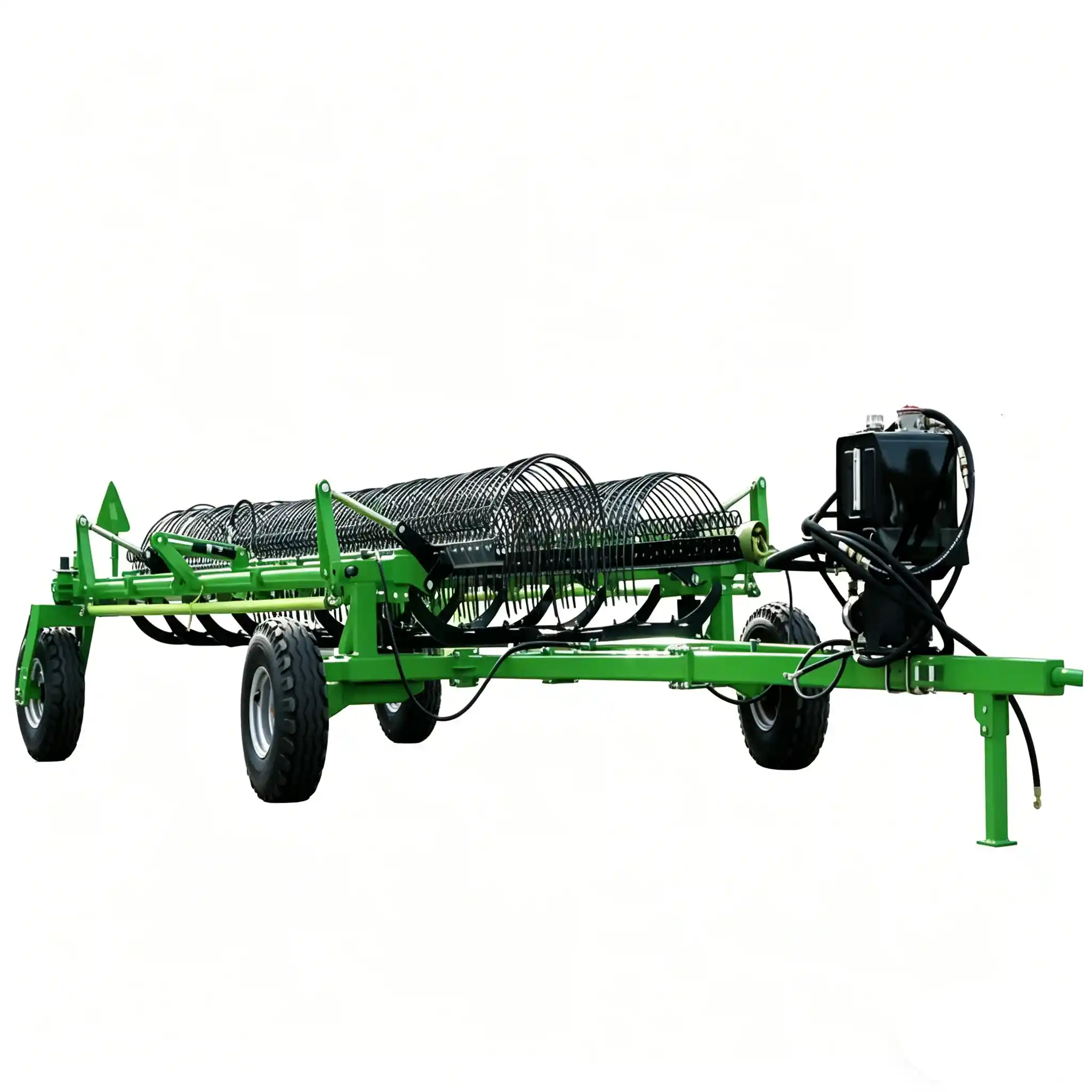
The 9LH-12 trailed hay rake is a wide-working, tractor-towed side-delivery rake designed to gather previously cut grass into organized windrows perpendicular to the direction of travel. Powered by any wheeled tractor rated 25–44 kW (35–60 hp), it covers a 12 m working width in a single pass — delivering 6–12 hm²/h of productive raking output that makes it one of the highest-throughput options available in the trailed rake category for large natural grassland operations.
The operating principle is straightforward: as the tractor tows the machine at 5–10 km/h, the 168-tine rake head sweeps cut grass across the full 12 m working width and deposits it in a transverse windrow — a row running perpendicular to the tractor’s forward path. Windrow size is adjustable by the operator to match the productivity of the downstream baling equipment: a thinner windrow for small square balers; a denser, wider row for high-output round balers. The rake assembly raises and lowers via the tractor’s hydraulic lever and cylinder — no manual adjustment, no dismounting. The tine mechanism is designed to fluff and elevate the grass as it collects, producing an aerated, loose windrow that dries faster than compacted rows.
This 9LH-12 trailed side-delivery rake with 12 m working width is purpose-built for large-area natural grassland and planted forage fields. At peak speed (10 km/h), a single machine covers 12 hm²/h — enough to rake 90+ hm² in a standard 8-hour shift. The machine’s tine action is gentle enough to leave grass roots undisturbed in the soil, protecting regrowth potential for subsequent cutting cycles. One operator handles the entire process from the tractor cab.
Best suited for: Large flat or gently sloping natural grasslands and planted forage fields. Not recommended for paddy fields, dense rocky terrain, steep hillsides, or areas with heavy debris that could damage the tine array.
Technical Specifications — 9LH-12 Side-Delivery Rake
| # | Parameter | Unit | Specification |
|---|---|---|---|
| 1 | Model Name | — | 9LH-12 Trailed Side-Delivery Hay Rake |
| 2 | Structural Type | — | Tractor-Driven Transverse Side-Delivery |
| 3 | Hitch Type | — | Trailed (Tow-Behind) |
| 4 | Required Tractor Power | kW | 25–44 |
| 5 | Working Width (Rake Width) | m | 12 |
| 6 | Working Speed | km/h | 5–10 |
| 7 | Productivity | hm²/h | 6–12 |
| 8 | Number of Rake Tines | pcs | 168 |
| 9 | Operators Required | persons | 1 |
| 10 | Machine Weight | kg | 1510 |
| 11 | Missed Raking Rate | ≤ | 3% |
| 12 | Dimensions — Working State (L×W×H) | mm | 5500 × 12000 × 1350 |
| 13 | Dimensions — Transport State (L×W×H) | mm | 9400 × 3400 × 1750 |
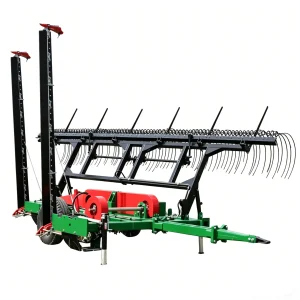
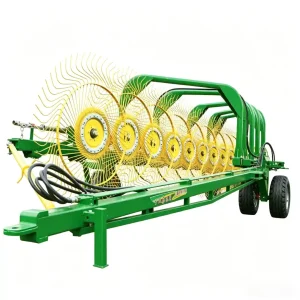
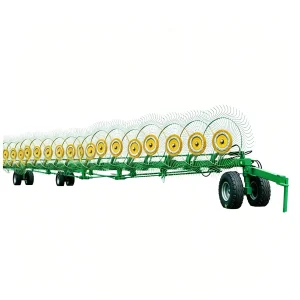
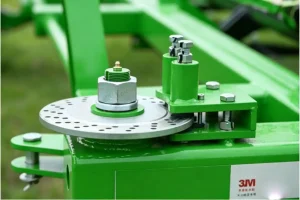
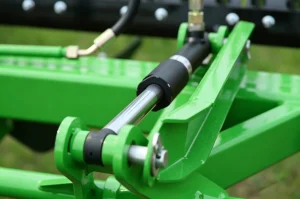
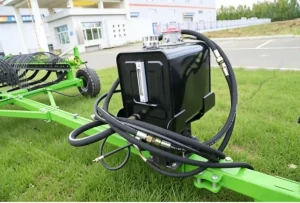
Product Detail Gallery
6 Performance Advantages of the 9LH-12 Trailed Hay Rake
12 m Side-Delivery Rake Width — Up to 12 hm²/h in a Single Pass
The 12 m working width is the defining specification of this side-delivery rake. At 10 km/h working speed, one machine covers 12 hm² per hour — 90+ hm² in a standard 8-hour shift. Compared to 4–6 m rakes common in the mid-range category, the 9LH-12 covers 2–3 times the area per hour with the same tractor and the same single-operator labor input. For commercial hay operations running under weather windows, this throughput difference directly determines whether a full cut is raked before rain arrives.
168 Tines — ≤3% Missed Raking Rate Across the Full Width
One hundred sixty-eight rake tines working across the full 12 m width achieve a certified missed raking rate of 3% or less. This means 97%+ of cut material is collected into the windrow on the first pass — reducing field losses and maximizing recoverable dry matter per hectare. At a typical alfalfa yield of 4–6 t/hm², a 3% collection loss floor means under 180 kg/hm² is left behind — acceptable for commercial operations, and competitive with the best side-delivery rake designs on the international market.
Adjustable Windrow Size — Operator-Controlled to Match Downstream Equipment
The operator controls windrow density from the cab to match the capacity of the baling equipment following behind. A denser, consolidated windrow feeds high-output round balers efficiently; a lighter, more spread row suits lower-capacity square balers or slow-drying conditions where additional airflow through the crop is needed before baling. This adjustability prevents the most common baler feed problem on large operations: a windrow that is either too large to feed smoothly or too thin to maintain consistent bale density.
Fluffy, Aerated Windrow — Faster Field Drying, Root Crown Undamaged
The tine action lifts and aerates the grass as it sweeps, depositing a loose, fluffy windrow rather than a compressed mat. Aerated windrows dry 20–35% faster than compacted rows in equivalent weather conditions — a meaningful difference when the harvest window is 2–3 days. The tine sweep is designed to collect at leaf and stem level without disturbing the soil surface, leaving grass root crowns fully intact for regrowth. This is particularly important on natural prairie, where root crown damage from aggressive raking reduces the following season’s yield density.
Hydraulic Rake Lift — Full Cab Control, No Manual Adjustment
The rake head raises and lowers via the tractor’s hydraulic lever and cylinder. The operator lifts the rake at field headlands, clears soft spots or drainage features mid-field, and sets working height from the cab without dismounting. On a 12 m wide machine making 20+ headland turns per hour, cab-based hydraulic control eliminates the dead time that manual lift mechanisms create — typically 15–25 minutes per operating shift on a large open field.
35–60 hp Tractor Requirement — Efficient on Modest Prime Movers
Despite its 12 m working width and 1510 kg machine weight, the 9LH-12 trailed hay rake only requires 25–44 kW (35–60 hp) — a power demand that the large majority of mid-range wheeled tractors already on-farm can meet. Raking applies less mechanical resistance than cutting or tillage, which is why a relatively modest tractor can drive a 12 m rake at full rated speed without working near its power limit. Lower engine load means lower fuel consumption per hectare raked.
Where the 9LH-12 Trailed Side-Delivery Hay Rake Performs Best
The following applications reflect the field conditions where this trailed hay rake for farm use consistently achieves its rated productivity and collection efficiency:
- Large-area natural grassland (100–1000+ hm²): This is the primary target market for the 9LH-12. At 6–12 hm²/h, it is the correct scale for commercial natural prairie operations where raking must keep pace with a high-output mower fleet. The transverse windrow pattern suits large open fields with long straight runs.
- Commercial forage farms running time-sensitive harvest windows: In regions where weather windows for hay harvesting are 2–4 days, the 12 hm²/h peak throughput allows a single machine to clear 90+ hm² per shift. Narrower rakes at 4–6 m cover 30–60 hm²/shift under the same conditions — a meaningful gap when rain arrives on day 3.
- Planted forage crops after tedding (alfalfa, ryegrass, clover): After the Tedder spreads the mowed crop for drying, the 9LH-12 consolidates the dried material into windrows sized for the downstream baler. The adjustable windrow density makes it flexible across different crop weights and baler models.
- Operations pairing with high-output round balers: The 9LH-12’s peak raking rate of 12 hm²/h matches the output of multiple round balers operating in parallel. A single rake can keep 2–3 standard round balers continuously supplied with windrows without creating a raking bottleneck in the harvest chain.
- Contract raking and custom harvesting services: The compact transport dimensions (9400 × 3400 × 1750 mm) allow road movement between client sites. One machine can service multiple large farms in a region during the harvest window, making it a viable investment for custom operators.
Terrain limitations: Best results on flat to gently sloping terrain. Avoid operation on heavily stoned ground, steep hillsides, paddy fields, wetlands, or areas with dense undergrowth that could tangle in the 168-tine array.
Why Choose Our Side-Delivery Rake — Key Numbers at a Glance
All figures are taken directly from the certified product specification sheet — not estimated catalog values:
Every unit ships with full English operating documentation, a complete spare parts list, and export documentation for international buyers. Tine replacement parts are stocked for fast dispatch. Our team responds to specification and compatibility queries within 24 business hours.
Frequently Asked Questions — 9LH-12 Trailed Hay Rake
Q1: What does “side-delivery” mean on the 9LH-12 trailed side-delivery rake with 12 m working width?
Side-delivery means the rake collects cut grass across its 12 m working width and deposits the windrow at one side of the machine’s path — or in this model’s case, perpendicular to the direction of travel (transverse delivery). The windrow runs across the field at 90° to the tractor’s path. This suits large open grassland operations where the baler follows a cross-field windrow pattern, keeping tractor turning distance minimal per bale.
Q2: How does the 9LH-12 achieve ≤3% missed raking rate across a full 12 m width?
The 168 tines are distributed across the full 12 m bar at consistent spacing, ensuring even coverage without gaps at the tine array edges or the center joint sections. The tine tips are shaped to sweep material at ground level without digging into the soil, which maintains both collection completeness and root crown preservation. Maintaining the correct working height — set once via the hydraulic lift — is the key field variable for staying within the ≤3% specification in varying crop conditions.
Q3: Can the 9LH-12 trailed hay rake for farm use handle wet or freshly cut grass?
The 9LH-12 is designed to rake already-cut grass — not to mow. Freshly cut, high-moisture material (above 70% moisture content) can clump at the tine base and reduce collection efficiency. For best results, rake after the crop has had at least 4–6 hours of field wilting — or after a Tedder pass that has started the drying process. For silage operations requiring fast raking of fresh-cut material, reduce working speed to 5–6 km/h and monitor windrow formation for clumping.
Q4: What tractor is needed to run the 9LH-12 side-delivery rake?
Any wheeled tractor with a rear hydraulic circuit and rated output of 25–44 kW (35–60 hp). No PTO drive is required — the 9LH-12 is ground-driven by its own wheel system, with the tractor providing only drawbar pull and the hydraulic signal for rake lift and lower. This means it is compatible with older tractor models that may not have a functioning rear PTO, broadening its usable equipment base.
Q5: How do I adjust windrow size on the 9LH-12 to match my baler?
Windrow density is controlled by the operator through forward speed and rake tine angle adjustment. Running at 8–10 km/h produces a lighter, more spread windrow — better for slow-drying conditions or small-capacity balers. Running at 5–7 km/h concentrates more material per unit length — better for high-output round balers. A general rule: match the windrow weight per meter to the baler’s rated per-minute intake to avoid feed rate irregularities that cause density variation across the bale.
What Operators Say About the 9LH-12 Trailed Hay Rake
“We operate a 650 hm² natural grassland operation in Inner Mongolia. Before the 9LH-12 we were running three 4 m rakes to keep up with the mowing pace. One 9LH-12 replaced all three in terms of daily coverage. The ≤3% missed rate is accurate — we measured our collection losses before and after switching and they dropped by more than half. The hydraulic lift works well on our uneven ground; we use it frequently mid-field.”
— Wang J., Grassland Operations Manager, Inner Mongolia, China
“I used to run two smaller rakes and spend half my harvest days wondering which one was going to need attention next. Bought the 9LH-12, sold both the old machines, and now I’m done raking before lunch most days. My neighbor stopped by to ask what the wide contraption behind my tractor was. I told him it was a retirement plan for smaller rakes. He ordered one last month.”
— Gary M., Hay Farm Operator, South Dakota, USA
Recommended Equipment — The Full Hay Production Chain
The 9LH-12 fills Stage 3 of a five-step hay production workflow. Below is the complete chain, with the specific operational reason each pairing adds value:
Mower / Mower-Rake (Mower Series)
Cuts standing grass and deposits it flat on the field surface or in an initial loose swath. The mowing pass is what creates the raw material the 9LH-12 then gathers. Matching mowing width to raking width avoids the raking machine leaving un-raked strips or wasting passes on already-cleared ground. Our Mower Series includes models from 1.4 m single-bar mounted machines up to 5.6 m dual-bar trailed models.
Hay Tedder (Tedder Series)
Deployed 4–8 hours after mowing in slow-drying conditions. The Tedder flips and aerates the flat-cut swath to accelerate moisture loss — cutting field drying time from 3–4 days to 1.5–2.5 days in average conditions. For the 9LH-12 to achieve its ≤3% collection efficiency, the crop should be sufficiently dry and loose before raking. A Tedder pass directly improves the raking quality and reduces tine-tip wear on damp, heavy material.
Side-Delivery Hay Rake — 9LH-12 (This Machine)
Gathers dried, spread grass across a 12 m working width and consolidates it into a transverse windrow at operator-adjusted density. The windrow is the direct input to the Round Baler — its width, density, and uniformity determine baler feed consistency, bale weight, and wrapping material consumption per bale. The 9LH-12’s 168-tine collection and ≤3% missed rate delivers windrows that feed downstream balers at consistent throughput.
Round Baler (Round Baler Series)
Picks up the windrow deposited by the 9LH-12 and forms cylindrical bales of 0.9–1.5 m diameter in under 60 seconds per bale at rated speed. The 9LH-12’s 12 hm²/h raking capacity can supply 3–4 round balers operating simultaneously without creating a windrow backlog in the field — important for large operations where baler utilization rate directly affects seasonal output.
Bale Wrapper / Handler (Wrapper / Handler Series)
For silage or long-term storage, the Wrapper applies stretch film within minutes of bale ejection, sealing each round bale anaerobically for 12–18 months of nutritional preservation at ambient temperature. The Handler moves and stacks finished bales without requiring a front-loader attachment, which is particularly valuable on large operations where 3–4 simultaneous balers produce bales faster than a single front-loader can clear them from the field.
Cover More Ground Before the Weather Turns
Get a direct quote on the 9LH-12 Trailed Side-Delivery Hay Rake — including freight, export documentation, and a matched spare parts package for your region. Tell us your tractor model and field size, and we’ll confirm compatibility and recommend the right companion equipment. We reply within 24 business hours.
Need higher or lower output than the 9LH-12? We carry multiple Hay Rake Series models across different working widths — ask for a comparison when you enquire.
Explore Our Full Agricultural Equipment Range
The 9LH-12 is one model in a complete lineup of hay production and tillage implements. Whether you need a full chain from mow to wrap, or standalone tillage equipment, we have stocked options ready to ship:
Hay Rake Series
Side-delivery and rotary rakes from 2.1 m to 12+ m working width — matched to operations of all scales
Single-bar mounted and trailed dual-bar reciprocating mowers from 1.4 m to 5.6 m cutting width
Round Baler Series
Fixed and variable chamber round balers for dry hay, straw, and silage — net wrap and twine models available
3–5 furrow hydraulic flip plows for primary tillage on all soil types — hydraulic headland turn standard
Disc Harrow Series
Offset and tandem disc harrows for stubble incorporation, seedbed preparation, and inter-crop tillage
Rotary Tiller Series
PTO-driven tillers from 1.0 m to 3.2 m for row crop, vegetable, and orchard floor management
Building a complete hay chain? Bundle the 9LH-12 Hay Rake + Mower Series + Round Baler and ask about combined shipping rates.
Contact us today →
9LH-12 | Trailed Hay Rake | Side-Delivery Rake | Trailed Side-Delivery Hay Rake for Farm | 9LH-12 trailed side-delivery rake with 12m working width | Mower Rake | GB/T Certified Agricultural Rake