Descrição
Models: 9GL-2.5 / 9GL-2.9 |
Standard: GB/T10940-2008 |
Drive: Rear-PTO Wheeled Tractor |
Power: 25–55 kW (35–75 hp)
What Is the 9GL-2.5/2.9 Mower Rake & How Does It Work?
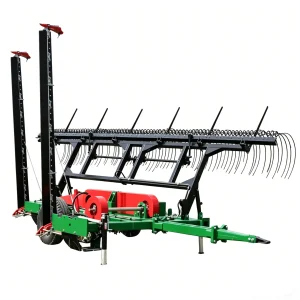
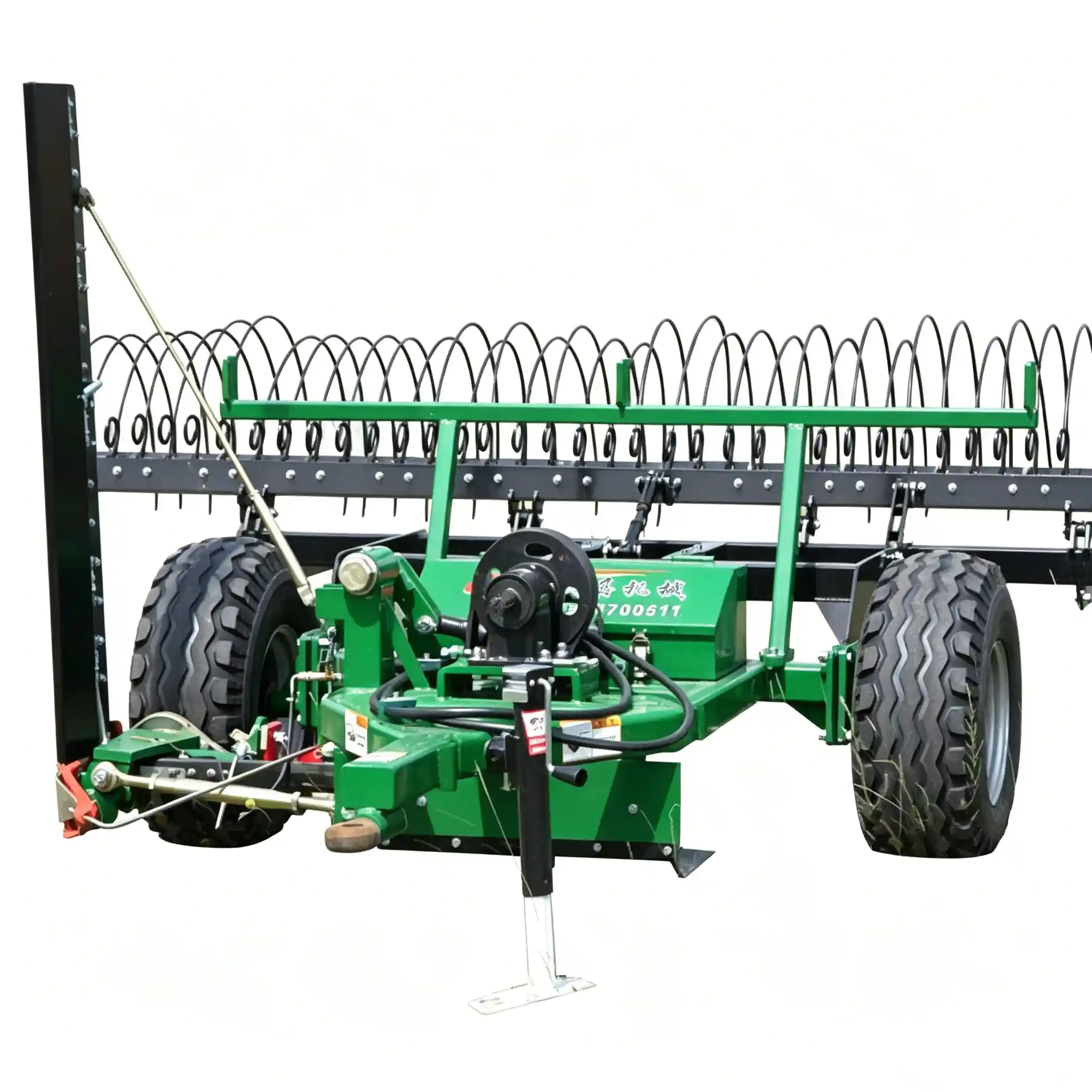
The 9GL-2.5/2.9 mower rake is a compact, rubber-wheel-supported, tractor-towed machine that cuts standing pasture grass and rakes the clippings into a baler-ready windrow in a single forward pass. Designed for rear-PTO wheeled tractors rated 25–55 kW (35–75 hp), it combines the function of a standalone sickle bar mower and a separate hay rake into one lightweight unit — operated by a single driver from the tractor cab with no extra crew.
The operating sequence is straightforward. Advancing at 6–7 km/h, the 34-piece reciprocating sickle bar cuts grass across a 2.5 m cutting width at a consistent 60–70 mm stubble height. Directly behind, the 2.9 m-wide spring-tine rake — 42 tines at 71 mm pitch — sweeps the freshly cut material sideways into a compact, uniform windrow alongside the cutting path. Both the cutter and the rake assembly raise and lower through the tractor’s hydraulic system. The PTO input runs at 540 r/min, which is the standard rear-PTO speed on the large majority of 35–75 hp wheeled tractors produced globally.
The reciprocating mower rake with 2.5 m cutting width is purpose-built for flat grassland and gently sloping pastures — natural prairie, steppe, and planted forage crops including alfalfa, ryegrass, clover, and Sudan grass. Its compact transport dimensions (3100 × 2920 × 2900 mm) make it practical for road movement between smaller farm plots without wide-load requirements.
Not recommended for: Paddy fields, wetlands, steep rocky terrain, dense forest undergrowth, or ground with frequent embedded stones, tree stumps, or deep drainage channels that risk sickle bar contact damage.
Technical Specifications — 9GL-2.5/2.9 Sickle Bar Mower Rake
| # | Parameter | Unit | Specification |
|---|---|---|---|
| 1 | Model Name | — | 9GL-2.5/2.9 Trailed Mower-Rake |
| 2 | Hitch Type | — | Trailed (Tow-Behind) |
| 3 | Cutter Mechanism | — | Reciprocating (Sickle Bar) |
| 4 | Cutting Width | m | 2.5 |
| 5 | Rake Working Width | m | 2.9 |
| 6 | Working Speed | km/h | 6–7 |
| 7 | Mowing Productivity | hm²/h | 1.2–1.44 |
| 8 | Raking Productivity | hm²/h | 1.5–1.8 |
| 9 | Average Stubble Height | mm | 60–70 |
| 10 | Required Tractor Power | kW | 25–55 |
| 11 | PTO Shaft Speed | r/min | 540 |
| 12 | Machine Weight | kg | 920 |
| 13 | Number of Rake Tines | pcs | 42 |
| 14 | Rake Tine Spacing | mm | 71 |
| 15 | Dimensions — Transport State | mm | 3100 × 2920 × 2900 (L×W×H) |
| 16 | Dimensions — Working State | mm | 3100 × 5000 × 950 (L×W×H) |
| 17 | Number of Moving Blades | pcs | 34 |
| 18 | Compliance Standard | — | GB/T10940-2008 |
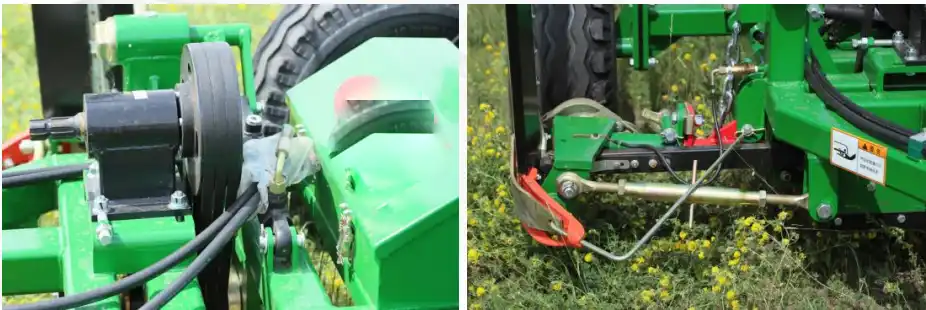
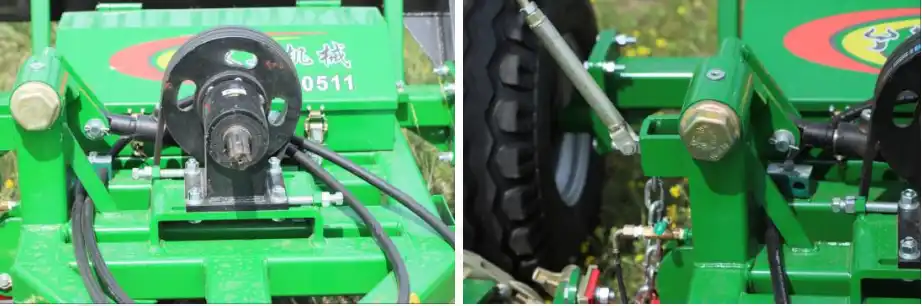
Product Detail Gallery
6 Reasons the 9GL-2.5/2.9 Mower Rake Outperforms a Two-Machine Setup
One Pass Replaces Two — Mowing and Raking Done Simultaneously
Running a standalone mower plus a separate rake requires two full field traversals per cut cycle, roughly doubling tractor fuel consumption and total field hours per hectare. This trailed windrower handles both jobs in one pass. At 1.2–1.44 hm²/h mowing and 1.5–1.8 hm²/h raking simultaneously, a single 8-hour shift covers 9–11 hm² with cutting and windrowing complete — without a second machine, a second driver, or a second fuel budget.
Agricultural Mower Rake with 42 Rake Teeth for Clean Collection
The 42 spring tines spaced at 71 mm pitch sweep the full 2.9 m rake width in a single motion, collecting cut material into a tight, consistent windrow without scattering. This windrow geometry matches the pickup width of most standard round balers, so the baler feeds directly without a secondary gathering pass. On fields with short-stemmed or fine grass crops, the 71 mm tine spacing retains fine material that wider-spaced rakes leave behind on the ground.
34-Blade Sickle Bar — Consistent 60–70 mm Stubble Across 2.5 m
Thirty-four moving blades cover the 2.5 m cutting width at approximately 13–14 blades per meter of bar length — a density that delivers even cut quality edge-to-edge without uncut strips. The 60–70 mm stubble height is the agronomic target for most perennial forage grasses: sufficient to protect the growing crown from mechanical damage while leaving enough leaf area for rapid photosynthetic recovery before the next cut.
Compact 920 kg Frame — Suitable for Smaller Tractors and Tighter Fields
At 920 kg, the 9GL-2.5/2.9 is 180 kg lighter than the larger 9GL-5.0/5.6 model, and its working footprint of 3100 × 5000 mm makes it maneuverable in fields with tighter headlands and more frequent turns. Farms running 35–50 hp tractors — common on small to mid-size operations — can deploy this sickle bar mower rake without any power upgrade to their existing prime mover.
Hydraulic Lift on Both Implements — Adjustments Made from the Cab
Both the cutter bar and the rake assembly raise and lower through the tractor’s hydraulic circuit. The driver lifts the implements at headlands, clears soft spots or drainage channels mid-field, and resets cutting height without dismounting. In a field requiring 20–30 headland turns per hour, this saves 15–20 minutes of dead time per operating shift compared to machines with manual lift mechanisms.
Standard 540 r/min PTO — No Adaptor Required on Most Tractors
The 540 r/min PTO input is the global standard for tractors in the 35–75 hp range. This lawn mower rake combination connects to the rear PTO shaft directly — no gear adaptor, no auxiliary gearbox. Attach the drawbar, connect the driveshaft, engage PTO at 540, and start operating. Total setup time from road transport to field-ready is typically under 10 minutes.
Where the 9GL-2.5/2.9 Trailed Windrower Performs Best
The following use cases reflect the specific field and crop conditions where this mower rake consistently delivers its rated productivity figures:
- Small to mid-scale hay farms (5–60 hm²): The 2.5 m cutting width and compact 920 kg frame suit fields where tight headland turns are frequent. The 2-in-1 function saves one full tractor run per cut cycle — on a 30 hm² operation with 3 annual cuts, that eliminates roughly 20–30 tractor-hours per season.
- Natural grassland and prairie pastures: The reciprocating sickle bar cuts cleanly through tangled, uneven natural swards where disc mowers clog or leave uncut strips. The reciprocating mower rake with 2.5 m cutting width is the correct choice for natural prairie where crop density varies unpredictably across the field.
- Planted forage crops (alfalfa, clover, ryegrass, Sudan grass): The sickle bar produces a clean stem cut that leaves plant crowns intact. This supports faster regrowth for the next cutting cycle compared to aggressive rotary disc cuts that can bruise stem bases and extend the recovery period by 3–5 days.
- Gently sloping pastures (up to approx. 8–10°): The tow-behind configuration with rubber-wheel support maintains stable cutting geometry on hillside grassland where self-propelled machines lose cut depth consistency.
- Contract mowing and multi-farm operations: The compact transport dimensions (3100 × 2920 × 2900 mm) allow road movement between client sites without wide-load permits in most jurisdictions. The broad 35–75 hp power range covers most tractor models found on smaller farms.
- Farms upgrading from single-function machines: Operators currently running a mower and a rake as separate passes can replace both with this single unit, immediately recovering the second machine’s operating cost, service time, and storage space.
Avoid operating in: Paddy fields, swamps, heavily stoned ground, steep slopes above 10°, dense shrub or forested terrain, or any ground where the sickle bar cannot maintain consistent contact without striking embedded objects.
Operating Guide — 9GL-2.5/2.9 Mower Rake Step by Step
Before First Use — Pre-Field Checks
- Walk the field at low speed and assess ground condition. Mark or avoid any stones, stumps, or embedded debris within 100 mm of the cutting height — a sickle bar contact event at 6–7 km/h can bend or fracture multiple blades simultaneously.
- Confirm all 34 moving blades are seated, undamaged, and fastened. Check all 42 rake tines for straightness — any bent tine will skew the windrow position and cause uneven baler feed downstream.
- Verify both hydraulic hose connections (cutter lift and rake lift) are fully seated and showing no seepage. Test lift function from the cab before entering the field.
- Confirm tyre pressure on both rubber wheels. The 920 kg machine weight transfers differently to the cutting bar if one tyre is under-inflated, moving actual stubble height outside the 60–70 mm rated range.
- Set PTO to 540 r/min and engage at low engine speed. Increase engine revs gradually to operating speed before advancing into the crop — sharp PTO engagement at full engine speed creates shock load on the drive train.
During Operation
- Maintain 6–7 km/h forward speed. Above 7 km/h, the rake tines can scatter material instead of consolidating it into a clean windrow; below 6 km/h, cut grass can bunch ahead of the blade guards and increase clog risk in dense crops.
- Lift both implements fully at every headland turn. The working height is only 950 mm — insufficient clearance for a turn without lifting on most grassland terrain.
- Drive in the same direction on each pass to deposit windrows consistently to the same side. Alternating direction reverses the windrow position and creates double-width rows that jam the baler pickup.
- If the sickle bar encounters an embedded obstacle and stops, disengage PTO immediately before attempting to clear the obstruction. Do not attempt to clear the bar while the drive is engaged.
- In crop moisture above 30%, reduce working speed by 0.5–1 km/h and monitor windrow compaction. Wet material can build up ahead of the tine array and overload the spring tines if speed is too high.
After Each Session — Routine Checks
- Brush all grass and soil debris from the sickle bar channel and knife sections. Wet plant material left against the blade guards corrodes the blade-to-guard interface within 3–5 sessions, widening the clearance gap beyond the 0.1–0.3 mm spec.
- Inspect all 34 moving blades for chips, cracks, or bent tips. Replace any blade with tip damage over 3 mm before the next operating session.
- Check all 42 rake tines for bending or breakage and replace affected tines immediately. A single missing or bent tine disrupts windrow uniformity across the entire rake width.
- Grease all nipple points every 50 operating hours: cutter drive head, crank arm housings, and PTO driveshaft universal joints. Use NLGI #2 lithium grease. Dry bearings on a reciprocating drive mechanism fail faster than any other component on this machine type.
- End-of-season: replace worn blade sections, apply rust-inhibiting oil to all unpainted metal surfaces, fully retract both hydraulic cylinders, and store in transport configuration (3100 × 2920 × 2900 mm) under cover on a flat surface.
Why Choose Our Mower Rake — Spec Numbers, Not Sales Copy
Every figure below is taken directly from the certified GB/T10940-2008 product data sheet:
Every unit ships with full English assembly and operating documentation, a complete spare parts list, and export documentation for international buyers. Our technical team responds to tractor compatibility and specification queries within 24 business hours.
Frequently Asked Questions — 9GL-2.5/2.9 Mower Rake
Q1: What makes the 9GL-2.5/2.9 a reciprocating mower rake with 2.5 m cutting width different from a disc mower?
The reciprocating sickle bar physically shears each grass stem between two opposing blades rather than cutting by high-speed rotary impact. This produces a cleaner stem cut with less bruising, which is particularly important for alfalfa and clover crops where leaf retention during drying directly affects bale nutritional value. Reciprocating designs also handle tangled or lodged natural grass swards without the clogging that disc mowers experience in dense crops.
Q2: Is the agricultural mower rake with 42 rake teeth suitable for fine or short-stemmed grasses?
Yes. The 71 mm tine spacing is designed to retain fine-stemmed forage material that wider-spaced rakes (80–100 mm) leave on the ground. On natural prairie grass and fine-leaved forage crops, the 42-tine configuration at 71 mm pitch collects material more completely than wider-pitch alternatives, reducing field losses per cut and improving total yield per hectare per season.
Q3: How does the 9GL-2.5/2.9 compare to the larger 9GL-5.0/5.6 model?
The 9GL-2.5/2.9 has a 2.5 m cutting width and 2.9 m rake width versus 5.0 m and 5.6 m on the larger model. It weighs 920 kg versus 1100 kg and requires 25–55 kW versus 30–60 kW. Peak raking output is 1.5–1.8 hm²/h versus 3.0–3.6 hm²/h. The compact model suits farms under 60 hm² and fields with tighter headland turns; the 5.0/5.6 suits larger open operations of 50 hm² and above.
Q4: What tractor is required to run this sickle bar mower rake?
Any wheeled tractor with a rear PTO rated 25–55 kW (35–75 hp) running at standard 540 r/min. The machine uses a tow-behind clevis hitch — no 3-point hitch is needed. This specification covers the large majority of mid-range wheeled tractors produced globally since the late 1970s, making it compatible with existing equipment on most farms in its target market.
Q5: Do I still need a separate hay rake after running this mower rake?
Not for direct-to-baler operations in good drying conditions. The 42-tine rake deposits a baler-ready windrow on the same pass as cutting. On operations that use a tedder to accelerate drying, a secondary raking pass to re-form the windrow after tedding is standard practice before baling — our Hay Rake Series covers this step if needed.
What Operators Say About the 9GL-2.5/2.9 Mower Rake
“We farm 45 hm² of mixed alfalfa and natural grass in Qinghai. Before switching to this machine, we were running a separate mower and a rake on two tractor passes. The 9GL-2.5/2.9 cut that down to one pass and brought our harvesting cost per hectare down by around 30% in the first season. The 42-tine rake leaves very little material on the ground — our bale weights went up noticeably compared to our old setup.”
— Chen L., Forage Farm Operator, Qinghai Province, China
“I bought this mower rake to replace two machines that had developed a rivalry with my schedule. One would be ready while the other needed parts, and they’d swap roles every other week. The 9GL-2.5/2.9 showed up, did both jobs in one lap, and hasn’t complained once in two seasons. It also fits in the same barn spot as one of the old machines, which my wife pointed out before I did.”
— Tom B., Hay and Cattle Farm, Nebraska, USA
Recommended Equipment — Complete Your Hay Production Chain
The 9GL-2.5/2.9 handles the first two stages of a five-step hay production workflow. Below is the full chain, with the specific reason each pairing adds measurable value:
Mower Rake — 9GL-2.5/2.9 (This Machine)
Cuts standing grass at a consistent 60–70 mm stubble height across a 2.5 m swath and simultaneously rakes the cut material into a tight windrow via the 42-tine 2.9 m rake. The 2-in-1 function compresses the first two stages of the harvest workflow into a single tractor pass — fewer passes per field means less soil compaction, less fuel burn, and less time before the crop reaches optimal baling moisture.
Hay Tedder (Tedder Series)
Deployed 4–8 hours after cutting in slow-drying conditions — high humidity, cloud cover, or dense sward material that traps moisture at the base. The Tedder fluffs and spreads the windrow to increase air circulation, cutting average field drying time from 3–4 days to 1.5–2.5 days. For silage operations targeting 30–40% DM wilt within 24 hours, tedding after this mower-rake pass is the fastest reliable route to hitting the wilt window before rain risk increases.
After tedding spreads the crop, a dedicated Hay Rake re-forms the dried material into a consistent, baler-optimized windrow. Windrow width and density directly affect bale uniformity and net wrap consumption per bale — a 10% wider-than-spec windrow can reduce bale density by 8–12% and increase per-bale wrap costs noticeably over a full season’s output. A clean secondary rake pass is the lowest-cost way to protect bale quality.
Round Baler (Round Baler Series)
Picks up the raked windrow and forms 0.9–1.5 m diameter cylindrical bales in under 60 seconds per bale at rated speed. Round bales stored field-side remain weather-resistant for 4–6 weeks without wrapping in moderate climates. Matched baler pickup width to this mower-rake’s windrow width prevents double-feeding and maintains even bale shape — critical for stable field storage and transport stacking.
Bale Wrapper / Handler (Wrapper / Handler Series)
For silage production or long-haul transport, the Wrapper applies stretch film around each round bale within minutes of ejection from the baler, creating an anaerobic seal that preserves forage nutritional value for 12–18 months at ambient temperature. The Handler moves and stacks finished bales without a front-loader — reducing the number of tractor configuration changes between baling and stacking when output rate is high.
Stop Making Two Laps. Start Making One.
Get a direct quote on the 9GL-2.5/2.9 Mower Rake — including freight options, export documentation, and a matched spare parts package for your region. Include your tractor model and we will confirm PTO and hitch compatibility before quoting. Reply within 24 business hours.
Looking for more output? The 9GL-5.0/5.6 delivers 3.0–3.6 hm²/h raking for farms of 50 hm² and above — ask us about both models.
Explore Our Full Agricultural Equipment Range
The 9GL-2.5/2.9 is one model in a complete lineup of hay production and tillage implements. Whether you need one machine or a full chain from cut to wrap, we have stocked options ready to ship:
Mower Series
Single-bar mounted reciprocating mowers and trailed dual-bar mowers from 1.4 m to 5.6 m cutting width
Hay Rake Series
Side-delivery wheel rakes and rotary rakes from 2.1 m to 7.3 m working width — matched to all baler types
Fixed and variable chamber round balers for dry hay, straw, and silage — net wrap and twine variants available
3–5 furrow hydraulic flip plows for primary tillage — hydraulic headland turn on all soil types
Disc Harrow Series
Offset and tandem disc harrows for stubble incorporation, seedbed preparation, and inter-crop tillage
Rotary Tiller Series
PTO-driven tillers from 1.0 m to 3.2 m working width for row crop, vegetable, and orchard floor management
Building a complete hay chain? Bundle the 9GL Mower Rake + Hay Rake Series + Round Baler and ask about combined shipping.
Contact us today →
9GL-2.5 | 9GL-2.9 | Mower Rake | Trailed Windrower | Sickle Bar Mower Rake | Lawn Mower Rake | Reciprocating mower rake with 2.5m cutting width | Agricultural mower rake with 42 rake teeth for clean collection | GB/T10940-2008