
Industry Application — Small Ruminant Farming
Square Hay Balers for Sheep & Goat Farms
How small-format bales reduce feed waste, simplify daily management, and match the scale of small ruminant operations.
Hay Waste Reduction
25–40%
saved vs open round bale feeding
Anyone who has managed goats for more than a season knows what happens when a round bale gets opened in their paddock. They climb it, burrow into it, urinate on it, and then refuse to eat anything they’ve touched. Goats are browsers by nature — they prefer to select from above, eat only what seems clean and fresh, and abandon anything that smells wrong. A round bale opened in a field is, from a goat’s perspective, rapidly contaminated from every direction at once.
Sheep are somewhat more practical about their feed but follow a similar pattern. Research trials comparing open round bale access against rack-fed small square bales consistently show 25–40% less hay consumed per unit of dry matter intake when waste is accounted for. For a small ruminant producer whose input costs are heavily weighted toward bought-in hay, that gap determines whether the enterprise is profitable.
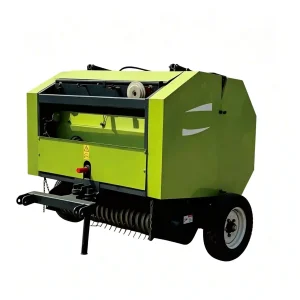
The Waste Problem in Small Ruminant Hay Feeding
Feed waste in small ruminants comes from several directions simultaneously. Goats pull hay out of a feeder faster than they eat it — the excess falls to the floor and gets soiled. Sheep in group pens develop hierarchy-based feeding patterns where subordinate animals get pushed out and try to grab mouthfuls from underneath, dragging hay onto the ground. In both cases, once hay contacts the floor, urinary contamination renders it unpalatable and the animals will not return to it.
The solution is not a better feeder design — though that helps — but a hay format that allows controlled, rack-based distribution in measured amounts. A small square bale broken into flakes and loaded into a hay rack provides exactly this. Each feeding delivers a defined amount with minimal excess. Animals eat from above, the rack keeps the hay off the ground, and what doesn’t get eaten in one feeding can often be left for the next without contamination.
For producers currently buying hay by the tonne in round bale format and losing a significant fraction to waste, switching to self-produced small square bales changes the economics of the enterprise meaningfully.
Forage Types for Sheep and Goat Production
Sheep and goats thrive on a wider range of forage types than horses, and this gives small ruminant producers more flexibility in what they grow and bale. Some considerations by crop:
Mixed Grass / Orchard Grass
Good all-purpose sheep forage. Medium protein, high palatability when baled correctly. Bales well at a wide moisture range and is the most forgiving crop type for operators running their first seasons with a new baler.
Alfalfa
High protein — useful for lactating ewes and does, growing lambs, and kids. Requires care at baling time: moisture below 18%, correct pickup height to minimise leaf shatter, and field speed moderated in dense windrows. Goats particularly favour alfalfa and waste less of it than grass hay.
Clover / Legume Mixes
Economical and nutritious. Bloat risk in sheep is real with high-clover diets, so introduce gradually and monitor. Red clover bales particularly well and stores well in square format in cool dry barn conditions.
Oat & Cereal Crop Hay
Cereal crops cut at the milky-dough stage make nutritious hay for goats and sheep. Baling is straightforward — cereal stems are robust and handle the plunger and knotter well. A good option for producers running both a grain crop and livestock on the same property.
Scale Matching: How Many Acres Do You Need?
Whether a baler is financially justified depends on your flock or herd size and your hay acreage. Here’s a rough guide for typical Canadian conditions:
| Flock / Herd Size | Estimated Annual Hay Need | Productive Pasture Required | Baler Justification |
|---|---|---|---|
| 10–20 sheep | 2–4 tonnes | 3–6 acres | Marginal — shared equipment or custom baling |
| 30–60 sheep | 6–12 tonnes | 8–15 acres | Viable — baler + hay sales cover costs |
| 20–40 goats | 4–8 tonnes | 6–10 acres | Viable with waste savings factored in |
| Mixed flock 80+ head | 16+ tonnes | 20+ acres | Clear ROI — consider twin-chamber model |
Recommended Equipment for Small Ruminant Producers
Small ruminant operations typically run smaller tractors — 40–65 HP is common — and that’s a good fit for our standard 9YF series balers. Our 9YF-2200 / 1900 / 1700 Square Hay Baler operates from 45 HP PTO upward on a 540 RPM standard tractor connection. The 1.7 m pickup width variant is particularly well matched to narrower windrows typical of smaller pasture paddocks, while the 2.2 m variant suits more open field conditions.
Key features that matter specifically for small ruminant hay production:
- Adjustable bale density: Produce firm, compact bales that don’t fall apart when a flake is pulled off for rack feeding. Loose bales waste more hay at the feeding point.
- Reliable knotter system: Untied or half-tied bales create mess in the barn and on the pasture — a genuine hazard where goats and sheep investigate everything at ground level. The German knotting device on the 9YF-1900 variant maintains consistent knot integrity across the day’s baling run.
- Profile-wheel pickup: Small paddock fields often have uneven terrain from animal traffic. The profile-wheel pickup adapts without digging in and contaminating bales with soil.
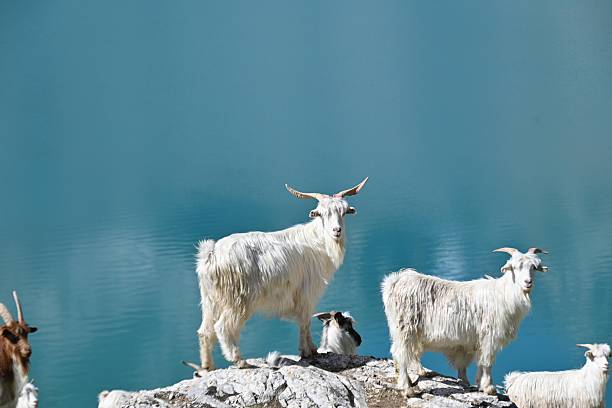
A group of goats standing on a rocky outcrop with a clear blue lake in the background.
Practical Feeding Setup for Sheep and Goat Barns
Getting the most out of small square bales in a small ruminant barn comes down to the feeding setup as much as the hay itself. A few approaches that work well:
- Keyhole or tombstone feeders: Allow multiple animals to eat simultaneously without displacement. Each animal occupies its own slot, reducing the dominant-animal exclusion that causes subordinate sheep and goats to waste hay trying to feed from the ground level.
- Hay nets: Preferred for goats, particularly dairy does that benefit from slower, more deliberate feeding patterns. Nets reduce the rate of intake and minimise the pull-and-drop habit that wastes loose hay.
- Elevated racks: Position so hay falls downward into the feeder as the animal pulls — not outward and onto the floor. A slight inward tilt on the rack bars achieves this and cuts floor wastage significantly.
For more information on baler specifications and to find the right model for your operation size and crop type, visit our square hay baler range or get in touch at [email protected].
Canada Hay-Balers Co., Ltd
10055 Hogarth Dr, Richmond, BC V7E 3Z9 | [email protected]
Editor:WM