
Few choices on a round baler get debated more than the tying system. The net wrap vs. twine question affects how fast you bale, how the bales hold up in storage, what your customers think of the finished product, and exactly how much you pay per bale at the end of the year. The right choice is not always the same for every operation — but the math behind it is surprisingly clear once you lay it out.
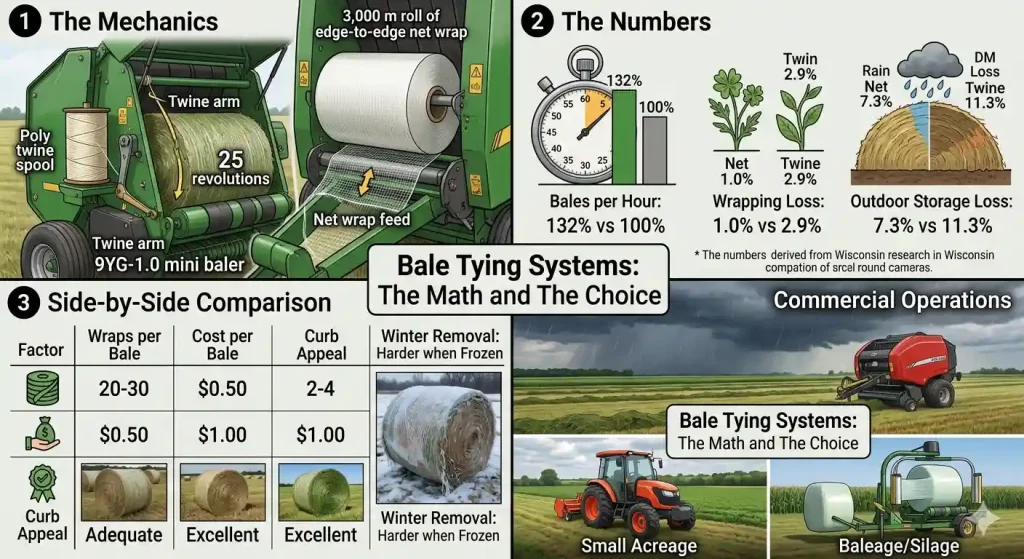
1. The Mechanics: How Each System Secures a Bale
Twine
Twine is a poly or sisal cord fed from a spool. After the bale reaches its set diameter, the chamber spins the bale while a twine arm wraps cord around the cylinder. A typical bale needs 20–30 revolutions of twine to be fully secured.
Net wrap
Net wrap is a knitted polyethylene mesh fed across the entire width of the chamber. Because the net covers the bale in a single sheet, only 2–4 revolutions are needed before the wrap is cut and the bale is ejected. The net effectively encases the cylinder rather than tying it.
2. The Numbers Every Operator Should Know
Wisconsin agricultural research and ASABE field studies have repeatedly measured the same outcomes:
3. Side-by-Side Comparison
| Factor | Twine | Net wrap |
|---|---|---|
| Wraps per bale | 20–30 revolutions | 2–4 revolutions |
| Cost per bale (typical) | ~$0.50 | ~$1.00 |
| Bales per hour | Baseline | +30% faster |
| Leaf loss in chamber | Higher | Lower |
| Outdoor storage loss | ~11% DM | ~7% DM |
| Bale shape retention | Adequate | Excellent |
| Removal in winter | Easy | Harder when frozen |
| Initial baler cost | Lower | Higher (mechanism + monitor) |
| Best for | Small acreage, baleage, indoor storage | Commercial production, sale, outdoor stacks |
4. Where Net Wrap Genuinely Wins
Speed during a weather window
Hay baling is often a race against rain. Saving 30% of baling time can be the difference between getting the crop into the barn and losing it. For custom operators who bill by the bale, net wrap is essentially mandatory — more bales per hour means more revenue per day.
Leaf retention on premium hay
Fewer revolutions in the chamber means less leaf shatter. For dairy alfalfa, horse hay, and any premium-priced hay where leaf-to-stem ratio is the visible quality marker, net wrap pays its premium back in the per-bale price.
Outdoor storage
Net wrap forms a tighter, more uniform shell that sheds water better than twine bands. Field studies show net-wrapped bales lose roughly one-third less dry matter outdoors than twine-wrapped bales. (That said, no wrap substitutes for proper inside storage — both options lose far more dry matter outside than in.)
Curb appeal
Bales going to a livestock auction, a feed dealer, or a roadside customer simply look more professional in net. It is a small thing that closes sales.
5. Where Twine Still Makes Sense
Smaller operations and mini balers
For most compact-tractor producers, twine systems are mechanically simpler, cheaper to service, and produce bales that are easy to open. A small farmer baling 5–20 acres is rarely throughput-limited, so the speed advantage of net wrap matters less. A reliable twine-equipped 9YG-1.0 round baler machine is often the most cost-effective choice for small acreage where every dollar of consumable matters.
Baleage and silage
For high-moisture forage that will be wrapped in plastic film immediately after baling, the in-baler tying system is mostly cosmetic — the plastic wrap does the real work. Twine is fine, simple, and cheap.
Operations that feed their own livestock
If you are feeding bales out within months and never selling, the marginal benefit of net wrap is small. Twine is fine, and the savings add up.
Cold-climate winter feeding
Frozen net wrap is genuinely difficult to remove. Twine, especially when cut with a knife, comes off easier. Operators in northern climates often deliberately keep a twine baler in the fleet for winter-feed bales.
6. Real Cost Per Bale Over a Season
Run a 1,000-bale season:
- Twine: 1,000 × $0.50 = $500 in consumables
- Net wrap: 1,000 × $1.00 = $1,000 in consumables
- Time saved with net wrap (32%): if baling at 30 bales/hour, that’s about 10 hours saved per 1,000 bales — 10 hours of fuel, labor, and weather risk
For commercial producers, the time saving alone usually justifies the consumable premium. For 100-acre hobby producers, the answer is often the other direction.
7. Dual-System Balers: The “Best of Both Worlds” Option
Most modern commercial round balers can be ordered with both twine and net wrap mechanisms. The operator selects the system from the cab based on the day’s conditions. This is the right call for any operator who:
- Runs both dry hay and baleage
- Sells some bales and feeds others
- Has both indoor and outdoor storage
- Wants resale flexibility — dual-system balers fetch better used prices
A capable dual-system unit such as the 9YG-2.24D round hay baler gives commercial producers the freedom to switch tying systems on the fly without any compromise on bale quality.
8. Selecting the Right Net Wrap or Twine
Quality matters more than brand name. A few practical buying tips:
- For twine: watch the knot strength rating, not just the listed length. UV stabilization is critical if your bales sit in the sun.
- For net wrap: roll length, edge-to-edge coverage, and tensile strength differ widely between budget and premium product. A tear in mid-roll costs more than the savings on cheap net.
- Climate match: some net wrap is rated for hot tropical use, others for cold storage. Buying outside the rated band shortens net life.
9. Common Pitfalls Both Ways
- Running too few wraps with net. Two wraps is the minimum, but 2.5–3 is safer for transport-heavy bales.
- Switching twines mid-roll. Different twine ratings need different baler tension settings. Mismatch causes broken twine and field stops.
- Storing bales on bare ground. Both systems lose to ground moisture; gravel pads or bale racks pay back in the first year.
- Forgetting to clean the cutting knife. Net wrap residues on the knife are the #1 cause of mis-cuts and tail-out problems.
Need Help Choosing a Tying System?
We can recommend the right setup for your crop, climate, and storage. Email [email protected] with your annual bale count and we will reply with a fitted quote.
Frequently Asked Questions
Can I retrofit net wrap to a twine-only baler?
Sometimes — many manufacturers offer factory-supported net wrap kits. The cost is often $3,000–$6,000 plus install. Compare to the price of a new dual-system baler before retrofitting an older machine.
Is net wrap recyclable?
Polyethylene net wrap can be recycled, but practical recycling streams vary by region. Check local agricultural plastics programs.
Do animals eat net wrap?
They can if it is left on the bale during feeding. Always remove all wrapping before feeding to prevent gastrointestinal blockages — this is true for both twine and net.
How many bales does one roll of net wrap make?
Typical 9,840 ft (3,000 m) rolls produce roughly 250–350 5×5 bales depending on wrap count and bale diameter.
Related Product Recommendations
Power & Traction Equipment: Tractors
The most essential partner for a baler is the tractor. The tractor not only provides the necessary traction but—more importantly—supplies power to the baler’s compaction and feeding mechanisms via the Power Take-Off (PTO) shaft.
Pre-Baling Equipment: Mowers and Rakes
Prior to baling, crops must be cut and gathered; these two types of machinery serve as the “advance team” for the baling operation.
Send Your Technical Requirements
Sample units, container quotes, OEM customization, and dealer pricing — our team replies within 24 hours. Most orders ship in 20–30 days from confirmation.
editor:WM