설명
Models: 9GL-5.0 / 9GL-5.6 |
Standard: GB/T10940-2008 |
Drive: Rear-PTO Wheeled Tractor |
Power: 30–60 kW (40–80 hp)
What Is the 9GL-5.0/5.6 Trailed Mower-Rake & How Does It Work?
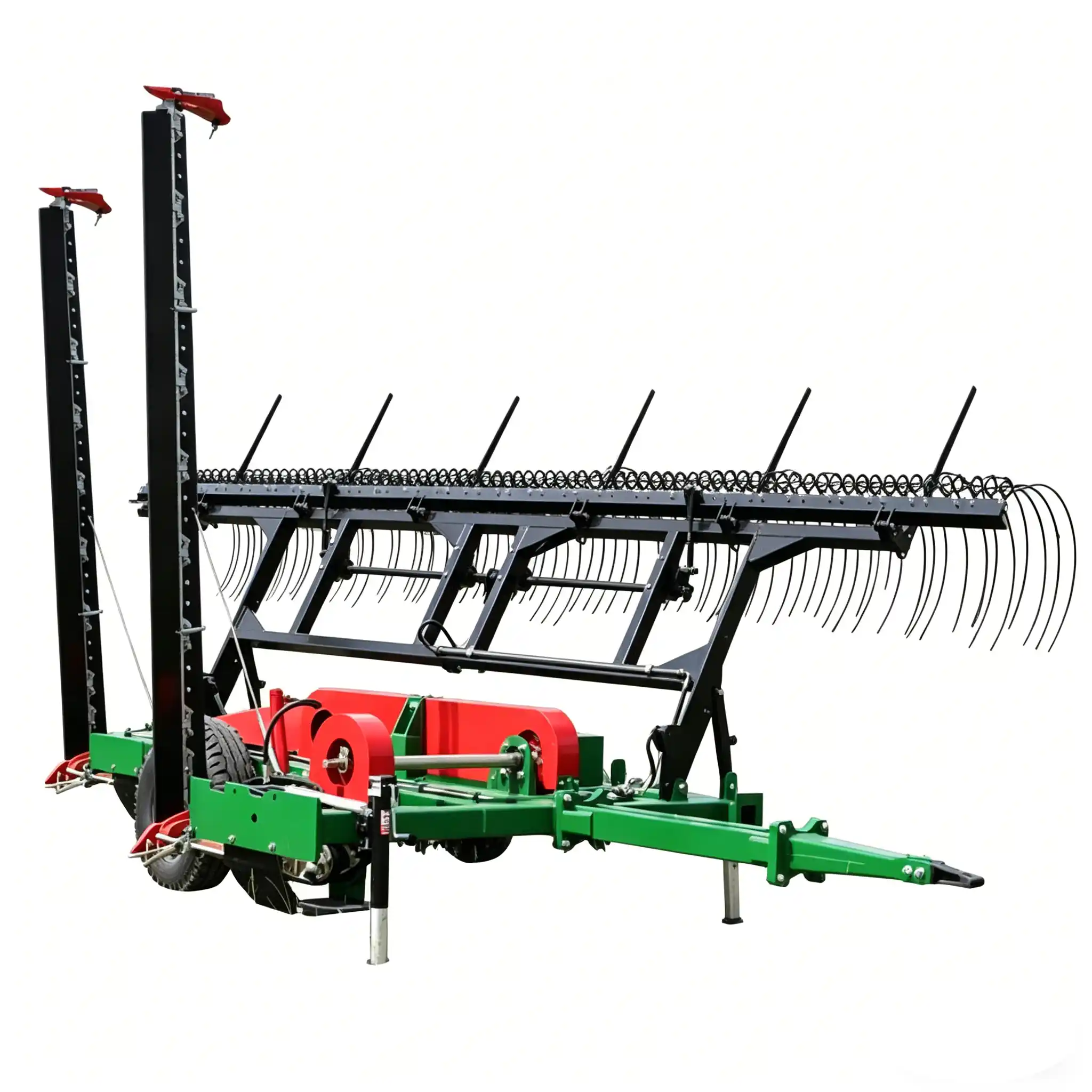
The 9GL-5.0/5.6 Trailed Mower-Rake is a rubber-wheel-supported, tractor-towed machine that cuts standing pasture grass and rakes the cut material into a baler-ready windrow — both in a single forward pass. Powered by any rear-PTO wheeled tractor rated 30–60 kW (40–80 hp), it replaces two separate field operations with one tractor run and one driver, with no additional crew needed.
The mechanics are direct: advancing at 6–7 km/h, the 68-piece reciprocating sickle bar severs grass across a 5.0 m cutting width at a consistent 60–70 mm stubble height. Immediately behind the cutter, the 5.6 m-wide spring-tine rake — 78 tines at 71 mm pitch — sweeps cut material sideways and consolidates it into a tight, uniform windrow ready for round baler pickup. Both the cutter and the rake lift and lower via the tractor’s existing hydraulic circuit, so the driver manages all adjustments from the cab. PTO input runs at the global standard 540 r/min, compatible with virtually all mid-range wheeled tractors in the 40–80 hp class.
At peak output, this pull-type mower-rake achieves 2.4–2.8 hm²/h mowing and 3.0–3.6 hm²/h raking — figures drawn directly from the certified GB/T10940-2008 specification sheet. The 9GL series trailed mower-rake compliant with GB/T10940-2008 is designed for flat to gently sloping grassland: natural prairie, planted alfalfa, ryegrass, clover, and Sudan grass fields. Its compact working height of 850 mm keeps the center of gravity low during operation, contributing to stable performance on gentle-slope terrain.
Not suitable for: Paddy fields, wetlands, steep rocky terrain, dense forest undergrowth, or ground with frequent embedded stones, tree stumps, or deep drainage channels that risk sickle bar contact damage.
Technical Specifications — 9GL-5.0/5.6 Pull-Type Mower-Rake
| # | Parameter | Unit | Specification |
|---|---|---|---|
| 1 | Model Name | — | 9GL-5.0/5.6 Trailed Mower-Rake |
| 2 | Hitch Type | — | Trailed (Tow-Behind) |
| 3 | Cutter Mechanism | — | Reciprocating (Sickle Bar) |
| 4 | Cutting Width | m | 5.0 |
| 5 | Rake Working Width | m | 5.6 |
| 6 | Working Speed | km/h | 6–7 |
| 7 | Mowing Productivity | hm²/h | 2.4–2.8 |
| 8 | Raking Productivity | hm²/h | 3.0–3.6 |
| 9 | Average Stubble Height | mm | 60–70 |
| 10 | Required Tractor Power | kW | 30–60 |
| 11 | PTO Shaft Speed | r/min | 540 |
| 12 | Machine Weight | kg | 1100 |
| 13 | Number of Rake Tines | pcs | 78 |
| 14 | Rake Tine Spacing | mm | 71 |
| 15 | Dimensions — Transport State | mm | 3860 × 5600 × 3000 (L×W×H) |
| 16 | Dimensions — Working State | mm | 3860 × 7600 × 850 (L×W×H) |
| 17 | Number of Moving Blades | pcs | 68 |
| 18 | Compliance Standard | — | GB/T10940-2008 |
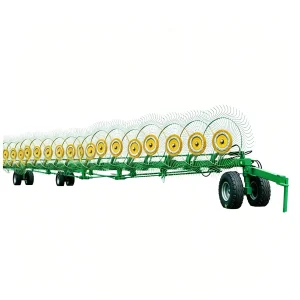
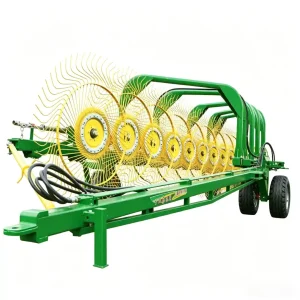
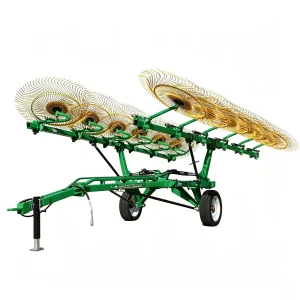
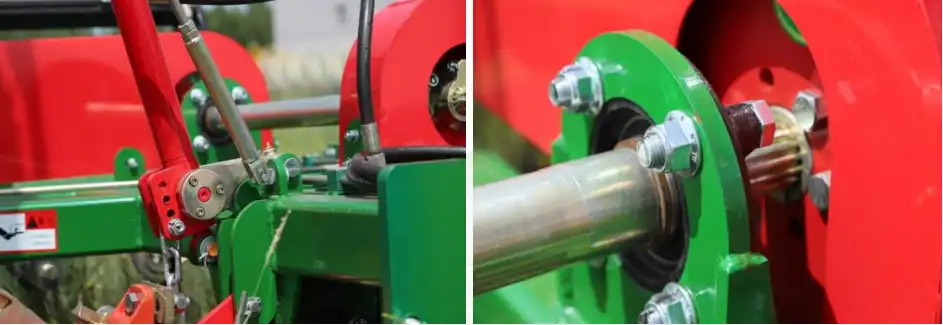
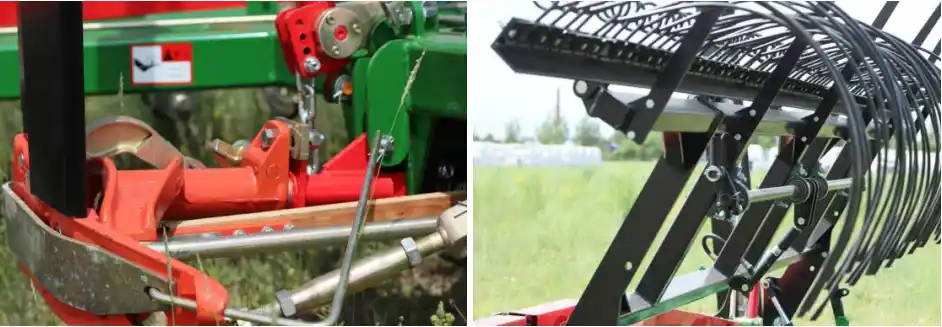
Product Detail Gallery of 9GL-5.0/5.6 Trailed Mower-Rake
6 Performance Advantages of the 9GL-5.0/5.6 Trailed Mower-Rake
Cuts & Rakes in One Pass — Replaces Two Full Tractor Runs
A standalone mower followed by a separate rake requires two complete field traversals, doubling tractor fuel burn and total field time per hectare. This pull-type mower-rake finishes both in a single pass. At 2.4–2.8 hm²/h mowing combined with 3.0–3.6 hm²/h raking, one 8-hour shift covers 19–22 hm² with cutting and windrowing fully complete — compared to roughly 11–14 hm² achievable with sequential single-function machines at equivalent speeds.
68 Moving Blades — Consistent 60–70 mm Stubble Across the Full 5.0 m Bar
Sixty-eight reciprocating moving blades cover the 5.0 m cutting width at approximately 13–14 blades per meter — a density that keeps cut quality uniform edge-to-edge without uncut strips. The 60–70 mm stubble height sits within the agronomic safe zone for most perennial forage species: high enough to protect root crowns, low enough to maximize yield recovery per cut.
78 Spring Tines at 71 mm Pitch — Baler-Ready Windrow, No Secondary Raking Needed
The 78-tine rake sweeps a 5.6 m swath into a compact, consistent windrow immediately behind the cutter bar. This windrow geometry matches standard round baler pickup widths, meaning the baler follows the windrow directly without a secondary gathering run. For high efficiency dual-cutter mower-rake for natural grass operations, this single-pass windrow output is the core time-saving mechanism.
Hydraulic Lift on Both Cutter & Rake — Full Cab Control, No Dismounting
Both implements raise and lower through the tractor’s hydraulic circuit. The driver lifts them at headlands, clears soft spots or drainage channels mid-field, and resets cutting height without stepping from the cab. On a field with 20–30 headland turns per hour, cab-based control saves 15–25 minutes of dead time per operating shift compared to manual lift systems.
Rubber-Wheel Chassis — 1100 kg Distributed for Low Soil Compaction
The entire 1100 kg machine rides on rubber wheels, spreading weight across a contact footprint that keeps ground pressure within safe thresholds for perennial pasture soils. On clay-loam and silty prairie — the primary terrain for this trailed mower-windrower — uncontrolled ground pressure can compact soil at 10–15 cm depth, reducing root density and depressing subsequent-season yields by 8–15%.
Standard 540 r/min PTO — Connects to Your Existing Tractor Without Adaptors
The 540 r/min PTO input is the international standard for tractors in the 30–80 hp range, covering the large majority of wheeled tractors in service on mid-size forage farms worldwide. No adaptor shaft, no gear ratio converter — connect the driveshaft, engage 540 PTO, and begin operating.
Where the 9GL Pull-Type Mower-Rake Performs Best
The following scenarios reflect field conditions where this trailed mower-windrower consistently achieves its rated performance figures:
- Commercial hay farms (50–500+ hm²): Eliminating one full field pass per cut cycle saves 50–80 tractor-hours per season on a 200 hm² operation running 3 annual cuts — roughly one full work week of field time recovered.
- Natural grassland and steppe pastures: The reciprocating sickle bar cuts through tangled, lodged natural swards where disc mowers clog. This is the primary use environment for the high efficiency dual-cutter mower-rake for natural grass — including northern steppe, inner Asian prairie, and mixed grassland pastures.
- Planted forage fields (alfalfa, clover, ryegrass, Sudan grass): Clean sickle-bar cuts leave plant crowns intact, supporting faster regrowth for subsequent cuts. Aggressive rotary disc cuts in the same crops can bruise stem bases and delay recovery by 3–5 days per cycle.
- Gentle-slope pastures (up to approx. 8–10° gradient): The tow-behind configuration and rubber-wheel chassis maintain stable cutting geometry on gently sloping hillside grassland where self-propelled machines lose stability.
- Silage and fresh forage operations: Freshly cut material raked immediately into windrows begins wilting faster than material left spread flat. When targeting 30–40% DM wilt within 24 hours for wrapped silage, the immediate windrowing action shortens the time from cut to wrapping.
- Contract mowing services: The 40–80 hp power bracket covers a wide range of client tractor models. Transport dimensions of 3860 × 5600 × 3000 mm allow road movement between farm sites without wide-load permits in most jurisdictions.
Avoid operating in: Paddy fields, swamps, heavily stoned ground, slopes above 10°, dense shrub or forested areas, and terrain where the sickle bar cannot maintain consistent ground contact without striking embedded objects.
How to Maintain the 9GL-5.0/5.6 Trailed Mower-Rake for Hay Harvesting
The 9GL is a low maintenance trailed mower-rake with a low failure rate — its reciprocating mechanism carries fewer rotating parts than disc alternatives, with no high-speed disc hubs or planetary gearboxes to service. Follow this three-tier schedule to keep it at rated performance through the full harvest season:
After Every Operating Session
- Brush all grass and soil debris from the sickle bar channel, finger guards, and knife sections. Wet plant material left against metal surfaces overnight corrodes the blade-to-guard contact interface within 3–5 sessions, widening clearance past the 0.1–0.3 mm target.
- Inspect all 68 moving blades for chips, bent edges, or cracks. Any blade with tip damage over 3 mm or a visible fracture should be replaced before the next run — one damaged blade increases vibration load across the full 5.0 m bar.
- Walk the 78-tine rake row and check for bent or broken tines. A bent tine disrupts windrow shape and causes uneven baler feed and inconsistent bale density downstream.
- Confirm all PTO driveshaft guard retaining pins are fully seated before the next operating session.
Every 50 Operating Hours
- Grease all bearing nipples on the cutter drive head, crank arm housings, and PTO driveshaft universal joints with NLGI #2 lithium grease. Dry reciprocating bearings fail faster than any other component — this 2-minute task prevents a multi-hour field repair.
- Check blade-to-guard clearance at multiple points across the 5.0 m bar. Target: 0.1–0.3 mm. Clearance above 0.5 mm causes continuous green streaks in the field (uncut grass passing through the gap) — adjust hold-down clips to restore spec.
- Inspect both hydraulic lift cylinders and hose connections for oil seepage. Hydraulic oil on a crop field contaminates forage and creates an environmental issue — fix immediately if any seeping is found.
- Check rubber wheel tyre pressure at both wheels. Under-inflation of 20%+ on the 1100 kg machine shifts cutting geometry and moves actual stubble height outside the 60–70 mm rated range.
End-of-Season Storage
- Replace all worn blade sections before storage. The first cut of the season is typically the highest-yield cut — starting it with worn blades means the most valuable harvest of the year runs below spec.
- Apply rust-inhibiting oil to all unpainted metal surfaces: sickle bar, blade guards, tine arm brackets, and crank linkages.
- Fully retract both hydraulic cylinders (cutter lift and rake lift) to protect the polished rod surfaces from oxidation. Oxidized rods damage the rod seals on first extension the following season.
- Fold to transport configuration (3860 × 5600 × 3000 mm), store under cover on a flat surface, and rest the frame on wooden blocks to take weight off the tyres during multi-month storage.
Why Choose Our Trailed Mower-Rake — The Numbers That Matter
Every figure below is taken directly from the certified GB/T10940-2008 product data sheet:
Every unit ships with full English assembly and operating documentation, a complete spare parts list, and export documentation for international buyers. Replacement tines, blade sections, and drive components are stocked for fast dispatch. Technical queries on tractor compatibility are answered within 24 business hours.
Frequently Asked Questions — 9GL Trailed Mower-Rake
Q1: Is the 9GL-5.0/5.6 a low maintenance trailed mower-rake with a low failure rate?
Yes. The reciprocating sickle bar has fewer moving parts than disc systems — no spinning disc hubs, no planetary gearboxes. Routine care is blade inspection per session and bearing greasing every 50 hours. In normal conditions, blade section wear is the most frequent service item, not structural failures. The 9GL series trailed mower-rake compliant with GB/T10940-2008 is specifically designed for straightforward field servicing by a general farm mechanic.
Q2: What is the difference between the 9GL-5.0/5.6 and the smaller 9GL-2.5/2.9 model?
The 9GL-5.0/5.6 is the large-format model: 5.0 m cutting width, 5.6 m rake width, 68 blades, 78 tines, 1100 kg, and peak raking output of 3.0–3.6 hm²/h. The 9GL-2.5/2.9 is the compact version: 2.5 m cutting width, 2.9 m rake width, 34 blades, 42 tines, 920 kg. The 5.0/5.6 suits farms of 50 hm² and above; the 2.5/2.9 suits smaller plots or fields with more frequent headland turns.
Q3: Can the 9GL handle thick or lodged natural grassland without clogging?
Yes — this is the key reason operators choose a pull-type sickle bar mower over rotary disc designs for natural grassland. The reciprocating blade physically shears through tangled, lodged swards rather than relying on high-speed impact energy. At the rated 6–7 km/h working speed, it maintains cut quality in dense natural prairie crops where disc mowers commonly clog or leave uncut strips along the cutting edge.
Q4: What tractor is needed to run the 9GL-5.0/5.6 Trailed Mower-Windrower?
Any wheeled tractor with a rear PTO rated 30–60 kW (40–80 hp) running at standard 540 r/min. The machine uses a tow-behind clevis hitch — no 3-point hitch category is required. This spec covers the large majority of mid-range farm tractors produced since the 1980s globally.
Q5: Do I still need a separate hay rake after using this mower-rake?
Not for direct-bale operations in good drying conditions. The 78-tine rake deposits a baler-ready windrow on the same pass as cutting. On operations that use a tedder to speed drying, a secondary raking pass after tedding is standard practice to re-form the windrow before baling — in which case a dedicated Hay Rake from our Hay Rake Series is the recommended companion.
What Operators Say About the 9GL Trailed Mower-Rake
“We operate 180 hm² of mixed natural and planted forage in Gansu province and previously ran a mower and rake as two separate passes. The 9GL-5.0/5.6 cut our per-hectare harvesting cost by around 38% in the first full season — mainly from eliminating one tractor run and one fuel-and-labor budget per cut cycle. The 68-blade bar holds cut quality consistently, even in the dense hillside grass sections on the western paddocks.”
— Liu M., Commercial Forage Farm, Gansu Province, China
“I used to make two laps around my 120-acre pasture every cutting — one for mowing, one for raking. My neighbor once asked why I was doing that. I said ‘tradition,’ which is apparently the expensive way to say ‘I didn’t know there was a better option.’ I bought the 9GL-5.0/5.6. One lap now. The windrows come out clean, the baler feeds them without complaint, and I’ve recovered roughly four hours per cutting day. My neighbor just ordered one too.”
— Dave K., Hay and Cattle Ranch, Wyoming, USA
Recommended Equipment to Complete Your Hay Production Chain
The 9GL-5.0/5.6 handles the first two stages of a five-step hay production workflow. Here is the full chain and the specific reason each pairing adds value:
Trailed Mower-Rake — 9GL-5.0/5.6 (This Machine)
Cuts standing grass at 60–70 mm stubble height across 5.0 m and simultaneously rakes the material into a baler-ready windrow. This 2-in-1 function compresses the harvest timeline — fewer tractor passes means the crop reaches optimal baling moisture faster and with lower DM loss during field drying.
Hay Tedder (Tedder Series)
Deployed 4–8 hours after cutting in slow-drying conditions (high humidity, overcast skies, or dense sward material). The Tedder fluffs and spreads the windrow to increase air exposure, cutting average field drying time from 3–4 days to 1.5–2.5 days. For silage operations targeting 30–40% DM wilt, tedding after the mower-rake pass is the fastest route to hitting the wilt target before rain risk increases.
Hay Rake (Hay Rake Series)
After tedding spreads the crop, a dedicated Hay Rake re-consolidates the material into a precise, baler-optimized windrow. Consistent windrow width and density directly affects bale uniformity, net wrap consumption per bale, and how evenly the baler’s pickup feeds — making windrow geometry a production efficiency issue, not just a neatness preference.
Round Baler (Round Baler Series)
Picks up the raked windrow and forms 0.9–1.5 m diameter cylindrical bales in under 60 seconds per bale at rated speed. Round bales stored field-side remain weather-resistant for 4–6 weeks without wrapping in moderate climates — practical for large operations where immediate barn transport is not available. Matched baler pickup width to this mower-rake’s windrow width prevents double-feeding and uneven bale shape.
Bale Wrapper / Handler (Wrapper / Handler Series)
For silage production or long-haul transport, the Wrapper applies stretch film around each round bale within minutes of ejection, creating a sealed anaerobic environment that holds forage nutritional value for 12–18 months at ambient temperature. The Handler moves and stacks finished bales without requiring a front-loader — reducing tractor configuration changes between baling and stacking when the Round Baler is producing 20–30 bales per hour.
Ready to Cut Your Field Operation Time in Half?
Get a direct quote on the 9GL-5.0/5.6 Trailed Mower-Rake — including freight, export documentation, and a matched spare parts package for your region. Include your tractor model and we will confirm PTO and hitch compatibility before quoting.
Ordering a full hay chain — Mower-Rake + Round Baler + Wrapper? Ask about bundle pricing and combined freight rates when you enquire.
Explore Our Full Range of Agricultural Equipment
The 9GL Trailed Mower-Rake is one product in a broad lineup of field-proven implements. Whether you need a complete hay production chain or tillage and soil preparation tools, we have matching machines ready to ship:
Single-bar mounted reciprocating mowers and trailed dual-bar mowers from 1.4 m to 5.6 m cutting width
Hay Rake Series
Side-delivery wheel rakes and rotary rakes matched to 2.1 m – 7.3 m working widths for all baler types
Round Baler Series
Fixed and variable chamber round balers for dry hay, straw, and silage — net wrap and twine variants available
Hydraulic Reversible Plow
3–5 furrow hydraulic flip plows for primary tillage — fully hydraulic headland turn on all soil types
Disc Harrow Series
Offset and tandem disc harrows for stubble incorporation, seedbed preparation, and inter-crop tillage
Rotary Tiller Series
PTO-driven tillers from 1.0 m to 3.2 m working width for row crop, vegetable, and orchard floor management
Building a full hay chain? Bundle the 9GL Mower-Rake + Hay Rake + Round Baler and ask about combined shipping rates.
Contact us today →
9GL-5.0 | 9GL-5.6 | Trailed Mower-Rake | Pull-Type Mower-Rake | Trailed Mower-Windrower | Pull-Type Sickle Bar Mower | High efficiency dual-cutter mower-rake for natural grass | GB/T10940-2008