
Industry Application — Small & Hobby Farming
Square Hay Balers for Small & Hobby Farms
You don’t need a hundred acres to justify owning a baler. Here’s when the numbers make sense — and what to look for in a machine that fits small-farm scale without compromising on quality.
Small Acreage
Mixed-Species Livestock
Rural Residential
The hobby farm and small acreage market sits in an interesting position in the hay equipment conversation. On one hand, producers at this scale are often told they’re “too small” to justify buying a baler — that custom baling or purchased hay makes more sense. On the other hand, the people most likely to be buying hay by the bale from a feed store — paying retail prices for individually counted bales — are exactly the people whose operations would benefit most from producing their own at a fraction of the cost.
The economics of small-farm baling are not always in favour of equipment ownership, but they more often are than the conventional wisdom suggests. The key variables are your current hay purchase cost, your productive pasture acreage, your livestock numbers, and whether you can identify a neighbour or local outlet to take the surplus bales your operation doesn’t use.
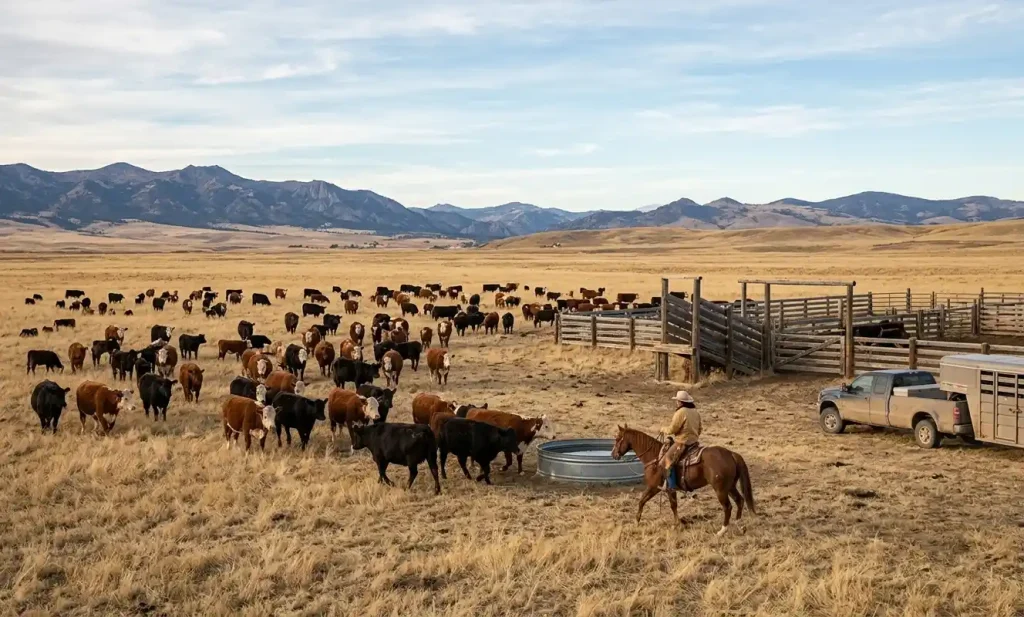
The Small Farm Hay Cost Problem
Retail hay prices at feed stores in BC and Ontario typically run $12–$20 per small square bale depending on season, species, and quality. A hobby farm with four horses feeding each animal 2–3 bales per day through a 180-day Canadian winter consumes 1,440–2,160 bales. At $15 per bale, that’s $21,600–$32,400 in hay costs for the winter feeding period alone.
A square baler purchased for on-farm use — producing the same bales from your own pasture — brings the cost per bale down to the labour and fuel equivalent. The capital cost of the equipment is recovered within a few seasons for most operations at that scale, and the ongoing cost per bale drops significantly relative to retail purchases.
When the Numbers Work for Small-Farm Baler Ownership
The economics of baler ownership at small-farm scale work best when several conditions align:
- You already own a tractor of 45 HP or more. If the tractor is in place for other farm work, adding a baler doesn’t add a second piece of capital equipment — it adds functionality to equipment you already own.
- You have 8–15+ productive acres of hay-capable pasture. Below 8 acres, the annual bale volume is unlikely to justify equipment ownership without significant retail sales supplementing on-farm use.
- You have livestock that consume hay year-round or through a long feeding period. Canadian winters of 5–7 months of hay feeding create the demand base that makes ownership viable.
- You can identify a local market for surplus bales. Selling even 30–40% of your production to a neighbour, local stable, or through a farm gate sign dramatically improves the payback timeline.
- You value feed provenance. Producing your own hay means you know exactly what went into it — no pesticide uncertainty, no unknown weed content, no soil type surprises. For hobby farm owners with horses or pigs raised for home consumption, this has real value beyond the economics.

Custom Baling as an Alternative — and Why Some Producers Move Beyond It
Custom baling — hiring a local contractor to bale your hay for a per-bale or per-acre fee — is the right starting point for very small operations or those testing whether hay production is viable on their property. Custom baling lets you produce hay without capital equipment ownership, understand your field’s productivity, and develop your haymaking process before committing to a machine.
The limitations become apparent over time:
- Scheduling dependency: Custom contractors bale when they’re available, not when your crop is at optimal moisture. Waiting 24 hours past ideal moisture for a contractor to arrive costs hay quality that’s difficult to recover.
- Cost per bale rises with volume: At small volumes, custom baling per-bale cost is reasonable. As your operation grows, the per-bale cost of custom baling remains constant while the total cost grows — at some volume level, ownership is clearly cheaper.
- Contractor availability is tightening: Experienced custom baling operators are a shrinking demographic in many rural areas. Depending on a contractor who may retire or reduce their service area in coming years creates supply chain risk for your feed programme.
Many hobby farm producers start with custom baling, recognise the limitations over two or three seasons, and move to equipment ownership when their operation’s volume justifies the investment.
What Small-Farm Operators Need from a Square Baler
A small hobby farm doesn’t need the most powerful baler on the market. But it does need a machine that:
Runs on your existing tractor
Most hobby farm tractors are in the 40–65 HP range. The 9YF series operates from 45 HP PTO on standard 540 RPM — compatible with the most common small-farm tractor configurations.
Operates on irregular plots
Hobby farm fields are often irregular, small, or awkward-shaped. A symmetrical longitudinal axis design improves stability and turning ease in these conditions compared to offset-drawbar machines.
Is simple enough to operate solo
Most hobby farm operators bale without extra labour. Single-operator design with a hydraulic ejector — so bales drop cleanly without a second person on the wagon — makes one-person baling practical.
Handles multiple crop types
Small hobby farms often grow a mix of grasses, clover, and whatever establishes on the pasture. A baler that adapts to variable windrow composition without constant recalibration reduces per-season frustration significantly.
The Neighbour Network: Turning Surplus into Income
One of the most reliable ways to improve the economics of small-farm baler ownership is selling surplus bales locally. Hobby farms in rural residential areas almost always have neighbouring horse owners, small ruminant producers, or backyard chicken keepers who buy hay by the bale at retail prices. Producing your own hay and selling 30–50% of output to a handful of neighbours at prices below the feed store — but above your production cost — converts the baler from a pure cost item into a modest income producer.
A “hay for sale” sign at the farm gate and a listing on a local Facebook farming group are usually sufficient to establish a local customer base. Consistent quality — same moisture, same species, consistent bale weight — builds repeat customers quickly in rural communities where reliable local hay supply is genuinely valued.
The Right Starting Point for Small-Farm Baling
For small and hobby farm operators, our 9YF-2200 / 1900 / 1700 Square Hay Baler is the practical entry point — matched to the tractor HP range most small farms already run, capable of handling the crop diversity typical of mixed pasture, and simple enough for a single operator to run without extensive mechanical background. The 1.7 m pickup width variant is particularly well suited to narrower fields and irregular plots.
If your operation has grown beyond pure hobby scale and you’re moving toward supplying local retail or wholesale hay markets, the step up to higher output capacity makes sense — and that conversation is worth having before purchasing. Our team at Canada Hay-Balers is based in Richmond, BC and services producers across Canada.
Browse full specifications at hay-balers.com/square-hay-balers, or reach us directly at [email protected] to discuss what your property, tractor, and feeding programme actually need.
Canada Hay-Balers Co., Ltd
10055 Hogarth Dr, Richmond, BC V7E 3Z9 | [email protected]
Editor:WM