
Every autumn across North America’s corn belt, millions of acres of corn stover — stalks, leaves, cobs, and husks — are left standing in the field after grain harvest. Most of it is chopped, tilled under, or simply left to decompose. Yet each acre of corn can yield between 2 and 4 tonnes of dry stover with real market value as livestock bedding, animal feed supplement, mushroom substrate, or biomass fuel. The difference between that residue becoming revenue and becoming a tillage cost is a single piece of equipment: a corn stalk round baler designed for the job.
Corn stalks present a unique baling challenge that standard hay-only machines are not built for. The thick, woody stalks resist compression, clog conventional spring-tooth pickups, and demand higher PTO torque than grass or alfalfa. This article explains why corn stover baling requires specialized equipment, how to time and execute the operation for maximum yield and bale quality, and which machines in Canada Hay-Balers Co.’s lineup are engineered specifically for this demanding crop.
Why Corn Stover Is a High-Value Residue Crop — The Economics
The U.S. corn belt alone produces an estimated 250–350 million dry tonnes of stover annually, and Canada’s corn-growing regions in Ontario, Quebec, and Manitoba add several million more. Historically treated as a nuisance, this biomass has seen rising demand from three converging sectors:
- Livestock operations: Beef cattle and dairy farms in the Northern Plains use corn stover as low-cost roughage or bedding during winter months, reducing straw purchase costs by 30–50%.
- Biomass energy: Corn stover bales are accepted feedstock at many biomass-to-energy plants, with contracted prices ranging from CAD $25–55/tonne depending on moisture content and proximity.
- Specialty markets: Mushroom cultivation, erosion control blankets, horticultural mulch, and pulp/paper feedstocks all purchase baled corn stover, often at premium prices for consistent moisture-content bales.
- Soil health management: Removing 40–60% of stover (leaving enough root mat for erosion control) is now recommended by many agronomists as a tool to reduce surface crusting and improve spring warming on heavy soils.
With baling costs (fuel, labor, twine/net wrap) typically running CAD $8–14 per bale on a well-matched machine, and sale prices of $12–30 per bale depending on destination, the margin case for corn stalk baling is strong — provided the equipment can handle the material efficiently.
What Makes Corn Stalks Different — The Engineering Challenge
Farmers who have tried to bale corn stover with a machine designed for grass hay quickly encounter several problems:
| Property | Corn Stalks | Grass / Alfalfa Hay |
|---|---|---|
| Stalk diameter | 20–35 mm (woody) | 1–5 mm (flexible stems) |
| Bulk density at harvest | Very low (≤15 kg/m³) | Medium (25–40 kg/m³) |
| Pickup challenge | Clogs spring-tooth pickups; tangles on tines | Handles well on standard spring-tooth |
| Compression resistance | High (rigid cell walls) | Low to medium |
| Moisture at baling | Target: 20–30% | Target: 14–18% (dry) or 45–65% (silage) |
| PTO torque demand | High — peaks at bale ejection | Moderate |
| Wrapping requirement | Net wrap strongly preferred (spring-back) | Twine or net wrap both viable |
The key takeaway: corn stover requires a hammer-claw or flail pickup system rather than conventional spring-tooth tines. Hammer-claw assemblies shred and meter the stalks into the bale chamber in controlled segments, preventing the long-fibre tangles that halt standard machines. Additionally, the bale chamber itself must have sufficient roller count and compression force to achieve useful bale density on low-bulk material.
Harvest Timing: The 10-Day Window That Determines Bale Quality
Corn stover baling is highly time-sensitive. The optimal window opens after grain combine harvest and closes when moisture drops too low for efficient baling — or when autumn rains push moisture back above 40%.
STOVER BALING TIMELINE (Northern Corn Belt / Ontario)
Days 0–3 Post-Harvest
Stover moisture 50–70%. Too wet. Allow field drying.
Days 4–10 Post-Harvest
Moisture 20–35%. Optimal baling window. Net wrap strongly recommended.
Days 11–20 Post-Harvest
Moisture <15%. Bales light and loose; increased PTO load. Twine only viable for short storage.
Post-First Rain
Moisture >40%. Mold risk high. Avoid baling unless for anaerobic composting.
In Ontario and Manitoba, the typical window falls between late September and mid-October. Timing a baler to follow the combine by two to four days — while the combine’s chaff and residue chopper distributes material evenly — gives the best balance of moisture and windrow uniformity. On fields where the combine spreads stover wide, a single light raking pass before baling significantly improves pickup efficiency and reduces unharvested field losses.
Equipment Selection: Why the Pickup System Is the Critical Variable
Canada Hay-Balers Co. offers two machines purpose-engineered for corn stalk baling, each suited to a different operational scale:
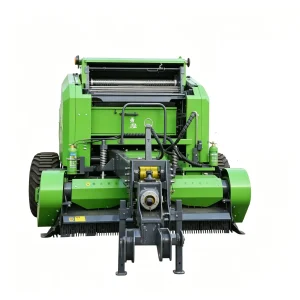
9YG-1.25 Cylindrical Baler — Heavy-Duty Corn Stalk Specialist
4,558 kg trailed machine with interchangeable spring-tooth and hammer-claw pickup assemblies. The hammer-claw head meters standing or windrow corn stalks directly into the bale chamber in controlled sections, eliminating clogging. Output: 40–80 bales/hour at 115–200 kg/m³ density. Requires 120 HP tractor.
- 18-roller compression system for consistent bale shape on low-density stover
- Sensor-controlled density regulation — compensates for varying stover moisture
- Can pick up standing stalks in single pass — eliminates separate raking stage
- 2,240 mm pickup width — covers wide combine spreading patterns
Bale Density, Net Wrap, and Storage: Getting Value Out of Every Bale
Corn stover bales are inherently less dense than hay bales due to the hollow stalk structure. A well-compressed 1.25 m diameter bale of corn stover typically weighs 250–380 kg — less than an equivalent-size alfalfa bale at 400–500 kg. This affects both transport efficiency and storage footprint. Several practices help maximize the value per bale:
- Bale at 20–30% moisture: Stalks at this moisture level compress more plastically than at bone-dry 12%, producing tighter, heavier bales. The modest moisture content also reduces dustiness during feedout, which is important for both livestock respiration and biomass handling.
- Always use net wrap for stover: The spring-back force of compressed corn stalks is substantial. Twine-wrapped stover bales frequently loosen or shed outer material within weeks. Net wrap counteracts spring-back effectively and dramatically reduces weathering losses.
- Store on elevated ground: Corn stover bales have lower wax content than alfalfa and absorb ground moisture readily. Store on gravel pads or crushed rock with bales on end or in a single layer. Stacked bales trap moisture at contact points.
- Air dry before capping: If bales are intended for long storage (>60 days), allow a 2–3 week field-drying period after baling before stacking, allowing internal moisture to equilibrate below 20%.
Downstream Markets for Corn Stover Bales: Where Your Bales Go
🐄 Livestock Bedding
Beef lots and dairy free stalls. Dry, course material; price $15–28/bale farm-gate.
⚡ Biomass Energy
Contracted delivery to biomass power or pellet plants. Requires <25% moisture. Prices CAD $25–55/tonne.
🍄 Mushroom Substrate
Specialty growers purchase whole bales or chopped stover as substrate base. Premium pricing in urban areas.
🌱 Erosion Control
Construction site blankets, highway slope protection. Government contracts available in BC and Ontario.
Soil Nutrient Budget: What You Take Away and What to Replace
A common concern with stover removal is nutrient mining. Agronomists generally agree that removing 50% of stover (every other row, or 50% windrow spacing) is sustainable on most soils with supplemental K and micronutrient inputs. The table below estimates nutrient removal per tonne of corn stover removed:
| Nutrient | kg/tonne stover removed | Replacement Recommendation |
|---|---|---|
| Nitrogen (N) | 6–8 kg | Covered by standard N fertilizer budget |
| Phosphorus (P₂O₅) | 1–2 kg | Minor; monitor soil P annually |
| Potassium (K₂O) | 9–13 kg | Most critical to replace; add 40–60 kg K₂O/ha when removing 50% stover |
| Sulphur (S) | 0.5–1.0 kg | Low concern; most S from atmospheric deposition |
The agronomic recommendation from Ontario Ministry of Agriculture, Food and Rural Affairs (OMAFRA) is to limit stover removal to no more than 50% of the total residue on soils with slopes greater than 2%, and to replace potassium inputs proportional to removal rate. Most farms baling for commercial sale find that soil-test-based fertilizer adjustments are easily offset by stover sale revenue.
Frequently Asked Questions — Corn Stalk Baling
Q: Can I bale corn stalks with a standard hay baler?
A standard spring-tooth hay baler will clog repeatedly on whole corn stalks. You need a machine with a hammer-claw or flail pickup designed to shred and meter stover. The 9YG-1.25 and YG-1.0C both feature hammer-claw pickups as standard.
Q: How long after corn harvest should I wait before baling?
On average, 3–5 days of field drying after combine harvest brings stover moisture into the 25–35% range, which is ideal for baling. Check with a moisture probe before committing — target below 35% for twine, below 30% for net wrap for best results.
Q: Do I need to rake corn stover before baling?
If your combine has a stover chopper and wide spreader, a light raking pass will improve windrow uniformity and pickup efficiency. On fields where the combine concentrates stover in a narrow band, raking may not be necessary. The 9YG-1.25’s 2,240 mm pickup width can handle wide spreading patterns without pre-raking in many cases.
Q: What tractor HP is needed for corn stalk baling?
The YG-1.0C runs efficiently on 40–55 HP tractors. The 9YG-1.25, designed for high-volume commercial operation, requires a 120 HP tractor to maintain throughput and avoid PTO stall on heavy windrows.
Q: Is net wrap required for corn stover bales?
Net wrap is strongly recommended. Corn stalks have high spring-back elasticity; twine-wrapped bales will loosen significantly within days. Net wrap holds the bale geometry, reduces weathering losses on outdoor-stored bales, and produces a more transport-stable bale for commercial buyers.
Q: Will removing corn stover damage my soil?
Removing up to 50% of stover is agronomically sustainable on most soils when combined with soil-test-based potassium supplementation. Avoid removing stover on slopes >2% or on soils prone to erosion. Always leave root mats intact and a surface residue layer.
Ready to Turn Corn Stover Into Revenue?
Canada Hay-Balers Co. supplies ISO 9001-certified corn stalk balers with hammer-claw pickups to farming operations across North America. Our technical team can advise on the right model for your acreage, tractor HP, and downstream market requirements.
Email us at [email protected] · Richmond, BC, Canada · Free B2B Quote Available