
⚖️ COMPARISON GUIDE
Round vs Square Hay Balers: Which Is Right for Your Farm?
A practical, head-to-head comparison covering bale handling, storage, weather resistance, cost-per-bale economics, and resale value — with clear recommendations by operation type.
It’s the most common question we hear from new hay producers: “Should I get a round baler or a square baler?” The honest answer is — it depends entirely on your operation, your market, your storage situation, and your labor reality. There is no universally “better” choice.
This guide compares the two side-by-side across the eight criteria that actually matter when you’re spending $30,000-$80,000 on equipment that has to pay for itself over 15+ years.
The Quick Answer
Choose a round hay baler if:
- You bale 50+ acres per year
- You don’t have indoor barn storage for all your bales
- You feed your own livestock (cattle, beef, dairy)
- Labor is limited or expensive in your area
- You operate on flat to moderately rolling terrain
Choose a square hay baler if:
- You sell hay commercially to horse owners or premium buyers
- You have indoor storage for the entire crop
- You ship hay long distances or export
- Your buyers specifically prefer or require square bales
- You bale primarily high-value alfalfa for the dairy market
Side-by-Side Comparison
| Criterion | Round Hay Baler | Square Hay Baler |
|---|---|---|
| Bale weight | 700 – 1,800 lbs | 40 – 75 lbs (small) / up to 2,200 lbs (large) |
| Hand handling | Impossible — needs equipment | Easy (small) / Equipment-only (large) |
| Outdoor weather resistance | Excellent (sheds water) | Poor (absorbs water) |
| Stacking efficiency | Lower (cylindrical voids) | Excellent (rectangular) |
| Transport density | Lower | Higher (better $/mile) |
| Baling capacity (tons/hr) | 10-20 (mid-size) | 8-15 (small) / 30-50 (large) |
| Tractor HP needed | 40-120 HP | 35-65 HP (small) / 130-260 HP (large) |
| Hay loss during feeding | 15-50% (without feeder) | 5-15% |
| Mechanical complexity | Lower (fewer moving parts) | Higher (knotter, plunger) |
| Maintenance burden | Lower | Higher |
| Resale market demand | Strong (livestock) | Strong (horse / export) |
| Premium $/ton resale price | Lower | Higher |
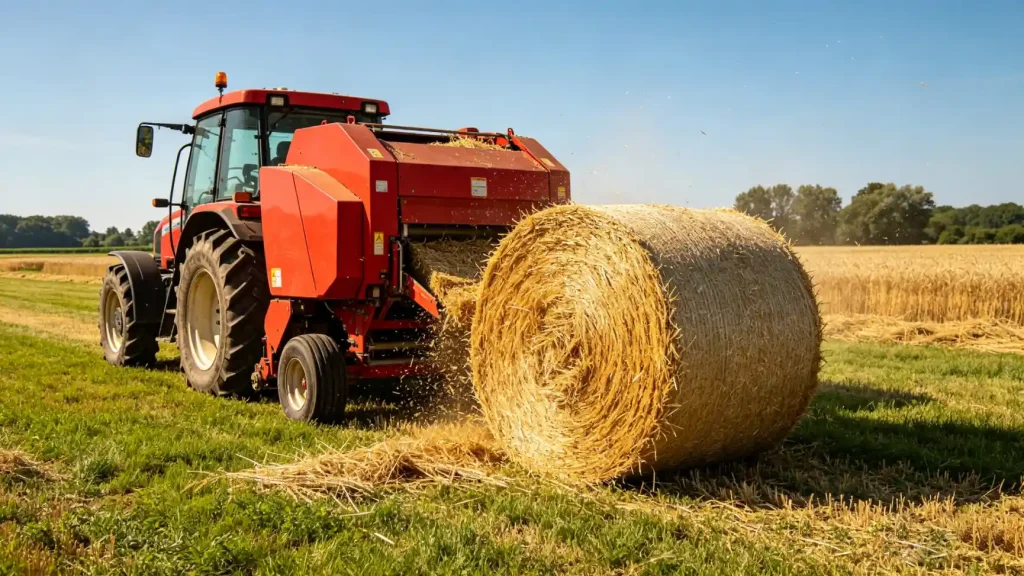
The Case for Round Hay Balers
Round balers dominate the global hay-baling market for good reasons rooted in physics and economics, not fashion.
Weather resistance is the killer feature. A net-wrapped round bale left in the field on grass for 12 months loses approximately 5-10% of its dry matter. The same hay in a small square bale, exposed to the same conditions, would lose 60-90% of its value within weeks. This single fact transforms the storage equation: if you don’t have indoor storage for your entire crop, round bales aren’t a preference — they’re a necessity.
Throughput per labor-hour is significantly higher. A single operator with a tractor and a round baler can produce 100-200 large bales per day. Producing the equivalent tonnage in small squares requires the same operator plus a wagon crew of 2-4 people stacking. In labor-tight markets — which describes most developed economies — round balers are the only economically viable option for mid-size operations.
Mechanical simplicity translates to reliability. Round balers have no knotter mechanism — the source of most square baler downtime. Fewer moving parts means fewer failure points, lower maintenance costs, and shorter learning curves for new operators.
Initial cost is typically lower for equivalent tonnage capacity. A 4×5 round baler at $35,000-$45,000 will outproduce a $25,000 small square baler in tons per season. On a dollar-per-ton-capacity basis, round balers are usually the more affordable choice.
The Case for Square Hay Balers
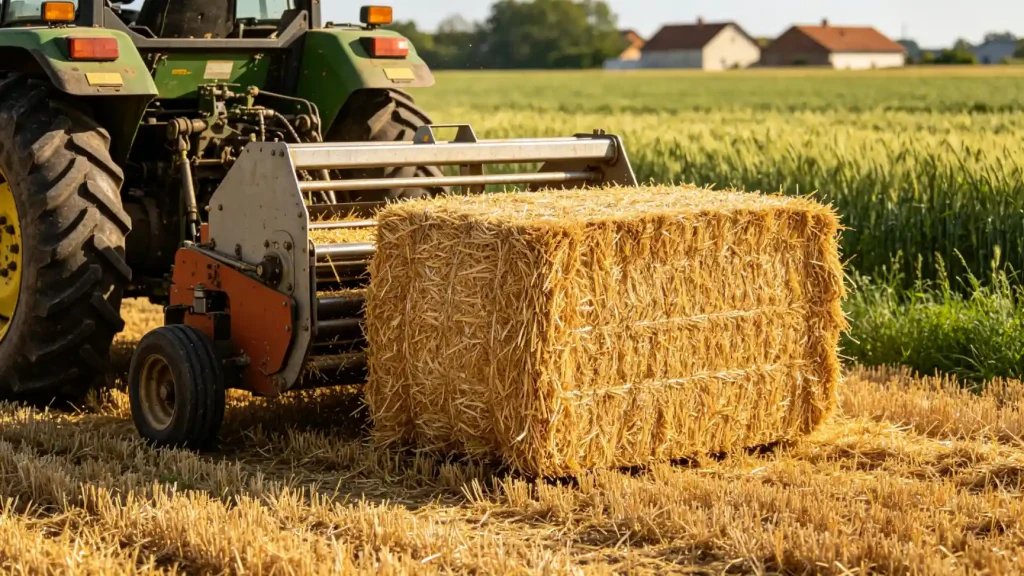
Despite round balers’ market dominance, square balers retain irreplaceable advantages in specific operations.
Premium pricing in the right market. The horse market pays a 20-40% premium per ton for small square bales over equivalent-quality round bales. For producers selling into this segment, that price differential more than covers the additional labor and storage costs. Premium alfalfa for dairy and export markets often follows the same pattern.
Storage and transport efficiency. A semi-truck loaded with large square bales hauls 30-40% more tonnage than the same truck loaded with round bales. For hay shipped over distance — especially export hay — this is a make-or-break economic factor.
Manageable feeding portions. A small square bale “flake” weighs 4-6 pounds — exactly the right size to throw to a few horses or a small group of livestock. A 1,200-pound round bale must be unrolled, fed in a feeder ring, or ground — all of which require additional equipment investment.
Indoor stacking density. Square bales stack tight against barn walls with no wasted volume. Round bales waste 20-30% of barn cubic feet to the inevitable gaps between cylinders. If indoor storage is a constraint, square is more efficient.
Cost-Per-Bale Economics: A Real Calculation
The headline price of the baler is just the entry fee. What actually matters is cost per bale produced over the life of the equipment. Let’s run honest numbers for a typical mid-size operation baling 50,000 lbs of hay annually.
Round Hay Baler — 4×5 Bales (1,000 lbs each = 50 bales/yr)
- Baler purchase: $35,000 ÷ 15-yr life = $2,333/yr
- Net wrap (50 bales × $3.50): $175/yr
- Maintenance & parts (5% of purchase): $1,750/yr
- Twine/wrap downtime & misc: $300/yr
- Total: $4,558/yr ÷ 50 bales = ~$91 per bale ($91 per 1,000 lbs of hay = $182/ton)
Small Square Baler — 60-lb bales (833 bales/yr for same tonnage)
- Baler purchase: $28,000 ÷ 15-yr life = $1,867/yr
- Twine (833 bales × $0.10): $83/yr
- Maintenance & parts (7% of purchase): $1,960/yr
- Labor (extra wagon crew, 833 bales × 1 min × $20/hr): $278/yr
- Total: $4,188/yr ÷ 833 bales = ~$5 per bale ($5 per 60 lbs of hay = $167/ton)
On a per-ton basis, the two systems are remarkably close. The differentiator becomes price realized at sale: if your local market pays $300/ton for square bales but only $200/ton for round bales (typical horse vs. cattle market spread), squares win economically. If those prices are inverted in your market — round wins.
📚 Read next: For a deep dive on per-bale cost calculation including all hidden expenses, see our Hay Baler Price Guide. To match a baler to your tractor, see Hay Baler Tractor HP Requirements.
Recommendations by Operation Type
Cattle / beef operation, 50-300 head
Round baler — net wrap, 4×5 or 5×5. Outdoor storage works, single operator can handle the full hay program, feeding is straightforward with a bale feeder ring.
Horse boarding / equestrian business
Small square baler — premium pricing, customer expectations, manageable feeding portions. Storage in a barn is mandatory.
Dairy operation
Both, depending on forage strategy. Round balers (silage-rated) for baleage; square balers for dry hay if buying premium alfalfa is part of the ration.
Commercial hay producer / contract baler
Both, ideally. Different customers want different bales. Operators serving 100+ customers typically run a fleet that includes both types and a large square baler for export-grade premium.
Small farm / homestead, under 20 acres
Mini round baler if you have a subcompact tractor; compact square baler if you have a 25-35 HP tractor and prefer manageable bales.
Export / large-scale commercial
Large square baler. Transport density is everything when shipping by container or truck across continents.
Common Misconceptions
“Round bales are always cheaper to make.” Not always. If you already own square baler equipment and your customers pay premium prices for squares, switching to round can actually reduce profitability.
“Square bales always store better than round.” Only with indoor storage. A net-wrapped round bale outdoors will outlast a square bale outdoors by an order of magnitude.
“You can use any tractor for any baler.” Absolutely not. A 40 HP tractor will struggle with a 5×6 round baler regardless of how flat your ground is. Match the tractor to the baler before anything else.
“Round balers are old-fashioned.” The opposite is true. Modern round balers feature net wrap, in-cab density control, moisture sensors, and bale wrapping — they’re now the most technologically advanced segment of the haymaking equipment market.
Frequently Asked Questions
Can I produce both round and square bales with one machine?
No. Round and square balers use fundamentally different bale-formation mechanisms. Operations needing both types run two separate machines.
Which bale type is more popular globally?
Round bales account for roughly 65-70% of global hay production. Small squares dominate horse-market regions; large squares dominate export and biomass markets.
Do round bales really shed water that well?
Yes — net-wrapped round bales stored on a base off the ground (gravel, pallets, or a well-drained slope) hold up remarkably well outdoors for 12+ months. Twine-tied rounds without net wrap perform less well.
What about hay loss during feeding?
Round bales fed without a feeder ring lose 30-50% to trampling and waste. With a proper bale feeder, that drops to 5-15% — comparable to square bales. Always budget for a feeder when running rounds.
The Bottom Line
Round vs square is rarely a “better/worse” question — it’s a “right tool for the job” question. The most successful operations we serve choose based on three brutally practical criteria:
- What does your end market actually pay for?
- What storage do you have?
- What labor is available?
Answer those three questions honestly, and the right baler type usually picks itself.
⭐ NEED HELP DECIDING?
Get a Free Operation Assessment
Tell us your operation size, market, storage, and tractor — our engineers will recommend the right baler type and model with a tailored quote within 12 business hours.
About this guide: Compiled by the engineering team at Canada Hay-Balers Co., Ltd, manufacturer of round and square hay balers exported to 40+ countries. ISO 9001 certified, 100+ technical patents.