
Straw as a Revenue Stream: The Opportunity After Grain Harvest
For Canadian grain producers growing wheat, barley, oats, or canola, the straw left behind after combining represents a significant secondary income opportunity that many operations are still leaving on the ground. At current baled straw prices of $35 to $80 per round bale depending on location, crop type, and end market, a 400-acre wheat farm generating 2.5 bales per acre on a light removal rate produces 1,000 bales with a gross value of $35,000 to $80,000 — revenue generated from material that would otherwise be burned, incorporated, or left to decompose. This guide covers the timing, equipment, agronomic considerations, and market options that allow grain producers to maximize the value of cereal straw while protecting long-term soil health.
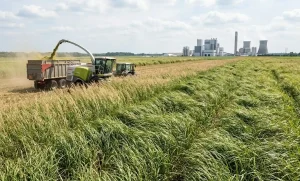
Understanding Straw Quality Differences Between Cereal Crops
Not all cereal straw commands the same market value, and quality differences between crops affect both feed utility and bedding performance:
| Straw Type | Feed Value (TDN%) | Bedding Quality | Typical Market Price (CAD/bale) |
|---|---|---|---|
| Oat straw | 45–50% | Excellent (soft, absorbent) | $55–80 |
| Barley straw | 40–45% | Good (softer than wheat) | $45–65 |
| Wheat straw | 35–42% | Good (standard industry bedding) | $40–60 |
| Canola straw | 30–36% | Poor (brittle, low absorbency) | $25–40 |
| Flax straw | 28–34% | Limited (tangles in equipment) | $30–45 (industrial/biofuel) |
Oat straw commands the premium price in most Canadian markets because of its combination of acceptable feed value (usable as a roughage extender for dry beef cows), soft texture preferred for horse and livestock bedding, and high moisture absorption relative to wheat straw. Prairie dairy operations in Alberta frequently pay a significant premium for clean, dry oat straw over wheat straw for calf and heifer bedding.
Optimal Timing for Post-Harvest Straw Baling in Canada
The post-harvest baling window in Canada varies by region and crop type, but the fundamental principle is consistent: bale as soon as field conditions allow after combining, before the straw absorbs moisture from morning dew cycles or rain events.
- Ideal baling moisture: 12 to 16 percent for long-term storage. Most Prairie straw after a dry August harvest can reach these levels within 24 to 72 hours of combining.
- Prairie timing: Late July through September, tightly linked to harvest completion. In southern Alberta and Saskatchewan, the window can be compressed by early September rain events.
- Ontario timing: Late July through August for winter wheat straw; late August through September for fall-seeded barley. The more humid climate of Southwestern Ontario means tighter moisture management windows than the Prairies.
- BC Interior timing: August through early September, with fire season conditions often producing naturally low-humidity conditions that accelerate field drying in the Okanagan and Thompson regions.
Combine Chopper Settings and Straw Swath Management
The decision about how to handle straw begins at the combine. Producers planning to bale straw have two options for swath management during grain harvest:
Full windrow option: Disengage the combine straw chopper entirely and allow the straw to fall as a full-length windrow behind the combine. This produces the most uniform windrow for baling but requires the windrow to be wide enough to spread field drying while being narrow enough to fit cleanly into the baler pickup. A combine header width of 25 to 30 feet typically produces a windrow that can be baled directly without raking — a significant time and cost saving.
Partial chop option: Run the combine chopper at a moderate setting that cuts straw to 15 to 20 cm lengths rather than the typical 8 to 12 cm full-chop setting. This is a compromise that allows reasonable baling while still providing some residue incorporation benefit for the remaining straw. It is the most common approach on Prairie operations that bale from 25 to 40 percent of the straw and incorporate the rest.
Raking for Baling: When Is It Necessary?
If the combine windrow is not wide enough to produce consistent bales without double-raking, a single rake pass to merge two rows can significantly improve baler throughput. However, raking dry straw requires care:
- Rake dry straw in the morning or late afternoon when relative humidity is higher — this reduces shattering of brittle straw heads that remain in the windrow.
- Set rake tines high enough to avoid soil pickup, which increases ash content and reduces the bedding and feed appeal of the finished bale.
- For horse bedding markets where cleanliness is a premium factor, soil-free straw commands meaningfully higher prices — the rake height setting is worth the time to calibrate precisely.
Baler Selection and Configuration for Straw Operations
Straw baling imposes different demands on equipment than hay baling. The key differences:
- Lower density requirements: Straw bales do not need to match the density required for high-moisture silage or haylage. A looser, lighter bale is generally acceptable for both bedding and roughage feed markets, which reduces the power demand on the tractor during baling.
- Twine vs net wrap for straw: Twine-tied straw bales are widely accepted for both bedding and industrial markets. Net wrap adds per-bale cost that may not be recovered in the straw market price unless the operation is specifically targeting horse bedding buyers who prefer the cleaner exterior of net-wrapped bales.
- Pickup wear: Cereal straw at harvest moisture is abrasive. Inspect pickup tines and belts at the midpoint of straw season and carry replacement tines in the tractor cab during operation.
The YG-1.0C Round Straw Baler Machine is purpose-designed for cereal straw operations with a pickup and chamber system optimized for the lower-density, higher-volume windrow profile typical of post-combine straw rows. For larger grain farm operations seeking to bale straw across multiple fields in a compressed post-harvest window, the 9YG-2.24D S9000 Beyond Round Baler delivers the throughput capacity and field reliability needed to complete large-volume straw harvest before weather events arrive.
Consistent tractor PTO performance throughout the straw harvest is essential for maintaining forward speed and bale density uniformity. A well-maintained agricultural PTO driveline rated to the baler peak torque specification prevents mid-field shaft failures that halt operation during the narrow post-harvest window.
Straw Markets in Canada: Who Is Buying and at What Price?
The Canadian straw market has diversified significantly in the past decade. Understanding your regional market options allows you to target the highest-value buyer category for your straw type and quality:
- Livestock bedding (cattle, horses, swine): The largest volume market in most Prairie provinces. Oat and wheat straw in clean, well-formed bales at 12 to 15 percent moisture. Prices highest in late winter when ranch operations run short of on-farm supply.
- Cattle feed — roughage extender: Barley and oat straw as a supplement to lower-quality hay rations in beef cow-calf operations during mid-winter feeding. Requires protein supplementation to balance the ration. Price is typically 30 to 40 percent below equivalent-quality grass hay.
- Mushroom substrate production: Wheat straw as a primary growing medium for oyster and other specialty mushroom producers, which has expanded significantly in BC and Ontario. Requires a specific low-moisture, high-cleanliness standard and often carries modest price premiums above standard bedding straw.
- Biomass and pellet fuel: Wheat and barley straw for co-firing in industrial boilers or for pellet manufacturing. Typically pays the lowest per-tonne price but accepts larger quantities — a useful market for straw that does not meet bedding quality standards.
- Construction and landscaping: Straw bales for erosion control, slope stabilization, and garden mulch. Typically a small-volume, regional market that pays above-average per-bale prices for clean, weed-free product.
Agronomic Safeguards: Protecting Your Field While Harvesting Straw
As with corn stover, cereal straw removal must be managed within an agronomic framework that protects long-term soil health. The following guidelines apply to Prairie and Ontario grain farms:
- Remove straw from no more than 50 percent of your crop acres in any given year in a no-till or minimum-till system.
- On fields with slopes above 3 to 4 percent, limit straw removal to 25 percent of available straw or avoid removal entirely and prioritize residue cover over revenue.
- In drought years where straw yields are below 1.5 tonnes per hectare, skip straw baling entirely — the soil protection value of the limited residue exceeds the revenue potential.
- On fields where straw is removed, apply a nitrogen fertilizer credit of 6 to 8 kg N per tonne of straw removed in the following season fertilizer plan.
- Track soil organic matter on straw-removal fields annually and adjust removal frequency if OM trends below your field-specific target level.
Straw Baling Equipment for Canadian Grain Producers
Canada Hay-Balers Co., Ltd supplies round baler equipment suited to cereal straw harvesting across the Prairie provinces, Ontario, and BC. Our team can advise on equipment selection for your specific crop type, field scale, and target straw market. Contact us for a product recommendation matched to your operation.
Canada Hay-Balers Co., Ltd
10055 Hogarth Dr, Richmond, BC V7E 3Z9, Canada
[email protected]