

Wheat and rice straw are among the world’s most abundant agricultural residues — and two of the most underutilized. In Canada’s Prairie provinces, an estimated 15–20 million tonnes of wheat straw are produced annually; a fraction is baled for livestock use, and the rest is burned, incorporated, or left to break down. In major rice-growing regions of Asia, Southeast Asia, and the Sacramento Valley of California, open-field burning of rice straw remains a significant air quality issue precisely because on-farm baling infrastructure is insufficient for the volume produced.
Yet straw markets are growing. Livestock demand for bedding is rising with intensified confined animal feeding operations (CAFOs). Biomass energy facilities are actively seeking contracted straw supply. The specialty growing sector — mushrooms, hydroponic systems, thatched roofing, and construction insulation — pays premium prices for clean, dry, consistently baled straw. For grain farmers operating in these regions, adding a straw baler to the post-harvest workflow is one of the highest-return equipment investments available per dollar of capital deployed.
This article covers the practical and commercial differences between wheat and rice straw baling, the specific machine requirements for each crop, field operation protocols, and how Canada Hay-Balers Co.’s equipment lineup serves both categories.
Wheat Straw vs. Rice Straw: A Field-Level Comparison
While both are cereal crop residues, wheat and rice straw have meaningfully different physical and agronomic properties that affect baling equipment selection, timing, and downstream market suitability.
| Property | Wheat Straw | Rice Straw |
|---|---|---|
| Stalk structure | Hollow, relatively uniform, 3–6 mm diameter | Hollow, fine-stemmed, high silica content |
| Silica (SiO₂) content | 3–5% of dry matter | 10–18% of dry matter — very abrasive |
| Moisture at harvest | Often 12–18% — typically ready to bale within 24–48 hrs of combining | 25–50% at harvest — requires 3–7 days field drying |
| Pickup challenge | Generally good on standard spring-tooth; long stems can wrap | Very fine stems lose material through wide-tooth pickups; high abrasion wear on rollers |
| Bale density achievable | 80–130 kg/m³ | 60–100 kg/m³ (lower due to silica stiffness) |
| Livestock feed value | Low but accepted as roughage supplement; 3–5% CP | Very low; primarily bedding and industrial use |
| Combustion energy value | ~15 GJ/tonne dry | ~13–14 GJ/tonne dry (ash higher) |
| Primary markets | Livestock bedding, feed roughage, biomass, thatching | Bedding, biomass, mushroom substrate, construction insulation |
The most important practical implication of the silica difference: rice straw accelerates wear on baler pickup tines, rollers, and chamber linings at roughly 2–3 times the rate of wheat straw. Equipment serviced for rice straw duty must have hardened roller surfaces and more frequent maintenance intervals — a factor to confirm with your equipment supplier before committing to a high-volume rice straw operation.
Wheat Straw Baling Operations: Field Protocols for Prairie and Mixed Grain Farms
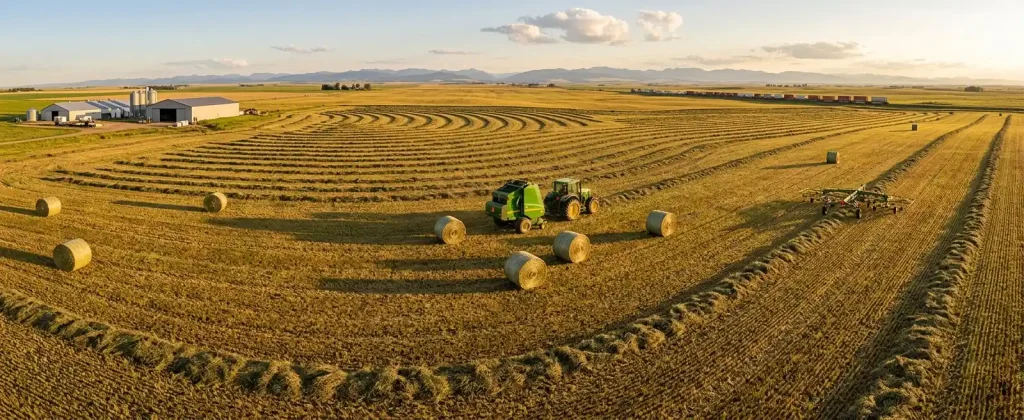
Wheat straw baling on Canadian prairie farms is a mature, well-understood operation. The combine cuts and threshes grain, leaving windrows of straw behind the header. In most years, if combining is done in dry weather, straw is ready to bale within 24 hours on the windrow. The critical management decisions are:
1. Windrow Density
Combine spreader width determines windrow geometry. Wide-spread straw (6+ m) may need a single merging pass with a hay rake before baling for consistent windrow width and bale weight uniformity.
2. Chaff Separation
Modern combines spread chaff with straw. Chaff-dominated bales have higher moisture retention and mold risk. On farms with chaff spreaders separate from straw, timing is easier to manage.
3. Dew and Morning Moisture
Windrow surface moisture from dew can spike readings. Start baling mid-morning, not at dawn. Probe the interior of the windrow — not the surface — for an accurate moisture check.
4. Wrap System Selection
Twine is cost-effective for straw baled into covered storage within 30 days. Net wrap is essential for outdoor stacked straw destined for sale 60+ days post-harvest.
For Saskatchewan and Alberta grain farms baling wheat, oat, or barley straw as a seasonal add-on operation, the 9YG-1.0 Round Baler offers an accessible entry point — it handles straw cleanly on standard spring-tooth pickup and requires only 40–55 HP tractor PTO power, making it compatible with the utility tractors commonly found on Prairie mixed-grain farms.
Rice Straw Baling: Managing the Silica Challenge
Rice straw baling is more technically demanding than wheat straw and is a growing priority in regions where open burning bans have been enacted. California’s San Joaquin Valley and Sacramento Valley, where rice burning restrictions have been progressively tightened since the 1990s under California’s Smoke Management Program, are the largest North American markets for rice straw baling services and equipment.
The primary management issues in rice straw baling are: high post-harvest moisture requiring a multi-day drying window; the risk of mold if baled too wet; and accelerated mechanical wear from silica abrasion. The following protocol reduces losses:
- Allow 4–7 days field drying after combine harvest before baling. Target windrow moisture below 20% for twine-wrapped bales destined for bedding markets; 18% or below for biomass buyers who specify moisture in contracts.
- Reduce tine spacing on pickup or choose a machine with tight-tine pickup for rice straw — the fine stems fall through wide-gap pickups, reducing yield. The YG-1.0C straw baler’s pickup geometry is well-suited to fine-stemmed straw types including rice.
- Increase roller inspection frequency — rice silica accelerates wear. Plan to inspect bale chamber roller surfaces every 200–250 bales when running rice straw, versus every 400–500 bales on grass hay. Replace worn rollers proactively to prevent bale shape irregularities.
- Always net-wrap rice straw bales. The low bulk density and silica-stiffened fiber structure produce bales with high spring-back. Net wrap counteracts this and dramatically reduces surface shedding during transport and storage.
- Store finished bales off-ground on gravel pads and cover with tarps where possible. Rice straw bales are more hydrophilic than wheat and will wick ground moisture rapidly.
Equipment Selection for Wheat and Rice Straw
Canada Hay-Balers Co. offers two machines that serve the wheat and rice straw segment most effectively:
9YG-1.0 Round Baler — Prairie Wheat Straw Standard
For Prairie grain farms baling clean wheat, oat, or barley straw in drier conditions where spring-tooth pickup performs well, the 9YG-1.0 delivers consistent 100–200 kg bales with low power demand. Its axial-flow feeding system reduces clogging on normal straw windrows and is easy to maintain through a busy harvest season. Requires 40–55 HP.
- Axial-flow feeder — reduces clogging in normal wheat straw conditions
- Simple mechanical design — minimal maintenance complexity during harvest
- Twine and net wrap support — flexible for different end-market requirements
Straw Market Pricing: A Canadian Reference Guide
Straw prices vary significantly by region, crop type, moisture content, and delivery terms. The following are approximate farm-gate and delivered reference prices based on Prairie Canada market observations:
| Straw Type | Market | Farm-Gate Price (CAD) | Delivered Price (CAD) |
|---|---|---|---|
| Wheat straw (dry, clean) | Livestock bedding | $18–30/bale | $35–55/bale |
| Wheat straw | Biomass (contracted) | $20–38/tonne | $45–70/tonne |
| Oat straw (premium) | Horse bedding | $28–42/bale | $50–75/bale |
| Barley straw | Cattle bedding / roughage | $15–25/bale | $30–45/bale |
| Rice straw (dry, <18%) | Mushroom substrate | $22–45/bale | $50–80/bale |
Straw Removal and Soil Health: The Prairie Agronomist’s Perspective
The most common agronomic objection to wheat straw baling is the concern over organic matter depletion. This is a legitimate consideration, particularly on lighter Prairie soils. The current consensus from Prairie agronomists and Agriculture and Agri-Food Canada (AAFC) is that:
- Removing <50% of straw in rotation with canola residue retention does not meaningfully reduce soil organic matter (SOM) on medium and heavy clay loam soils over a 5-year horizon, provided crop rotation includes legume cover crops.
- On sandy or light loam soils, straw removal should be balanced with manure applications (an existing resource on livestock-grain mixed farms) or cover crop incorporation.
- No-till systems benefit more from residue retention than minimum-till, so farms transitioning to no-till should reassess straw removal rates accordingly.
- Straw baling revenue often pays for the potassium and sulphur amendments needed to maintain soil fertility, making the net agronomic and economic outcome positive on most Prairie mixed operations.
Frequently Asked Questions — Wheat & Rice Straw Baling
Q: How quickly can I bale wheat straw after combining?
In dry Prairie conditions, wheat straw can be ready to bale 12–24 hours after combining. Check windrow moisture (interior, not surface) — target below 18% for twine baling, below 16% for long-term outdoor net-wrapped storage.
Q: Can a standard hay baler handle wheat straw?
Yes — clean wheat straw on a well-formed windrow is within the operating range of standard spring-tooth round balers like the 9YG-1.0. Rice straw, mixed chaff-and-straw, or wind-tangled windrows may benefit from the hammer-claw pickup of the YG-1.0C.
Q: Is net wrap necessary for straw, or does twine work?
Twine works well for straw baled into covered storage and used within 60 days. For straw stacked outdoors and sold over winter or spring, net wrap significantly reduces weather deterioration and maintains bale geometry through freeze-thaw cycles.
Q: Is rice straw profitable to bale in Canada?
Rice is not a major Canadian crop. However, for operations near rice-growing regions in the US (California, Arkansas) exporting to mushroom growers or biomass facilities, contracted rice straw baling can be highly profitable. The key is securing a delivery contract before investing in equipment, as rice straw markets are more specialized than wheat.
Q: How long can straw bales be stored before quality degrades?
Net-wrapped wheat straw bales stored on elevated ground in a single-layer layout can maintain <20% moisture and acceptable quality for 18–24 months. Stacked bales and ground-contact bales degrade significantly faster due to moisture wicking and restricted airflow at contact points.
Q: Do I need to tell buyers what the straw moisture is?
Biomass buyers almost always have moisture specifications in their contracts (typically <20–25%). Bedding buyers care more about visible mold and cleanliness. Always disclose moisture at sale for commercial transactions — misrepresentation of wet bales as dry is a common source of commercial disputes in the straw market.
Start Baling Straw Profitably This Harvest Season
Whether you’re baling Prairie wheat straw for livestock or specialty rice straw for the mushroom market, Canada Hay-Balers Co. has a purpose-built machine for your operation. Our team can match you to the right baler based on your crop, tractor, acreage, and end market.
Contact us: [email protected] · Richmond, BC, Canada · Free B2B Quote — Ships Worldwide
editor:WM