
BEEF CATTLE RANCHING & WINTER HAY SYSTEMS
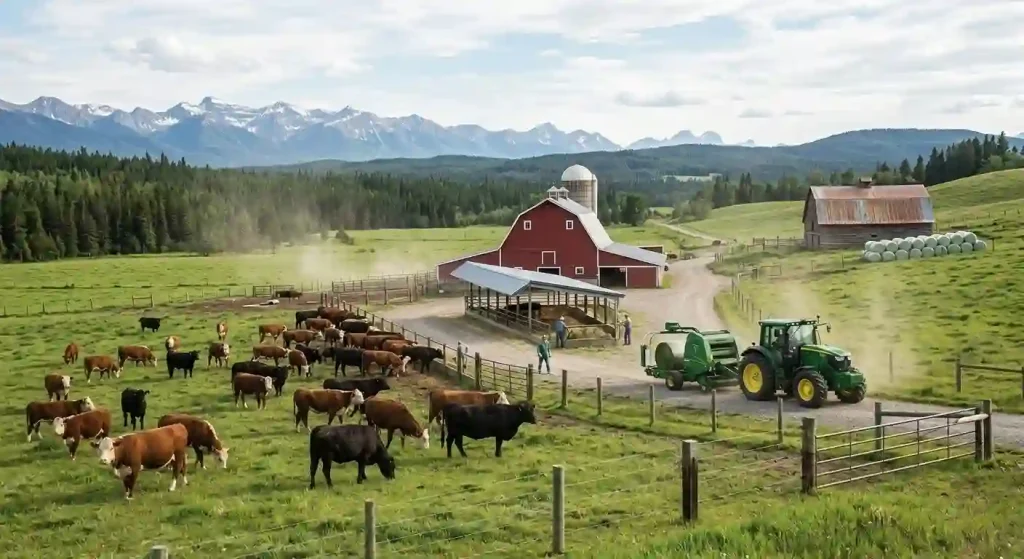
On a beef cattle ranch, hay is the foundation of winter survival. The difference between a well-stocked hay yard and a short one is not measured in dollars per bale in October — it is measured in body condition scores in February, conception rates in May, and calf weights at weaning in September. Getting the baling operation right during the brief Canadian hay season is one of the most consequential decisions a beef producer makes each year.
How Round Bales Became the Standard for Canadian Beef Operations
Round bales have dominated beef cattle hay systems across western Canada and the northern plains for over four decades, and for straightforward, practical reasons. A large round bale weighing 500 to 700 kg represents more than two weeks of feed for a mature beef cow, reducing the frequency of handling and feeding labor to a manageable routine even on large operations with limited staff.
The geometry of the round bale is itself a storage advantage. A well-formed cylindrical bale sheds precipitation from its curved surface, allowing outdoor field storage or simple covered rows without the significant dry matter losses that accumulate on the flat, exposed faces of square bales stored outdoors. This is critical on the Canadian prairies and in the BC Interior, where hay must often bridge five to six months of winter feeding before the first grass is available in spring.
From a labor perspective, round bales are handled with common equipment already present on beef ranches — a front-end loader or bale spear mounted on a farm tractor. This eliminates the specialized handling chains and conveyors required for large square bales and keeps the total equipment investment accessible for operations of all sizes.
Calculating Your Ranch’s Annual Baling Requirement
The most persistent cause of hay shortfalls on beef ranches is optimistic inventory planning. Producers consistently underestimate their true feeding requirement by overlooking the compounding effect of small overages in daily feed consumption, feed wastage, and the additional feed burden created by extended cold periods or late springs that delay pasture turnout.
A practical planning framework for a beef cow-calf operation starts with the base requirement: a dry beef cow in good body condition consuming quality grass hay at 2% of body weight per day requires approximately 13 to 14 kg of dry matter. A lactating cow in the first three months after calving increases that requirement to 16 to 18 kg. Replace any bale-weight figures you use in planning with verified bale dry matter weights rather than as-baled weights, as net wrap-measured bale mass does not account for moisture.
The following table provides a starting point for ranch-level inventory planning across different herd configurations. Add 15% to any calculated total as a weather and quality reserve, and plan to carry at least 30 days of surplus feed into the following spring to avoid purchasing at peak winter hay prices.
| Herd Category | DM/Head/Day | Bales/100 Head/180 Days | Assumed Bale DM (kg) |
|---|---|---|---|
| Dry beef cows (500 kg avg.) | 10 kg | 360 | 500 kg DM |
| Cow-calf pairs (lactating) | 14 kg | 504 | 500 kg DM |
| Yearling steers/heifers | 7 kg | 252 | 500 kg DM |
| Bulls | 12 kg | 432 | 500 kg DM |
Baler Selection for Beef Ranch Operations
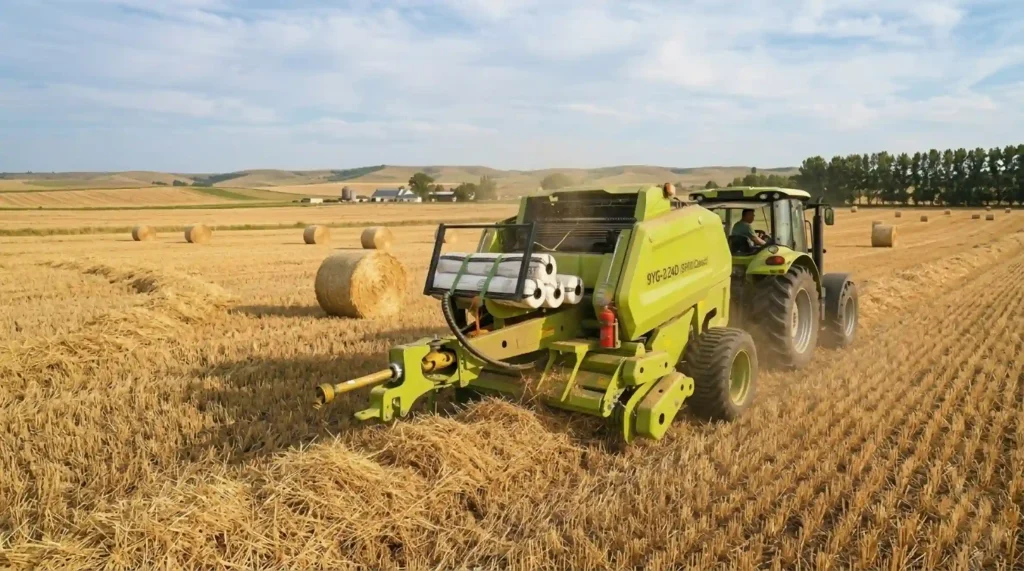
Beef ranches typically operate in one of two baling configurations: owner-operated equipment baling their own acreage, or a combination of own-baling and custom contractor services for peak-season overflow. Both approaches benefit from equipment that maximizes throughput during the narrow baling windows that characterize Canadian summer weather patterns.
For a ranch baling between 800 and 3,000 bales annually — a range typical of Alberta and Saskatchewan cow-calf operations with 200 to 600 animal units — the priority specifications are: reliable belt drive with minimal adjustment requirements during a long field day, a net wrap system that produces consistent bale wrap quality at speed, and a pickup reel engineered to handle the heavy, mature grass windrows typical of late-season native and tame pasture cuts.
The 9YG-2-24D S9000 Classic Round Baler is well-positioned for the beef ranch market, combining proven chamber design with a low maintenance profile suited to operations where the equipment operator is also the ranch manager, veterinarian, and parts-chaser. For larger-volume operations seeking maximum throughput, the 9YG-2-24D S9000 Beyond delivers enhanced capacity and advanced belt management systems that reduce downtime during extended baling runs.
Round Bale Feeding Systems for Beef Cattle
How you feed round bales has a larger impact on actual feed cost per cow than nearly any other management variable. Feed wastage from poorly managed round bale feeding routinely reaches 30 to 45% in operations where bales are simply rolled out on the ground without confinement — the equivalent of throwing away nearly half of your hay crop before the cow ever touches it.
Covered ring feeders — the cone-style hay rings with a solid top cover — consistently produce the lowest wastage rates in Canadian trials, typically 3 to 8%. Open-ring feeders without covers produce 10 to 20% wastage depending on stocking density. Unrolling bales in strip-grazing patterns or row-feeding on frozen ground is practical for large groups but requires careful management to prevent bale pile-up and selective grazing.
Covered Ring Feeder
3–8% waste. Best ROI for confined winter feeding yards. Reduces rain/snow contamination and trampling losses significantly.
Recommended for: Confined winter lots
Open Ring Feeder
10–20% waste. Lower capital cost. Adequate for operations with moderate stocking density and shelter from prevailing weather.
Recommended for: Small-medium herds
Bale Unrolling
25–45% waste on bare ground, 15–25% on frozen ground. Labor intensive but enables controlled strip-grazing of large groups.
Recommended for: Large pasture groups
Timing Your Beef Ranch Baling Operation
The beef cattle hay calendar in Canada’s major production regions runs from mid-July through mid-September for the primary baling window, with significant regional variation. In BC’s Interior and in southern Alberta and Saskatchewan, the window opens as early as late June for first-cut irrigated fields and can extend into late September for native range and fall regrowth. In northern Alberta and Manitoba, the window compresses to July and August, with frost risk accelerating end-of-season pressure significantly.
Experienced beef producers consistently emphasize the value of not cutting more hay than you can bale within a reliable forecast window. A windrow that sits through a rain event loses 10 to 20% of its sugars and protein through leaching and respiration before it is even baled. The ability to bale quickly after sufficient wilting — ideally within 36 to 48 hours of cutting in good drying weather — depends entirely on having dependable equipment with the throughput capacity to keep pace with your mowing operation.
Minimizing Round Bale Storage Losses on the Ranch
Outdoor bale storage is the default for most beef ranches, and with proper site preparation it can achieve remarkably low losses. Place bales on well-drained sites — a 15 to 20 cm layer of crushed gravel or coarse stone base reduces ground-contact spoilage by 60 to 70% compared to direct soil contact. Orient rows north-south to equalize sun exposure on both sides. Space rows at least three meters apart to allow tractor-width access and air circulation.
On flat terrain in high-precipitation areas such as BC’s coastal interior regions, consider covering rows with breathable hay tarps or purpose-made outdoor bale covers. These reduce weathering losses from the typical 8 to 15% for uncovered outdoor bales to 3 to 6%, and the capital cost per bale covered is typically recovered within one or two storage seasons through reduced spoilage losses.
Finally, inventory your bales after storage and before feeding begins. Visually inspect outer bale surfaces for mold and decomposition, verify net wrap integrity, and remove any bales showing significant deterioration to a separate feeding area where they can be fed to low-priority stock rather than mixed into the primary cow herd ration.
Frequently Asked Questions
How many acres of hay do I need per beef cow for a 180-day Canadian winter?
A common planning estimate is 1 to 1.5 acres of productive tame hay per cow-calf pair for a 180-day winter, assuming yields of 1.5 to 2.5 tonnes per acre for a single cut. Operations in higher-rainfall areas or with irrigated fields can often reduce that land requirement significantly. Native pasture baling at 0.3 to 0.8 tonnes per acre requires proportionally more land to meet the same requirement.
What causes round bales to heat excessively after baling?
Excessive heating in freshly baled round bales is caused by microbial respiration and is almost always moisture-related. Bales made at above 20% moisture provide sufficient water activity for aerobic bacteria and molds to metabolize the bale’s sugars and proteins, generating heat as a byproduct. Severe heating — above 60°C internal temperature — causes Maillard browning reactions that bind proteins in a form unavailable to cattle. These caramelized proteins appear as brown discoloration when the bale is opened and represent a real loss of available nitrogen in the ration.
Should I test my hay before winter feeding begins?
Yes. Near-infrared hay testing through a commercial forage lab costs $15 to $30 CAD per sample and takes 2 to 5 business days. Testing three to five representative bales from each cutting gives you the data needed to balance winter rations accurately rather than relying on estimated hay quality. Producers who test consistently report significant reductions in protein supplement purchases, because they can feed to actual nutritional content rather than applying a blanket supplement rate based on assumed average hay quality.
What is the best grass for beef cattle hay in western Canada?
Smooth bromegrass and orchardgrass blends dominate tame hay production across the prairies for their combination of yield, palatability, and protein content. Timothy is preferred in BC and the northern prairies for its winter hardiness and high palatability. Alfalfa-grass mixes significantly boost protein and energy density but require more management at baling to control bloat risk from pure legume consumption. For native range, blue grama, western wheatgrass, and fescue species form the backbone of the western Canadian beef hay base.
Can I feed net wrap along with the bale to cattle?
No. Net wrap must be completely removed before feeding. Net wrap is made from synthetic polymer materials that cattle will consume when exposed at the bale surface, leading to rumen impaction — a serious and potentially fatal digestive condition. Develop a consistent net wrap removal and disposal system before feeding begins each season, and inspect bales for residual net wrap fragments after removal. This is particularly important in ring feeder systems where cattle access the bale from multiple angles as it decreases in size.
Stock Your Ranch for a Full Canadian Winter
Canada Hay-Balers Co., Ltd. offers round balers matched to beef ranch-scale baling requirements — from compact starter models to high-throughput commercial units. Our team is based in Richmond, BC and ready to support your equipment selection, delivery, and after-sale service needs.
Canada Hay-Balers Co., Ltd. | 10055 Hogarth Dr, Richmond, BC V7E 3Z9 | [email protected]