
Industry Application — Livestock Bedding
Square Hay Balers for Poultry & Swine Bedding Production
Why straw in small square format is the preferred bedding material for broiler, turkey, and swine operations — and how to produce it efficiently.
Poultry and swine operations consume enormous volumes of bedding material. A commercial broiler barn housing 30,000 birds goes through several tonnes of straw per flock — and most integrated broiler producers run multiple flocks per year. Swine farrowing facilities require consistent deep-litter management throughout the production cycle. In both cases, the bedding material arrives in a format that can be handled efficiently by barn staff without machinery inside the facility itself.
That requirement — hand-distributable, no machinery in the barn — defines the format: small square bales. A single bale carried through a barn door, broken open, and spread by hand covers a meaningful area of floor. The process is scalable to any barn size and doesn’t require a tractor or loader inside the facility at any point during the bedding cycle.
Bedding Requirements by Species
Different livestock species have different bedding requirements, and understanding them shapes both the crop choice and the bale specification:
Broiler Chickens
- High absorbency essential — wet litter causes footpad dermatitis and breast blisters, both welfare issues and processor demerits
- Initial bedding depth: 5–8 cm; replenished between flocks
- Wheat and oat straw preferred for absorbency and dust levels
- Low moisture at baling (<14%) critical — wet straw in a broiler barn compounds litter moisture management problems
Turkey Houses
- Larger birds produce more manure per head — higher bedding volume requirements than broilers
- Turkeys manipulate bedding material more actively — a straw that holds together rather than breaking into short sections is preferred
- Barley straw’s softer stem holds up better under turkey activity than stiffer wheat straw in some facilities
- Deeper initial pack (8–12 cm) typical for larger bird sizes
Swine Farrowing & Finishing
- Farrowing pens use straw for nest building — sows instinctively build nests before parturition, and straw availability reduces stress-related behaviours
- Deep litter finishing systems use straw continuously — the composting action generates heat that benefits pigs in unheated barns through Canadian winters
- Chopped straw preferred in some farrowing systems — bale processors or hand-loosening of square bales provides this
- Weed-free straw important — sows in farrowing pens ingest significant straw
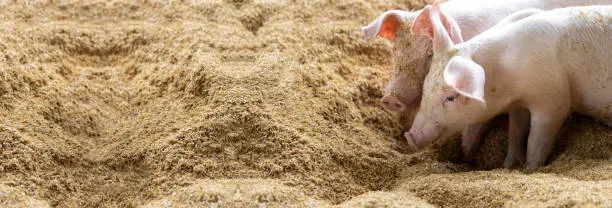
Why Round Bales Don’t Work in Barn Bedding Applications
Round bales are occasionally used in loose-housing livestock facilities, but they present operational problems that accumulate quickly in a managed barn environment. The issues are practical rather than theoretical:
- Access: Moving a 300–500 kg round bale into a poultry barn or through a swine facility doorway requires a front-loader and a door wide enough to admit one — most barn designs don’t accommodate this for daily bedding operations.
- Unrolling: Distributing straw from a round bale by hand is physically demanding and produces uneven coverage. A square bale broken into flakes distributes uniformly and can be targeted to areas of heavier use.
- Storage: Round bales stored outdoors near barns pick up moisture and external contamination. The outer 10–15 cm of a field-stored round bale is typically discarded in a managed bedding system. Square bales stored inside retain full usable volume.
- Quantity control: A round bale opened in a barn delivers 300+ kg of straw in one event. Managing exactly how much bedding is added on a given day is impossible with round bales and straightforward with square bales counted by the bale or flake.
Straw Quality Standards for Bedding Production
Bedding straw quality is less demanding than feed hay in terms of nutritional content, but has its own specific requirements:
Volume Planning for Integrated Poultry and Swine Operations
Commercial bedding volumes are large. Planning baling capacity against barn consumption is a useful exercise before purchasing equipment:
| Facility Type | Approx. Straw / Flock or Year | Bales Required (≈20 kg) |
|---|---|---|
| Broiler barn — 10,000 birds | ~5 tonnes/flock × 5–6 flocks | 1,250–1,500 bales/year |
| Broiler barn — 30,000 birds | ~15 tonnes/flock × 5–6 flocks | 3,750–4,500 bales/year |
| Turkey house — 5,000 birds | ~8 tonnes/flock × 2–3 flocks | 800–1,200 bales/year |
| Deep litter swine — 200 head | ~20–30 tonnes/year | 1,000–1,500 bales/year |
For a grain-growing farm supplying straw to a neighbouring integrated poultry operation, the volumes above indicate whether a baler investment makes sense. A 30,000-bird broiler facility consuming 4,000+ bales per year provides a stable, predictable demand base that justifies equipment ownership with a manageable payback period — particularly when the baler also services hay production for the grower’s own livestock.
Equipment Recommendation for Bedding Straw Production
Straw baling for bedding markets favours throughput and consistency over fine density calibration. The 9YF-2200S Square Hay Baler is the appropriate configuration for farms producing both hay and bedding straw — the wider 2.2 m pickup width handles combined windrows after grain harvest efficiently, and the machine transitions between crop types without significant reconfiguration.
For high-volume straw bedding contracts where throughput in the post-harvest window is critical, the twin-chamber configuration doubles daily output from a single operator and tractor. Contact us at [email protected] to discuss which configuration fits your straw volume and delivery schedule, or visit our square baler product range for full specifications.
Canada Hay-Balers Co., Ltd
10055 Hogarth Dr, Richmond, BC V7E 3Z9 | [email protected]
Editor:WM