
Drum mowers have quietly become one of the best-kept secrets in small-farm hay equipment. They are simpler than disc mowers, cheaper to buy, almost impossible to plug, and surprisingly tough — many farmers report 20+ years of trouble-free service from a single unit. But not every drum mower is created equal, and matching one to your tractor takes more than reading the cutting-width number off a brochure. This drum mower buying checklist walks you through every spec that matters before you spend the money.
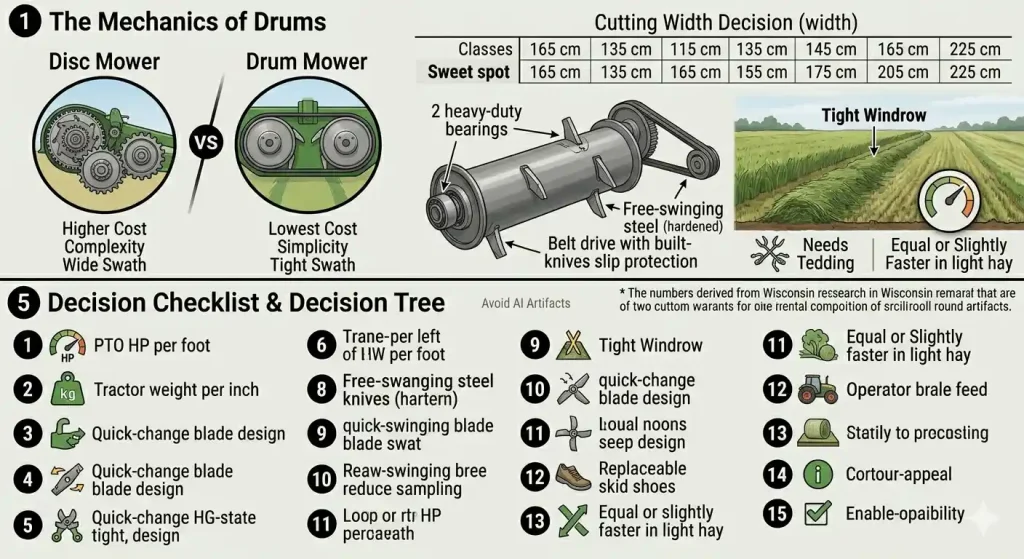
1. How a Drum Mower Works (and Why That Matters)
A drum mower uses two large vertical drums spinning in opposite directions. Free-swinging knives at the bottom of each drum cut the crop, and the drum bodies sweep the cut material inward, leaving a tight, narrow windrow. Power flows from the tractor PTO through a belt drive (most common) or a gearbox to the drum bearings.
The simplicity is the engineering benefit. With only two drums and a pair of bearings per drum, there are dramatically fewer wear points than a 5- or 6-disc cutterbar. Belt-drive units add a slip protection feature for free — if the knives hit a rock or stump, the belt slips before the drum gets damaged.
2. The Cutting Width Decision
| Cutting width | Drums | PTO HP | Tractor weight | Best for |
|---|---|---|---|---|
| 53 in (1.35 m) | 2 small | 25–40 HP | 2,500–4,000 lb | Compact tractors, orchards |
| 65 in (1.65 m) | 2 standard | 35–50 HP | 3,500–5,000 lb | Most small farms — the sweet spot |
| 74 in (1.85 m) | 2 large | 40–60 HP | 4,500–6,000 lb | Mid-size farms, light hay |
| 83 in (2.10 m) | 2 oversize | 55–75 HP | 5,500–7,000 lb | Top end of drum class |
The 165 cm (65 in) drum mower is the most popular size in the small-farm market for a reason — it pairs well with most 35–50 HP utility tractors and finishes 4–5 acres per hour in good conditions.
3. Weight — Often the Real Limiting Factor
Drum mowers hang to one side of the tractor. The drum housings, drive belt cover, and protective curtain all add up; even a “small” 65-inch drum mower can weigh 800–1,000 lb. Before you buy:
- Check your tractor’s 3-point hitch lift capacity at 24 in behind the link arms — this is where the mower’s weight effectively acts
- Look at the loaded weight balance with the mower in transport position; the front end of light tractors can lift
- If you operate on slopes, plan for 30% higher effective weight load due to leaning
4. PTO Speed and Shaft Compatibility
Almost all drum mowers run at 540 RPM PTO. A few European-market machines list 1,000 RPM as standard. Always confirm:
- PTO speed match: 540 RPM mower must connect to a 540 RPM tractor PTO. The PTO shaft yokes must mate (1 3/8 in 6-spline is the most common).
- Shaft length: Manufacturer-supplied PTO shafts are sized for a generic tractor. With a small or short-coupled tractor, the shaft may be too long; with a large tractor, too short. Measure before delivery.
- Slip clutch or shear bolt: Almost every quality drum mower includes one. Verify which it is and where the spare bolts are kept.
5. Hitch Category
Most drum mowers in the 53–74 in size range use Category 1 three-point hitches. Larger 83 in and trailed units may use Category 1/2. If your tractor has a quick-hitch system, confirm hitch pin spacing on the mower matches — adapter kits exist but are an extra cost item.
6. Blade Design and Replacement
Drum mower blades are simple, free-swinging steel knives, four to eight per drum. Things to check:
- Blade material — hardened tool steel; cheap mild-steel blades wear out in one season
- Quick-change blade design — bolt-on is fine, but quick-pin systems save 30 minutes a season
- Blade thickness — thicker blades resist breaking on small stones
- Replacement blade availability — confirm spares are stocked locally before you buy
7. Cutting Height and Stubble Control
Most drum mowers cut at a fixed height between 1 in and 2.5 in, controlled by skid shoes underneath the drums. Adjustments are mechanical (different bolt holes) rather than hydraulic. For grazed pasture or weed-heavy fields, look for a model with at least three height positions.
8. Working Speed and Productivity Expectations
Drum mowers run faster than disc mowers in light, dry crop because the drums sweep the material clear of the cutterbar. Realistic numbers:
- 53 in drum mower, 30 HP tractor: 2.5–3 acres per hour
- 65 in drum mower, 40 HP tractor: 3.5–5 acres per hour
- 74 in drum mower, 55 HP tractor: 4.5–6 acres per hour
One operational caveat: the windrow is tight. If you do not have a tedder, plan for either two raking passes or a longer drying time before baling.
9. Drum Mower vs. Disc Mower Quick Comparison
| Factor | Drum mower | Disc mower |
|---|---|---|
| Lowest HP supported | ~25 HP | ~35 HP |
| Maintenance complexity | Lowest | Medium |
| Plugging risk | Very low | Very low |
| Swath / windrow | Tight, narrow — needs tedding | Wide, fluffy |
| Speed in light hay | Faster | Equal or slightly slower |
| Speed in heavy first cut | Slower | Faster |
| New price (mid-size) | $1,800–$3,500 | $3,500–$10,000 |
| Service life | Excellent — 20+ years common | 10–20 years typical |
10. The Drum Mower Buying Checklist
Use this list before signing a purchase
- Cutting width vs. tractor PTO HP: 7 PTO HP per foot of cut as a rule of thumb
- Tractor weight: at least 70 lb of tractor weight per inch of cutting width
- 3-point hitch category: matches your tractor (Category 1 most common)
- PTO speed: 540 RPM standard — confirm match
- PTO shaft length and yoke: measured to your tractor specifically
- Slip clutch or shear protection: included; spares supplied
- Drum bearings: heavy-duty, sealed, replaceable
- Belt drive: tensioner adjustable; spare belt available locally
- Knife material and quick-change: hardened steel; bolt or pin design
- Cutting height range: matches your typical crop (1–2.5 in)
- Skid shoes: replaceable, with multiple height positions
- Safety curtain: full-coverage front and side guards
- Transport position: hydraulic or mechanical; folds vertical for road transport
- Spare parts availability: verify dealer stocks knives, bearings, belt, slip clutch
- Warranty terms: at least 1 year, ideally with field-service support
11. What to Pair With a Drum Mower for a Complete Hay System
The drum mower is one piece of the puzzle. To finish a small-farm hay operation, plan for:
- Tedder — essential because of the tight windrow drum mowers leave
- Hay rake — to combine swaths for baling
- Round baler — sized to the same tractor
For producers buying a drum mower for a 30–45 HP tractor, a compact mini round baler such as the 9YG-1.0 round baler machine closes the loop with a tightly matched, low-HP-friendly system. For 50–65 HP tractors that need bigger commercial bales for sale, the 9YG-2.24D S9000 Classic round baler pairs naturally with a 65–74 in drum mower output.
12. Common Buying Mistakes
- Choosing engine HP instead of PTO HP. A 40-engine-HP tractor often makes only 30–32 PTO HP.
- Skipping the tedder. Drum mowers leave tight windrows; without tedding, drying time triples in humid climates.
- Ignoring belt access. Some economy models bury the drive belt under welded panels — replacement is a workshop job, not a field repair.
- Buying with no slip protection. One rock will destroy an unprotected drum bearing. Always confirm slip clutch or shear bolt presence.
- Mismatched PTO yoke. Especially common when buying internationally — verify spline count and diameter.
Get a Quote on a Drum Mower Sized to Your Tractor
Tell us your tractor brand, PTO horsepower, and acreage. We will recommend a drum mower configuration with a delivered price. Email [email protected].
Frequently Asked Questions
Is a drum mower better than a disc mower for a 40 HP tractor?
It depends on workload. For under 30 acres a season, a drum mower’s lower price and lower maintenance often win. For 50+ acres or commercial work, a disc mower’s wider swath and faster drying earn back the price difference.
Can a drum mower handle wet hay?
Yes — drum mowers are notably plug-resistant in wet, lodged crop. The drum geometry sweeps material clear of the cutting plane.
How often do I replace drum mower knives?
For a 50-acre annual operation, expect to replace knives once a season. Sandy soils or rocky fields will shorten that to every 100–150 acres.
Can I run a drum mower on a tractor with no remote hydraulics?
Yes — most drum mowers raise to transport via a manual lever or a mechanical lock. This is a significant advantage for older or budget tractors that don’t have rear hydraulic remotes.
Related Product Recommendations
1. Power & Traction Equipment: Tractors
The most essential partner for a baler is the tractor. The tractor not only provides the necessary traction but—more importantly—supplies power to the baler’s compaction and feeding mechanisms via the Power Take-Off (PTO) shaft.
2. Pre-Baling Equipment: Mowers and Rakes
Prior to baling, crops must be cut and gathered; these two types of machinery serve as the “advance team” for the baling operation.
3. Post-processing Equipment: Net Wrappers / Film Wrappers
For silage with high moisture content, effective sealing after baling is absolutely critical.
4. Logistics and Stacking Equipment: Bale Grabs and Bale Transporters
Baled forage is extremely heavy (particularly round bales, which can weigh up to several hundred kilograms), making manual handling virtually impossible.
Send Your Technical Requirements
Sample units, container quotes, OEM customization, and dealer pricing — our team replies within 24 hours. Most orders ship in 20–30 days from confirmation.
editor:WM