
Industry Application — Crop Residue Management
Square Hay Balers for Grain Crop Straw Recovery
Turning post-harvest wheat, barley, oat, and rice straw into a marketable, transportable product — and why square format makes the economics work.
1–2 t/acre
Typical Prairie straw yield
<14%
Target baling moisture
3–5 days
Post-harvest baling window
5+ markets
End uses for baled straw
When the combine clears a grain field, it leaves behind a residue that most producers treat as a nuisance to manage. Spreading and incorporating straw into the soil is one option. Burning — where still permitted — is another. But neither of those approaches captures any value from what the field produced. Square baling straw is the option that converts crop residue into revenue, and does so with the same machine used for hay production the rest of the season.
The economics depend on your market access and straw volume, but the fundamentals are consistent: straw that costs almost nothing beyond labour and equipment time to bale can be sold into several active markets at prices that make the operation financially worthwhile, particularly on farms where the baler is already owned for hay production.
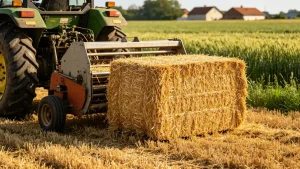
Why Square Format Wins for Straw Recovery
Straw recovery is not a gentle harvesting task. The material is dry, abrasive, and often comes off the combine windrow in uneven volumes depending on grain crop variety, combine settings, and field conditions. The machine doing the baling needs to handle those variable inputs without blocking, and the resulting bale needs to be in a format that downstream buyers can use.
Square bales win on multiple dimensions in this application:
- Transport density: A flat-bed truck loaded with square bales carries more dry matter per load than the same truck loaded with round bales — the stacking geometry is simply more efficient. This reduces transport cost per tonne of straw delivered.
- Container export: Square bales fit into standard shipping containers for export to markets in Japan, Korea, and the Middle East where compressed straw is used for animal bedding and industrial feedstock. Round bales cannot be efficiently loaded into standard containers.
- Manual distribution: Poultry barns, mushroom substrate facilities, and equine operations that use straw for bedding all need a format that one person can carry and open by hand. Small square bales deliver this — round bales require equipment at every stage of handling.
- Price point: Retail straw — sold per bale to hobby farms, landscape contractors, and garden centres — commands a higher price per tonne than bulk straw sold by the load. Square bales are the retail format; round bales are the bulk format.
Crop-by-Crop Straw Baling Guide
Different grain crops leave different straw characteristics behind, and understanding them helps you set the baler correctly from the first pass:
Timing the Harvest: The Post-Combine Window
Straw baling is time-sensitive in a different way from hay. The grain has already been harvested — the urgency now is field turnover, weather, and market delivery timing. On the Prairies, that window between combine and first autumn rain is often 3–5 days. A baler that runs reliably and without field stoppages during that period captures more value than a faster machine that requires adjustments.
A few timing-related points for straw baling:
- Bale immediately after the combine passes when possible. Straw that sits in windrows overnight before baling picks up dew. If that moisture exceeds 14–15%, heat damage and mold risk in the bale rises significantly.
- Consider windrow consolidation. Combine windrows are often narrower than ideal for baler pickup width. Raking two windrows together increases material volume per pass and improves bale density without requiring multiple passes.
- Run at a slightly higher bale density setting for straw versus hay. Straw compresses more at the same spring tension setting due to its lower natural bulk density. Firmer bales are more transport-stable and hold twine tension better in stacked loads.
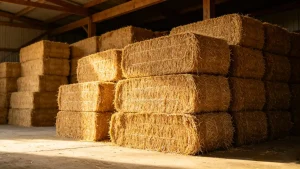
Straw End Markets: Where Your Bales Go
Understanding end markets before you bale helps you make the right decisions on bale size, density, and format. The main channels for square-baled straw in Canada:
Livestock Bedding (Equine & Poultry)
The most accessible and consistent local market. Horse barns, boarding facilities, and poultry operations buy straw year-round. Oat and wheat straw command the best prices. Demand is stable and local.
Mushroom Substrate Production
Oyster and shiitake mushroom producers use wheat straw as a primary growing medium. Demand is concentrated near urban centres with commercial mushroom operations. Square bales are the preferred format — easy to portion and sterilise in batch quantities.
Landscape & Garden Retail
Garden centres, nurseries, and home improvement stores retail straw for garden mulching, frost protection, and composting. Small square bales are the standard retail format in this channel. Seasonal demand peaks in spring and autumn.
Erosion Control & Construction Sites
Municipal and provincial infrastructure projects use straw bales extensively for erosion control on cut slopes, sediment barrier construction, and site rehabilitation. Contracts are typically larger-volume and price-negotiated.
Export Markets
Japan, South Korea, and the Middle East import Canadian straw for animal feed supplement and industrial use. Export buyers require square format for container loading efficiency. This market rewards consistent bale weight, tight twine, and low moisture.
Equipment for Straw Recovery: The 9YF-2200S
Straw recovery puts specific demands on a baler. The material is abrasive, dry, and often comes in uneven windrow volumes depending on combine spread settings. The machine needs a robust feeding system, a reliable knotter that handles dry material cleanly, and enough pickup width to clear windrows efficiently.
Our 9YF-2200S Square Hay Baler is the multi-crop variant in our lineup — designed explicitly for operations that bale both hay during the growing season and straw after grain harvest. Crop switching requires no significant reconfiguration beyond bale density and pickup height adjustment. The 2.2 m pickup width handles consolidated straw windrows efficiently, and the machine operates equally across all grassland and farmland terrain types.
For high-volume straw recovery operations covering large acreages in a narrow weather window, daily throughput is the binding constraint. In that case, our twin-chamber 9YFS-2.2 model doubles per-pass output from a single tractor-operator combination — the right configuration when harvest timing pressure is acute and field acreage demands maximum baling rate.
Canada Hay-Balers Co., Ltd
10055 Hogarth Dr, Richmond, BC V7E 3Z9 | [email protected]
Editor:WM