
Buying Guide Series — B01
Square Baler vs Round Baler: Which Is Right for Your Farm?
The choice between square and round baling equipment is one of the most consequential decisions in farm machinery — and the right answer depends entirely on your specific operation, not on what the neighbour is running.
Walk through any agricultural equipment dealership in Canada and you’ll find both square and round balers on the floor, often side by side. The sales conversation tends to focus on specifications — pickup width, output capacity, power requirements. What gets discussed less often is the more fundamental question: does the bale format itself fit what you’re trying to do with the hay or straw?
Bale format is not a reversible decision once you’re in the field. The format determines how you store, handle, feed, transport, and sell your product. Getting that decision right before choosing specific equipment saves significant time, money, and frustration downstream.
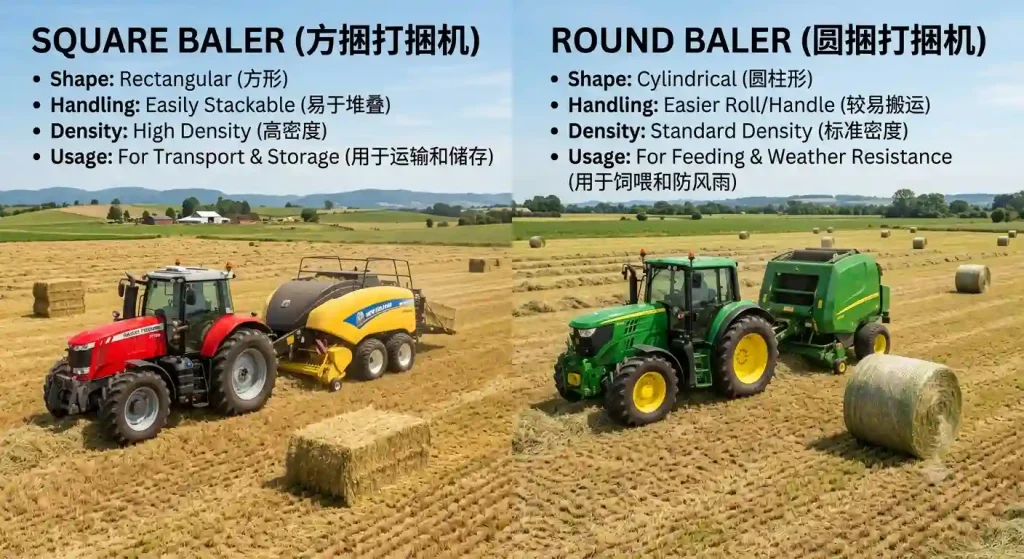
Understanding the Fundamental Difference
A square baler compresses hay or straw into rectangular bales using a reciprocating plunger, then ties them with twine. The resulting bale is uniform in shape, stackable on flat surfaces, and in the case of small square balers, light enough to carry by hand. A round baler rolls the crop into a cylinder using belts or rollers, then wraps it with twine or net wrap. The resulting bale is heavy, curved on all surfaces, and requires machinery to move at any scale.
Those physical differences drive almost every downstream handling, storage, feeding, and market consideration. The comparison is not primarily about which machine is better — it’s about which bale format serves your operation.
Head-to-Head Comparison: Eight Decision Factors
| Factor | Small Square Baler | Round Baler |
|---|---|---|
| Bale weight | 18–30 kg — hand-portable | 250–600 kg — machinery required |
| Labour per tonne | Higher — multiple handling steps | Lower — machinery handles all movement |
| Storage flexibility | Barn loft, garage, any covered space | Outdoor rows or large open shed |
| Feed waste | <5–10% with racks/nets | 11–40% depending on feeder type |
| Winter feeding (Canada) | Accessible by hand at any temperature | Freeze risk below −15°C |
| Market / sale format | Retail, export, feed stores | Farm gate bulk, large livestock ops |
| Tractor requirement | 45 HP+ PTO, 540 RPM | 40–100+ HP depending on bale size |
| Best fit operation | Small–medium farms, horses, retail hay | Large beef operations, custom baling |
The Labour Equation: Where Most Producers Get It Wrong
The most common argument for choosing a round baler is labour saving. On the surface, this argument is correct — a round baler drops one large bale per cycle that a tractor then moves once, versus a square baler producing dozens of smaller bales that need to be collected, stacked, and stored. Per tonne of hay produced, round baling requires fewer person-hours.
Where the calculation gets more complex is in the downstream labour and equipment costs that round bales introduce:
- Moving round bales requires a tractor with front-end loader or bale spike — every single time a bale is moved, from field to storage to feeding.
- Round bale feeders for horses and small ruminants produce 20–40% wastage, which means buying or producing more hay per animal per season than with rack-fed square bales.
- Outdoor-stored round bales lose their outer 10–15 cm to weather and UV exposure — that dry matter loss is invisible in the field but real at feeding time.
- At −20°C and below, round bales freeze to the ground and to each other. Freeing a frozen bale with a cold tractor on a February morning is not a minor inconvenience — it’s a regular operational challenge for Prairie cattle producers.
For operations that already own a loader-equipped tractor and are running large beef herds where these challenges are accepted as normal, the round baler’s labour advantage holds. For everyone else — especially horse operations, small livestock farms, and hay sellers — the comparison shifts considerably when all costs are counted.
Storage: The Factor That Often Decides the Question
Ask yourself one question about your property: where will you store the hay you produce through a full Canadian winter? The answer to that question often determines which baler type makes practical sense.
Small square bales stack densely against flat barn walls, fit in loft spaces, fill the corners of equipment sheds, and can be moved by one person into any storage configuration. A standard 2-car garage holds 150–200 bales with room to work — enough to carry a small horse property through a Prairie winter without a delivery.
Round bales need open ground with access for a loader tractor. A row of 20 round bales requires significant outdoor or large-shed space, and outdoor storage means weathering losses and freeze issues through winter. Many hobby farms and small equestrian properties simply don’t have that space — and building it to store round bales costs more than the equipment savings justify.
The Storage Test
Before choosing a baler type, calculate how many bales you need to store to carry your livestock through a full Canadian feeding period (typically 150–200 days). Then ask whether your existing covered storage accommodates that volume in square or round format. Most small farm properties answer that question decisively in favour of square bales.
Market Considerations: Selling What You Produce
If your operation produces more hay than your own livestock consume — or if commercial hay production is part of your income model — the market format question becomes decisive.
Feed stores, garden centres, equestrian facilities, and hobby farm supply outlets buy small square bales. They can be stacked on pallet racking, priced individually, and loaded into vans and cube trucks. Export buyers shipping to Japan, South Korea, and the Middle East require square format for container loading efficiency.
Round bales sell primarily farm-gate or through agricultural auctions into larger livestock operations. The market is local, price-sensitive, and dependent on buyers who have their own bale-handling equipment. For producers targeting retail or export markets, round format is simply not what buyers want.
If you plan to sell hay and want to reach the widest possible buyer base, square format gives you access to retail, wholesale, and export channels that round bales cannot serve.

Who Should Choose a Square Baler
Your operation fits if you:
- Feed horses, sheep, goats, or mixed livestock
- Have limited or indoor-only storage space
- Want to sell hay at retail or export
- Operate in a cold climate where winter access matters
- Don’t have a loader-equipped tractor
- Farm small or irregularly shaped fields
- Want single-operator baling without a bale wagon crew
Round baler may suit if you:
- Run a large beef herd (80+ head) on open pasture
- Have loader tractor already in your fleet
- Sell farm-gate bulk to other cattle producers
- Have outdoor storage space for rows of bales
- Prioritise minimising labour over minimising feed waste
- Bale large acreages with wide, even windrows
- Don’t need individual bale handling at any point
Can You Run Both? The Dual-Format Strategy
Some larger operations run both baler types — square for first-cut premium hay destined for retail and equine markets, round for later cuttings or lower-quality forage fed on-farm to cattle. This strategy maximises revenue from high-quality forage while reducing labour on the bulk feeding portion of the operation.
Running both formats requires two machines, two sets of settings expertise, and two storage systems. It makes sense when the revenue differential between retail-square and bulk-round hay justifies the added complexity — typically on operations producing 5,000+ bales per season.
For most operations under that scale, choosing one format and optimising for it produces better outcomes than trying to split between two systems with a single-operator farm workforce. If that format is square — and for the majority of Canadian small and mid-size operations it is — our square hay baler range covers the output requirements from small hobby farms through commercial export production. Contact us at [email protected] to discuss your specific situation.
Canada Hay-Balers Co., Ltd
10055 Hogarth Dr, Richmond, BC V7E 3Z9 | [email protected]
Editor:WM