

DRY HAY STORAGE & YEAR-ROUND DAIRY FEEDING
A well-stocked dry hay inventory is the insurance policy every dairy farm needs. When silage supplies run short, when a wet autumn prevents late cuts from fermenting cleanly, or when dry cow and heifer groups need a lower-energy complement to their ration, properly baled and stored dry hay is the answer. Getting the baling right from the start protects months of nutritional value and prevents the hay shed from turning into a compost pile.
The Specific Role of Dry Hay in a Dairy Feeding Program
Many dairy nutritionists and farm managers treat silage and dry hay as interchangeable — simply different forms of stored forage. In practice, they serve distinct roles within a well-designed total mixed ration. Dry hay, particularly high-quality first- or second-cut alfalfa, provides a physical fiber source whose long particle length promotes rumen mat formation and effective rumination. This is something fermented silage, with its softer, more compacted structure, is less effective at supplying.
Transition cow programs — the critical three weeks before and after calving — frequently rely on dry hay as the primary forage to control dry matter intake and support rumen health during one of the highest-risk periods in a cow’s production cycle. Having a reliable supply of clean, low-mold dry hay specifically set aside for this purpose is standard management practice on well-run Canadian dairy farms.
For heifer development programs, dry hay also provides a cost-effective, lower-energy roughage that allows target growth rates to be achieved without excess body condition. The ability to segregate and store dry hay independently of the main silage supply gives nutritionists greater flexibility to formulate precisely for each group.
Moisture at Baling: The Single Most Important Variable
No other factor influences the long-term quality of dry hay more than moisture content at the time of baling. This is well understood, yet moisture-related hay losses remain among the most common and costly avoidable problems on Canadian dairy farms each year.
Round bales stored at moisture above 20% create an ideal environment for mold growth, particularly Aspergillus fumigatus and various Fusarium species. These organisms not only reduce dry matter and digestibility — they produce mycotoxins that suppress immune function, reduce feed intake, and directly impair milk production and reproductive performance. A bale that looks slightly discolored when opened in February may have cost your operation far more than its purchase or production value through the preceding months of subclinical mycotoxicosis in your milking cows.
The practical guideline is straightforward: bale when the windrow measures 18% moisture or below, as verified by a calibrated probe or dedicated hay moisture meter. Wait for afternoon baling windows when morning dew has fully burned off. Baling in the cooler, moister hours of early morning consistently produces bales that will not hold through a five-month Canadian winter storage period.
Moisture Risk Reference — Round Bale Dry Hay
- Below 18%: Safe for round bale storage without ventilation. Low mold risk through standard winter storage.
- 18–20%: Marginal zone. Consider conditioning agents (propionic acid-based). Store in well-ventilated facility.
- 20–22%: High risk. Significant dry matter loss expected within 60 days. Not recommended for dairy feeding.
- Above 22%: Severe mold and heat damage likely. Consider as silage candidate with stretch-film wrapping instead.
Bale Density and Shape: Why Geometry Matters for Winter Storage
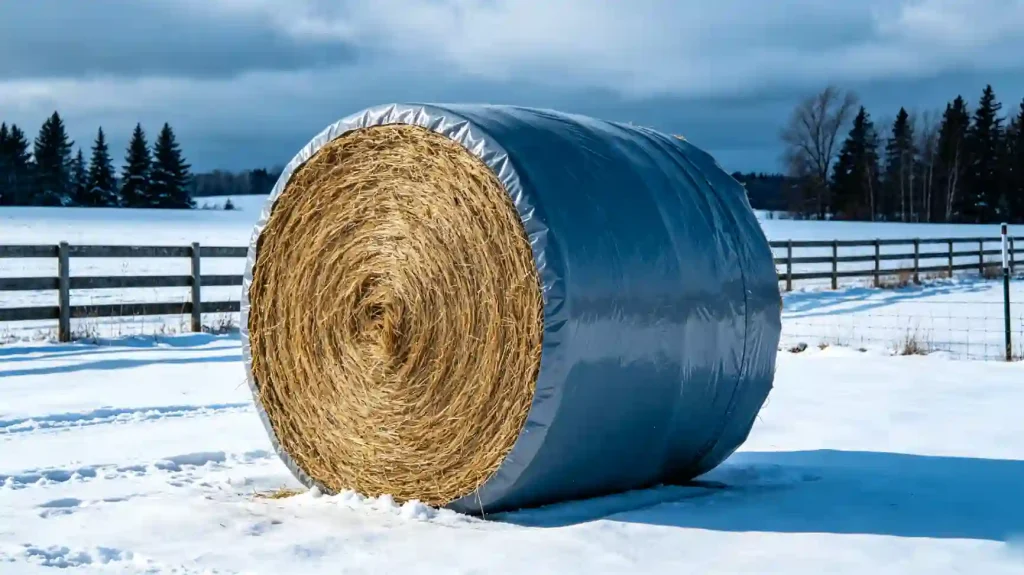
A round bale’s ability to shed rain and resist weathering during outdoor storage depends entirely on its geometric regularity. A bale with flat sides, concave ends, or uneven density distribution channels water into the bale instead of shedding it. This is not merely a cosmetic issue — water infiltration into a dense round bale can penetrate 15 to 30 cm before evaporation and drying halt its progress. In a bale stored outdoors under a Canadian winter, that moisture freezes, thaws, and refreezes, progressively destroying the outer layers throughout the storage period.
A high-quality round baler produces bales that are consistently cylindrical, with flat ends and even density from core to outside edge. This is a function of chamber design, belt tension management, and pickup reel performance — all characteristics that separate purpose-built commercial balers from entry-level alternatives. The 9YG-2-24D Round Hay Baler from Canada Hay-Balers Co., Ltd. is engineered to produce consistently shaped bales across varying windrow densities, ensuring predictable outdoor storage performance season after season.
Calculating Your Winter Hay Requirements
Systematic pre-season hay inventory planning is one of the clearest distinctions between operations that manage comfortably through a Canadian winter and those that face feed shortages in February and March. The calculation is not complicated, but it must be done honestly, accounting for storage losses and variable weather-related feeding demand.
| Animal Group | Dry Hay DM/Head/Day (kg) | 180-Day Winter Need per Head (kg) | Notes |
|---|---|---|---|
| Dry cows | 10–12 kg | 1,800–2,160 kg | Primary forage source for far-off dry period |
| Milking cows (supplement) | 3–5 kg | 540–900 kg | Fiber supplement alongside silage TMR |
| Heifers (6–12 mo.) | 5–7 kg | 900–1,260 kg | Primary roughage source |
| Calves (post-weaning) | 1.5–3 kg | 270–540 kg | Free choice alongside starter grain |
Add a 15% buffer to your calculated total to account for storage losses and any feeding days required by unexpectedly severe weather or delayed spring turnout. A farm that budgets precisely to need rarely has a comfortable winter. The cost of purchasing emergency hay in February at premium winter prices routinely exceeds the cost of storing a modest buffer from the previous season’s production.
Outdoor vs. Indoor Round Bale Storage: A Practical Comparison
Most Canadian dairy operations store a portion of their round hay bales outdoors, either from capacity constraints or deliberate cost management. Outdoor storage is viable, but it requires proper site selection and bale positioning to minimize losses. Bales stored on well-drained gravel or crushed stone bases lose approximately 5 to 8% of their dry matter over a six-month winter period. Bales stored directly on soil, particularly in lower-lying areas prone to standing water, routinely lose 15 to 25% of their dry matter — primarily from ground contact spoilage that can extend 30 to 45 cm into the bale from the base.
Indoor storage on concrete or compacted gravel reduces losses to 2 to 4%, but the capital cost of covered storage is substantial. A practical middle ground used widely in western Canada is crushed stone outdoor rows covered with breathable fabric tarps, which typically achieve 6 to 9% losses while requiring minimal infrastructure investment.
Regardless of storage method, orient round bales with their flat ends facing north-south to minimize direct UV degradation of the net wrap on the bale’s weather-exposed surfaces. Stagger row spacing by at least one meter to allow visual inspection and air movement between rows during the storage period.
Selecting the Right Baler for Your Dry Hay Operation
A dairy farm’s dry hay baling requirements differ somewhat from a pure hay production operation. Dairy farms typically produce hay from managed, intensively fertilized fields with high yield potential, meaning windrows are dense and field speed matters for timely completion. They also frequently require a baler that can transition between hay and silage crops within the same season — a capability that demands robust engineering and wide operational moisture tolerance.
The 9YG-2-24D Round Hay Baler delivers the combination of field speed, bale density, and all-season versatility that dairy operations require. Its net wrap system produces clean, tight bales optimized for winter outdoor storage, while its drive system handles the variable crop densities typical of multi-cut dairy hay programs. For farms seeking a full-featured flagship model, the S9000 Beyond adds enhanced chamber pressure control for operations managing both silage and dry hay from the same equipment investment.
Review our complete round baler lineup to compare specifications across all available models and find the right match for your farm’s size, crop types, and tractor configuration.
Frequently Asked Questions
How long can dry hay round bales be stored safely in Canada’s climate?
Properly baled dry hay at or below 18% moisture, stored on a raised base and covered or well-drained, retains its core nutritional value for 18 to 24 months. Beyond two years, protein and vitamin content degrade measurably. Most operations plan on a one-season rolling inventory rather than multi-year storage.
Does net wrap or twine provide better protection for outdoor winter storage?
Net wrap consistently outperforms twine for outdoor storage in Canadian conditions. Net wrap applies tension across the entire bale surface rather than at two or three twine bands, producing a tighter, more weatherproof outer layer. The reduction in weathering losses typically offsets the higher cost of net wrap within a single storage season for operations keeping bales outdoors through winter.
What is the best time of day to bale hay for dairy in western Canada?
Experienced hay producers in BC, Alberta, and Saskatchewan consistently recommend baling between noon and 6 PM during clear weather, allowing morning dew to fully evaporate and the sun’s heat to drop surface moisture to its daily low. Early-morning baling, while tempting during hot spells to avoid afternoon heat, frequently results in bales that are 2 to 4 percentage points wetter than afternoon bales from the same windrow.
Can moldy hay be safely fed to any class of dairy cattle?
This is a risk-based decision that should involve your veterinarian or dairy nutritionist. Light surface mold on exterior bale layers is typically removed and discarded; the core of the bale is often usable for dry stock at low feeding rates. However, mold that has penetrated more than 15 cm into the bale represents a genuine mycotoxin risk, particularly for fresh cows and pre-fresh heifers. Any hay with visible black or green internal mold should not be fed to any class of milking cow or animal within 60 days of calving.
How many round bales does an average dairy farm in BC need for winter?
This varies significantly by herd composition and the proportion of dry hay in the ration. As a rough guide, a 100-cow dairy with a standard 180-day winter feeding period and 30% of forage DM from dry hay typically requires 350 to 500 large round bales (500–600 kg each). Operations where dry hay is the primary roughage for dry cows and heifers only, with milking cows on full silage, may need 180 to 250 bales for the same herd size. Accurate planning requires calculating actual DM demand by animal class rather than using herd-level averages.
Is propionic acid treatment worth it for hay baled at borderline moisture?
Propionic acid-based preservatives applied at baling have been shown in multiple university trials to allow safe storage of hay baled at up to 22% moisture, reducing mold development and maintaining palatability through the storage period. The cost per bale is modest — typically $0.50 to $1.50 CAD per bale at standard application rates — and for an operation regularly catching hay in marginal weather conditions, the return on investment is highly favorable compared to the cost of spoilage losses on untreated borderline-moisture bales.
Build Your Dairy Hay Inventory With Confidence
Canada Hay-Balers Co., Ltd. supplies round balers built for Canadian dairy operations — consistent bale density, reliable net wrap, and all-season durability. Contact our Richmond, BC team to discuss specifications, pricing, and delivery.
Canada Hay-Balers Co., Ltd. | 10055 Hogarth Dr, Richmond, BC V7E 3Z9 | [email protected]
editor:WM