
Walk into any baler dealer with a serious budget and the very first question you will be asked is, “Fixed chamber or variable?” It is the most consequential choice in a round-baler purchase — it changes the bale density, the crop conditions you can run in, the horsepower you need, the maintenance you will pay for over a decade, and the resale value of the machine. This guide is the practical, no-jargon comparison of fixed chamber vs. variable chamber round baler so you can put your money in the right place.
1. How Each Chamber Type Works
Fixed chamber baler
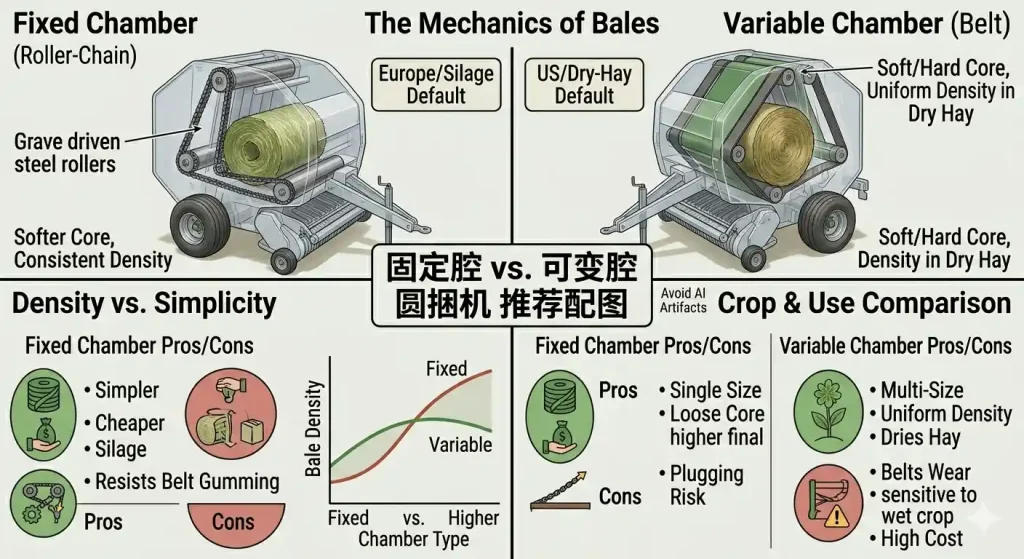
A fixed chamber baler is a round chamber with driven steel rollers (or chains-and-slats) that spin and form the bale to a single preset diameter. Crop is fed in until the chamber is nearly full, then compaction begins. When the bale reaches its set size, it is wrapped, the tailgate opens, and the bale is ejected. Because the geometry is fixed, the design is mechanically simple and very robust.
Variable chamber baler
A variable chamber uses a combination of fixed rollers and adjustable belts. As the crop enters, the belts expand outward to accommodate a growing bale. Pressure can be controlled from the very first armful — operators can choose a soft core for better drying, or a hard core for maximum density and storage life. The bale diameter can be set anywhere from about 3 ft to 6 ft on the same machine.
2. The Core Trade-Off: Density vs. Simplicity
Industry research and farmer experience consistently agree on one point: variable chamber balers produce bales of more consistent density throughout the bale, and reach higher densities overall — important for baleage, dry hay, and any crop you plan to store outside or transport long distances.
Fixed chamber balers, by contrast, build bales with less dense centers because the chamber only starts compacting when the chamber is nearly full. Some operators consider this a feature (useful for animals that need to tear into a softer core), but it limits the machine in dry, leafy crops where a soft center can collapse during handling.
Fixed Chamber — Pros
- Lower purchase price (often 15–25% cheaper)
- Fewer moving parts; lower maintenance cost
- Better in wet or short-stem crops (silage, baleage)
- Less belt fouling on damp days
- Robust and forgiving — ideal for less experienced operators
Fixed Chamber — Cons
- One bale size only
- Less dense centers in dry hay
- Slightly higher horsepower draw at finish
- Noisier operation (chain or roller drive)
- Bale must reach full size to seal off — no early ejection
Variable Chamber — Pros
- Adjustable bale diameter (one machine, many sizes)
- Higher and more uniform bale density
- Soft- or hard-core options for drying or storage
- Lower horsepower required at peak
- Preferred by U.S. commercial dry-hay producers
Variable Chamber — Cons
- Higher initial cost
- Belts wear and need periodic replacement
- More sensitive to wet, sticky material (gumming on belts)
- More complex hydraulics and electronics
- Higher resale price but higher repair invoices
3. Cost Comparison — What You Actually Pay
| Cost line | Fixed chamber | Variable chamber |
|---|---|---|
| Typical new price (mid-size, USD) | $22,000 – $45,000 | $32,000 – $80,000+ |
| Belt replacement set | N/A (rollers/chains) | $1,200 – $2,500 |
| Roller/chain replacement | $800 – $2,000 | Lower (fewer) |
| Annual maintenance budget | $300 – $700 | $500 – $1,200 |
| Resale after 8 years | 40–55% of new | 45–60% of new |
| Tractor PTO HP needed (5×4 bale) | 55–65 HP | 50–60 HP |
4. Which Crops Favor Which Chamber?
Choose fixed chamber if you mostly bale:
- Silage / haylage (40–60% moisture): rollers handle wet, heavy crop without belt gumming. This is why fixed chambers dominate Europe, where roughly 80% of harvested forage is haylage.
- Short, brittle crop: short stems start forming a bale immediately in a roller chamber.
- Straw in moderate volumes: simple, fast, and reliable for cereal-straw operations.
Choose variable chamber if you mostly bale:
- Dry grass hay or alfalfa: consistent density top-to-bottom keeps premium hay saleable.
- Mixed hay sizes: when one customer wants 4 ft and another wants 5 ft 6 in, only a variable chamber lets you switch in seconds.
- Outdoor-stored hay: harder bale shells shed water better and resist deformation.
5. Crop Compatibility — The Hidden Decision Factor
Many North American buyers default to variable chamber because that is what dealers stock. But if your operation handles a high percentage of crop residue — corn stalks, cotton stalks, rice straw — a fixed chamber design is often the better engineering match. The roller geometry handles short, abrasive material that would otherwise slip and gum on belts. A purpose-built fixed-chamber unit such as the 9YG-1.25 cylindrical baler for corn stalk illustrates the design choices that make sense for stalk and residue baling specifically.
6. Throughput and Cycle Time
Variable chamber balers are typically faster per bale because the operator can ease into compression early — there is no “loose feed → chamber full → start compacting” delay. In dry-hay conditions, a modern variable chamber will produce 30–45 5×5 bales per hour. A comparable fixed chamber will run 25–35 bales per hour, but with simpler controls and less risk of plugging.
That said, mid-size fixed-chamber balers have closed much of the gap. A modern unit such as the 9YG-2.24D S9000 Classic round baler uses an optimized roller layout to push bale density higher than older fixed designs, while keeping the cost-per-bale advantage that fixed chambers are known for.
7. Maintenance and Long-Term Reliability
Fixed chamber maintenance is dominated by roller bearings, drive chains, and PTO components. None of these are exotic; almost any farm shop can service them. Belt-driven variable chambers add belt tension monitoring, belt-tracking adjustments, periodic belt replacement (every 15,000–25,000 bales depending on conditions), and belt-cleaning kits to manage gumming.
One often-overlooked factor: storage. Belts deteriorate from sunlight and rodents during winter; rollers do not. If your baler will sit outside or in an open shed for half the year, fixed chamber will likely give you a longer service life with less prep work each spring.
8. The Hybrid Option: Semi-Fixed / High-Density Chambers
Several manufacturers now offer “semi-fixed” or HD-variable designs that combine a roller core with belts on the outside. These produce a soft core (good for drying) and a hard outer shell (good for storage) — and many are net-wrap-ready out of the box. They cost more than a pure fixed chamber but typically less than a top-tier variable. For mid-size operations baling a mix of hay and silage, a semi-fixed chamber is often the most flexible single-machine choice.
9. Decision Framework — A 5-Question Checklist
- Will more than 30% of my baling be at over 35% moisture? If yes → fixed chamber leads.
- Do I sell dry hay commercially? If yes → variable chamber leads.
- Will I need different bale sizes for different customers? If yes → variable chamber.
- Is the budget tight, or is this my first round baler? Fixed chamber is forgiving and cheaper to live with.
- Do I bale crop residue (corn stalk, rice straw) at scale? Fixed chamber, every time.
Talk to a Specialist Before You Buy
Tell us your crop mix, acreage, and tractor HP. We will tell you which chamber type — and which model — gives you the lowest cost per bale over five seasons. Email [email protected].
Frequently Asked Questions
Are fixed chamber balers obsolete?
No — far from it. Fixed chambers dominate the European market and continue to gain share in residue-baling and silage operations worldwide. They are particularly strong in the corn-stalk, rice-straw, and baleage segments.
Can a variable chamber baler bale at any size, or only its rated maximum?
Any size up to its maximum, in continuous adjustment. You can run 4 ft bales for one customer and 5 ft 6 in bales for another from the same machine on the same day.
Do fixed chamber bales really have softer cores?
Yes. The chamber starts compacting only when nearly full, so the first material in becomes the loose center. This is irrelevant for many applications and a real benefit for some (animals can tear into the core easier).
Is a fixed chamber better for net wrap?
Both chambers run net wrap effectively. Fixed chambers had a historical edge with twine in wet conditions, but modern variable chambers handle both equally well.
Related Product Recommendations
Power & Traction Equipment: Tractors
The most essential partner for a baler is the tractor. The tractor not only provides the necessary traction but—more importantly—supplies power to the baler’s compaction and feeding mechanisms via the Power Take-Off (PTO) shaft.
Pre-Baling Equipment: Mowers and Rakes
Prior to baling, crops must be cut and gathered; these two types of machinery serve as the “advance team” for the baling operation.
Send Your Technical Requirements
Sample units, container quotes, OEM customization, and dealer pricing — our team replies within 24 hours. Most orders ship in 20–30 days from confirmation.