
Compact and mid-size utility tractors in the 30–60 HP range power a huge share of small and family farms. They are versatile, fuel-efficient, and just powerful enough to run a serious mowing implement — but pairing the right disc mower for a 30-60 HP tractor requires more thought than just matching numbers on a spec sheet. Tractor weight, PTO type, hydraulic remotes, hitch category, and your terrain all shape the right choice.
This guide is the practical buyer’s checklist used by hay producers, hobby farmers, and dealers who outfit compact tractors every day. Read it before you spend $4,000–$10,000 on a mower.
1. Why Disc Mowers Dominate the 30–60 HP Class
For decades the 30–60 HP tractor used a sickle bar mower or a drum mower. Both still work, but disc mowers have largely taken over because they:
- Cut twice as fast as a sickle bar in the same conditions
- Don’t plug in tall, lodged, or damp forage
- Leave a wider, more uniform swath that dries faster
- Have fewer time-sensitive setup steps than a sickle bar
The trade-off is power: disc mowers demand consistent PTO output and a tractor heavy enough to handle the side load. Below 30 HP they push the envelope; above 60 HP they leave performance on the table.
2. The 7 Specifications That Actually Matter
(1) Cutting width — match it to your acreage
| Cutting width | Discs | PTO HP needed | Best for |
|---|---|---|---|
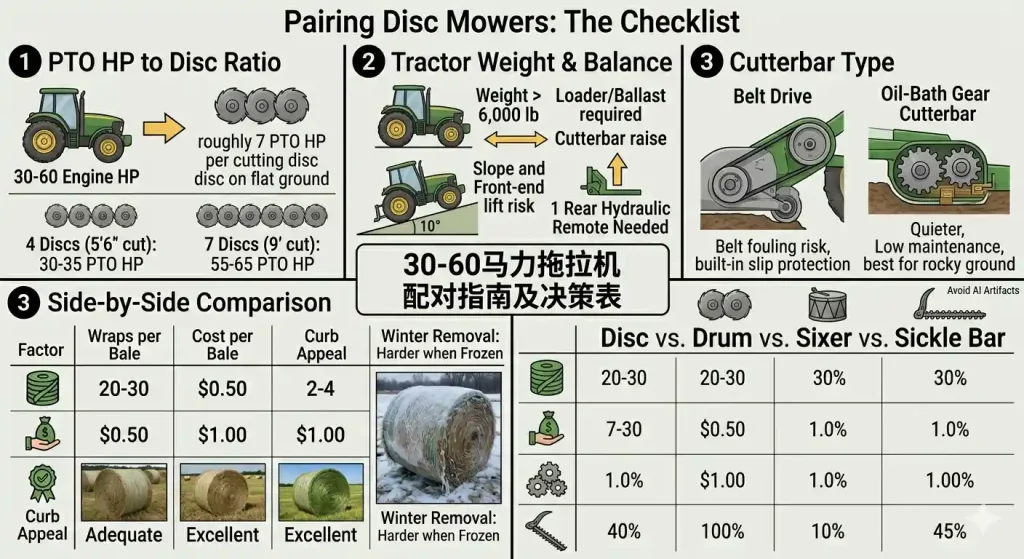
| 5 ft 6 in (1.65 m) | 4 | 30–35 HP | Small acreage, hilly fields, orchards |
| 7 ft (2.1 m) | 5 | 35–45 HP | Most compact-tractor hay operations |
| 8 ft (2.4 m) | 6 | 45–55 HP | Mid-size farms with flat ground |
| 9 ft (2.8 m) | 7 | 55–65 HP | Large fields, top of the 60 HP class |
(2) Weight and tractor balance
Disc mowers hang to one side. The single biggest cause of trouble for 30–60 HP buyers is a mower that is too heavy for the tractor — even when the HP rating is fine on paper. Watch:
- Front-end lift: A heavy three-point disc mower lifts the front of a light tractor. Add front weights or a loader for ballast.
- Side-load on the left front tire: When the mower is folded or carried, all the weight pushes through one tire. Confirm tire pressure ratings match.
- 3-point hitch capacity: Compact tractors often list a lower lift capacity than buyers assume. Check the spec sheet.
(3) PTO — speed and shaft type
Almost all disc mowers run on 540 RPM PTO. Confirm:
- Your tractor PTO shaft is 540 RPM (not 1,000 RPM economy or live PTO only)
- The PTO shaft length matches your hitch geometry — too long jams; too short whips
- Slip-clutch protection is included or available — disc mowers absolutely need it
(4) 3-point hitch category
Most 30–60 HP tractors use Category 1 hitches; some heavier models above 50 HP use Category 1/2 quick-hitch compatible setups. The mower must match — adapter bushings exist but they add wear points.
(5) Hydraulic remotes
Disc mowers raise from work to transport position with a hydraulic cylinder. You need at least one rear hydraulic remote on the tractor. Some machines have hydraulic side-shift; budget machines use mechanical pin shift. Confirm before you buy.
(6) Drive type — gear vs. belt
Modern disc mowers use either an oil-bath gear cutterbar or a belt-driven cutterbar. Belt-drive units have built-in slip protection if the cutterbar hits a rock; gear-drive units are usually quieter and need less maintenance. Both work — the better one depends on how clean your fields are.
(7) Discs and blades
Free-swinging blades are now the standard. Look for hardened steel, easy bolt-on replacement, and at least 3 in of overlap between adjacent discs to prevent strips of uncut crop.
3. Disc Mower vs. Drum Mower vs. Sickle Bar — At a Glance
| Feature | Disc mower | Drum mower | Sickle bar |
|---|---|---|---|
| Min HP for 6 ft cut | ~35 HP | ~25 HP | ~25 HP |
| Speed in field | Fastest | Fast | Slow |
| Plug resistance | Excellent | Good | Poor in lodged crop |
| Cut quality | Clean, uniform | Clean, narrow swath | Cleanest close-cut |
| Maintenance | Medium | Low | Medium-high |
| Purchase price (new) | $3,500–$10,000 | $1,800–$3,500 | $1,500–$3,500 |
For pure 30 HP buyers on a budget, a drum mower is often the better value. Once you have 40+ HP and want speed, the disc mower wins on every dimension except sticker price.
4. Field Conditions That Change the Calculation
Hills and slopes
The disc mower’s side-mounted geometry can shift the tractor’s center of gravity dangerously on slopes. If you mow more than 10° regularly, choose a smaller cutting width than the tractor would otherwise allow, and make sure the front end is properly weighted.
Rocky ground
Disc mowers throw rocks forward at high velocity. A cab is strongly recommended — and never run a disc mower on a new field where you don’t know what’s underneath the grass.
Dense, lodged, or wet crop
This is where disc mowers shine. Their high disc speed (around 3,000 RPM) chops through lodged grass that would plug a sickle bar. Just be ready to slow ground speed in heavy, wet first cuttings.
Orchard and obstacle work
Compact 4–5 disc mowers with side-shift are ideal for orchard floors. Pair them with a small round baler for orchard mulch — operations like a 9YG-1.25 cylindrical baler are well suited for collecting and rolling the resulting windrow into compact bales for mulch sale or compost.
5. Used vs. New — What to Inspect
Used disc mower inspection checklist
- Spin each disc by hand — listen for bearing noise or roughness
- Check oil level and color in the cutterbar — milky oil means water ingress
- Look for cracks at disc mount welds and around hitch points
- Confirm slip clutch turns and engages
- Check belt condition and idler tension (belt-drive units)
- Inspect blade overlap; replace any blades worn under 3/4 of original length
- Verify hydraulic cylinder doesn’t leak when raising the cutterbar
- Test in the field with the seller before paying — refusal is a red flag
6. Realistic Productivity Expectations
- 5-disc, 7 ft cut, 40 HP tractor: 3–4 acres per hour at 5–6 mph in moderate hay
- 6-disc, 8 ft cut, 50 HP tractor: 4–5 acres per hour at 6–7 mph
- 7-disc, 9 ft cut, 60 HP tractor: 5–6 acres per hour, more in light crop
Productivity drops about 20% in heavy first-cutting grass and another 15% on uneven ground. Plan accordingly.
7. Total Investment to Get from Standing Crop to Bale
If you are building a hay system on a 30–60 HP tractor, budget for a complete chain, not just the mower:
- Disc mower: $3,500–$8,500
- Tedder (recommended in humid climates): $2,500–$5,000
- Rake: $1,800–$4,500
- Round baler: $5,000–$25,000 depending on bale size and class
For producers in this tractor class who want to feed and sell from the same machine, a small commercial round baler such as the 9YG-2.24D round hay baler pairs naturally with a 5- or 6-disc mower and finishes the system without overloading a 50 HP tractor.
8. Buyer Mistakes to Avoid
- Sizing on engine HP instead of PTO HP. Always use rated PTO horsepower; engine HP can be 15–20% higher.
- Ignoring tractor weight. A 60 HP tractor that weighs 3,500 lb is not the same as one that weighs 6,500 lb.
- Assuming “rated for 40 HP” means it works on 40 HP in any conditions. Manufacturer ratings are for ideal flat ground and clean crop.
- Skipping the slip clutch. Without one, a single rock can destroy a cutterbar.
- Buying width before checking gates. Confirm the transport width fits through every gate and along every road on the route.
Need a Mower Sized to Your Tractor?
Send your tractor model, PTO horsepower, and acreage. We will recommend the right disc mower configuration. Email [email protected].
Frequently Asked Questions
1.Will a disc mower work on a 30 HP tractor?
A small 4-disc unit (about 5 ft 6 in cut) can work on 30 HP, but you will be at the edge in any heavy crop. Drum mowers are often a better fit at this HP level.
2.Do I need a cab for a disc mower?
Strongly recommended. Disc mowers can throw rocks and debris forward. A cab or full ROPS with safety glass is the safe choice.
3.How often do I change the cutterbar oil?
Most manufacturers specify the first oil change after 50 hours, then annually or every 200 hours, whichever comes first.
4.Can I run a disc mower on a tractor with no rear remote?
No — the cutterbar lift requires hydraulic flow. You can have a remote installed, but it is added cost.
Related Product Recommendations
Power & Traction Equipment: Tractors
The most essential partner for a baler is the tractor. The tractor not only provides the necessary traction but—more importantly—supplies power to the baler’s compaction and feeding mechanisms via the Power Take-Off (PTO) shaft.
Pre-Baling Equipment: Mowers and Rakes
Prior to baling, crops must be cut and gathered; these two types of machinery serve as the “advance team” for the baling operation.
Send Your Technical Requirements
Sample units, container quotes, OEM customization, and dealer pricing — our team replies within 24 hours. Most orders ship in 20–30 days from confirmation.
editor:WM