
Why Herd Size Is the Starting Point for Every Silage Baler Decision
Selecting the right silage baler is not simply a matter of budget or brand preference. For Canadian dairy producers, the size and daily dry matter demand of your herd determines everything from bale diameter and wrapping speed to PTO horsepower requirements and seasonal throughput targets. Getting this match wrong leads to either chronic under-production during the critical harvest window or costly over-investment in capacity that sits idle. This guide walks you through the core selection criteria so that your baling system is sized precisely for the herd you are feeding.

Understanding Daily Dry Matter Demand by Herd Size
Before you evaluate any machine, you need a firm number for your herd daily silage consumption. A lactating Holstein cow in peak production typically consumes between 12 and 15 kg of dry matter per day from fermented forage alone. Multiply that figure by your milking herd count, add a 15 percent buffer for dry cows, heifers, and inventory carryover, and you have your target supply volume.
- 50-head herd: approximately 750–900 kg DM per day from silage, requiring roughly 2–3 standard 5×4 ft round bales daily.
- 150-head herd: approximately 2,250–2,700 kg DM per day, requiring 6–9 bales daily during winter feeding.
- 300-head herd: approximately 4,500–5,400 kg DM per day, which demands consistent baling throughput during each cutting and a reliable wrapping sequence.
These projections assume three to four silage cuttings per season across Ontario, Quebec, or the BC Lower Mainland. Producers in shorter-season zones such as the Prairie provinces must factor in compressed windows and potentially push more volume per cutting.
Fixed-Chamber vs Variable-Chamber Balers: Which Fits Your Scale?
The mechanical architecture of the baler has a direct impact on throughput consistency, bale density, and suitability for high-moisture silage crops.
Fixed-chamber balers produce bales of a pre-set diameter. They are mechanically simpler, easier to maintain in remote farm settings, and typically more forgiving of slightly variable crop moisture. For herds under 80 milking cows where one operator handles everything from cutting to stacking, a fixed-chamber unit offers a strong cost-to-productivity ratio.
Variable-chamber balers allow the operator to adjust bale diameter on the fly, which matters when crop yield per acre changes significantly between cuts or between fields. For larger herds producing 800 or more bales per season, the ability to maximize bale density and reduce wrapping film costs per tonne of DM stored is a tangible economic advantage.
PTO Horsepower Requirements Matched to Herd Scale
Silage crops at ideal harvest moisture (65–70 percent) are dense and heavy. Under-powered balers stall, produce inconsistent bale density, and increase twine or net wrap consumption. The table below shows typical PTO demand by herd scale:
| Herd Size | Recommended Baler Class | Minimum Tractor PTO (HP) | Typical Bale Output (bales/hr) |
|---|---|---|---|
| Up to 60 cows | Compact round baler | 40–55 HP | 8–12 |
| 60–150 cows | Mid-size round baler | 55–80 HP | 12–18 |
| 150–300 cows | Full-size round baler | 80–110 HP | 18–25 |
| 300+ cows | High-capacity round baler | 110+ HP | 25–35+ |
Reliable power transfer from tractor to baler is equally critical. A well-maintained agricultural power take-off driveline ensures consistent torque delivery and reduces vibration-related wear on the baler pickup, which is the most maintenance-intensive component during high-moisture silage runs.
Net Wrap vs Twine: Choosing the Right Binding for Dairy Silage
Net wrap consistently outperforms twine for silage applications across Canadian dairy operations. The primary reason is speed: net wrap typically completes the binding cycle in 8–12 seconds compared to 30–45 seconds for twine, which translates directly into more bales per hour during the narrow harvest window before morning dew or afternoon showers arrive.
Net wrap also distributes tension more evenly across the bale face, which reduces air pockets in the outer layer and supports tighter anaerobic conditions once plastic film wrapping is applied. For high-value dairy silage where even marginal aerobic spoilage represents a direct feed quality loss, this matters at scale.
Twine remains the more economical choice for operations under 50 cows where total seasonal bale count stays below 300 units and field-to-barn transit time is short. Some producers also prefer twine where bale re-wrapping with an inline wrapper is part of their system, as twine is easier to strip prior to the second wrap stage.
Crop Pickup Width and Field Efficiency for Larger Herds
As herd size grows, field efficiency becomes a compounding factor. A wider pickup header reduces the number of passes required to clear a field and keeps the tractor moving at a consistent ground speed, which is important for bale density uniformity. For herds over 150 cows managing 200 or more acres of dedicated forage ground, balers with crop pickup widths of 2.1 m or wider are worth the premium.
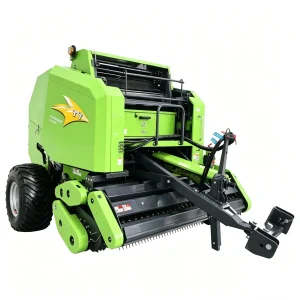
The 9YG-2.24D S9000 Beyond Round Baler is engineered with a wide-intake pickup system capable of handling dense windrows of high-moisture grass and legume silage. Its reinforced roller design maintains bale shape consistency even when operating at elevated forward speeds, making it well suited for larger dairy operations seeking to reduce total harvesting hours per cut.
Bale Size and Plastic Film Consumption Economics
Larger bale diameters (5×5 ft or 5×6 ft) store more DM per unit of wrapping film, reducing per-tonne preservation cost. For a 200-cow operation consuming 4,000 bales per season, shifting from a 4×4 ft bale to a 5×5 ft bale at equivalent DM density can reduce wrapping film expenditure by 20–30 percent, a significant line item in the annual forage budget.
However, larger bales require appropriate handling equipment — a rear-mount bale spear or bale processor matched to the bale weight — and storage rows that allow adequate airflow to prevent condensation buildup on the film surface. These downstream logistics should be verifyed before committing to a larger-format baler.
Matching Baler Models to Common Canadian Dairy Herd Scenarios
Scenario A — 40 to 80 cows, owner-operated, BC or Ontario: A compact unit such as the 9YG-1.25A Round Baler or the 9YG-1.0 Round Baler Machine provides sufficient throughput for two to three cuttings per season while remaining compatible with tractors in the 40–65 HP range common on smaller family operations.
Scenario B — 100 to 180 cows, mixed forage system, Prairie provinces: A mid-capacity unit with net wrap capability and a minimum 75 HP PTO requirement handles both the compressed harvest season and the higher total bale count. The 9YG-2.24D S9000 Classic Round Baler covers this tier with a robust bale chamber suited to both grass and alfalfa silage crops.
Scenario C — 250 to 400 cows, commercial dairy, Quebec or Alberta: Operations at this scale benefit from a high-capacity baler combined with an inline or tandem wrapper to eliminate the transportation bottleneck between baling and wrapping. The 9YG-2.24D S9000 Beyond is designed for this production tier, with a chamber geometry that maintains consistent bale density across variable crop conditions and extended daily operating hours.
Maintenance Accessibility and Parts Availability in Rural Canada
A silage baler that fails mid-harvest represents more than a repair cost — it can mean a full cutting lost to over-wilting or rain damage. When evaluating any machine, assess parts lead times for the pickup tines, drive belts, net wrap mechanisms, and roller bearings. For operations more than two hours from a dealer, maintaining a basic on-farm spares kit for high-wear components is strongly advisable.
Look also at the greasing interval schedule. Machines requiring daily greasing during the harvest season demand operator discipline that is often unrealistic during peak workloads. Units with extended-interval or centralized lubrication systems reduce downtime risk and are worth factoring into the total cost of ownership.
Making the Final Decision: A Checklist for Canadian Dairy Producers
- Calculate your total seasonal bale target before contacting any dealer — herd size × DM demand × season length.
- Verify your tractor rated PTO output at 1,000 RPM, not just the engine horsepower figure.
- Determine whether net wrap or twine better fits your downstream handling system.
- Measure your typical windrow width and density to match pickup header specifications.
- Account for Canadian weather risk — compressed harvest windows in the Prairies require higher hourly throughput than the same herd size would need in BC or Ontario.
- Verify parts and service availability within a realistic transport radius of your operation.
- Request references from other dairy producers in your region who have operated the same model for at least two full seasons.
Need Help Matching a Baler to Your Dairy Operation?
The team at Canada Hay-Balers Co., Ltd has assisted dairy producers across British Columbia, Alberta, Ontario, and Quebec in specifying round balers that match herd scale, forage type, and tractor capacity. Reach out with your herd size and seasonal bale target and we will recommend the right unit from our current product line.
Canada Hay-Balers Co., Ltd
10055 Hogarth Dr, Richmond, BC V7E 3Z9, Canada
[email protected]