
For most of the 20th century, agricultural residues — wheat straw, corn stover, oat chaff, canola pods, rice straw — were an afterthought. Plow them in, burn them off, or leave them to decompose. That calculus is changing rapidly. Driven by renewable energy targets, carbon markets, and the economics of circular agriculture, farm residue biomass has become a legitimate income stream for grain and mixed-crop farmers across Canada, the United States, and Europe.
The enabling technology is the round baler. Without it, collecting, transporting, and delivering loose stover or straw to a biomass facility is operationally impossible at commercial scale. A well-matched round baler converts field residue into standardized, storable, shippable bales that meet the intake specifications of biomass energy plants, biogas digesters, pellet manufacturers, and carbon-negative construction product companies. This article covers the biomass opportunity for grain farmers, the specific equipment requirements for high-volume residue baling, and how to evaluate whether your farm is positioned to enter the agricultural biomass market.
The Agricultural Residue Biomass Market: Size, Structure, and Canadian Opportunity
Canada’s agricultural sector generates an estimated 30–40 million tonnes of dry crop residue annually, predominantly wheat straw on the Prairies, corn stover in Ontario and Quebec, and canola straw across Saskatchewan and Alberta. Of this, less than 10% is currently baled for off-farm use. The rest is incorporated, burned where regulations permit, or left as field organic matter.
The structural demand for this material is growing from three primary channels:
🔥 Biomass Power Generation
Dedicated biomass electricity plants (common in Ontario, BC, and across Europe) accept baled agricultural straw and stover as primary fuel. Contracted supply agreements of 3–5 years at CAD $25–55/tonne (delivered) are increasingly available near rural generation facilities. Key spec: moisture <25%, consistent bale dimensions.
⚗️ Biogas & Anaerobic Digestion
AD facilities co-digest agricultural straw with food waste or livestock manure to produce renewable natural gas (RNG). Straw bales are accepted at higher moisture (25–40%) in this channel. Ontario and BC have active RNG injection programs that increase facility gate prices.
🪵 Wood Pellet & Straw Pellet Mills
Densified straw pellets are exported to European energy markets where coal replacement biomass is in strong demand under EU renewable mandates. Pellet mills source raw straw bales at $20–40/tonne, requiring very dry material (<15% moisture). High-volume contracts of 5,000–50,000 tonnes/year are common.
Canada’s Clean Fuel Standard (CFS), implemented in 2022, is generating carbon credits for biomass producers that reduce fossil fuel lifecycle emissions. This adds an additional financial layer to agricultural biomass baling that is distinct from the commodity market price. Farmers in provinces with active carbon markets (BC, Alberta) can potentially access both biomass sale revenue and carbon credit income from the same baling operation.
What Biomass Buyers Actually Require: Bale Specifications You Must Meet
Biomass facilities are not informal buyers — they operate like industrial raw material purchasers. Bales that do not meet intake specifications are rejected or docked in price. Understanding these specifications before investing in equipment is essential.
| Specification | Biomass Power Plant | Pellet Mill | AD / Biogas Facility |
|---|---|---|---|
| Moisture content | <25% | <15% | 25–45% (wetter accepted) |
| Bale density | >100 kg/m³ | >120 kg/m³ | Flexible |
| Bale shape consistency | Round ±5% | Square bales often preferred | Round acceptable |
| Contaminant limits | Zero soil, stones, metal | Zero contaminants | Minimal; organic contaminants tolerated |
| Wrap system | Net wrap removed on intake; twine accepted at many sites | Twine preferred (no net wrap metal) | Either; net wrap usually removed |
| Preferred bale dimension | 1.25–2.24 m diameter | Smaller bales (1.0–1.25 m) for handling | Flexible — larger preferred for transport efficiency |
The most commonly violated specification is moisture content. Biomass buyers test bales on delivery with hand-held or conveyor-mounted moisture meters. A load of bales testing above spec moisture gets either rejected or docked at a per-percentage-point penalty. For farmers baling straw for biomass sale, investing in a reliable field moisture meter — and baling conservatively on the dry side of the target — is non-negotiable.
Baling Volume and Logistics: Can Your Farm Scale to Commercial Biomass Supply?
Biomass supply contracts are typically structured in tonnes per year, not bales. A typical small biomass facility contract might be 500–2,000 tonnes annually. To contextualize this in farming terms:
| Contract Volume | Approximate Bales Needed (1.25 m @ 280 kg) | Approximate Crop Acres Needed | Baling Days Required |
|---|---|---|---|
| 500 tonnes/year | ~1,785 bales | ~400–600 acres | 15–20 days (1.25 m baler) |
| 1,000 tonnes/year | ~3,570 bales | ~800–1,200 acres | 28–35 days |
| 2,000 tonnes/year | ~7,140 bales | ~1,600–2,400 acres | 55–70 days |
A 500-tonne biomass supply contract is achievable with a single high-capacity baler working across 400–600 acres of grain farm in a typical Prairie harvest window. A 2,000-tonne contract — more common among larger biogas facilities — requires either multiple machines, custom baling contracts with neighboring farms, or a baling cooperative arrangement. The latter is an increasingly common model in Ontario and Manitoba, where farmer groups pool residue supply to secure better contract terms.
Equipment Selection for Agricultural Biomass Baling
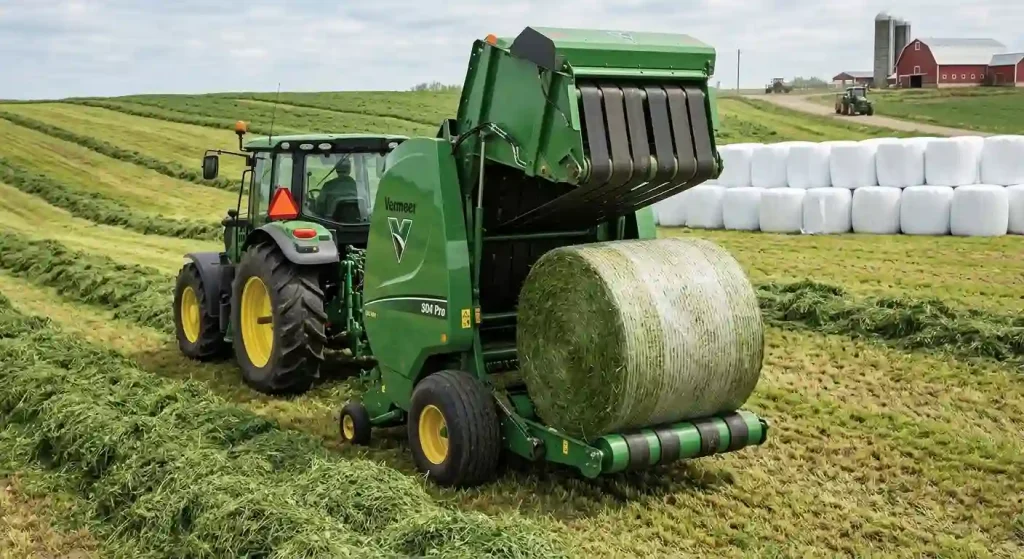
For biomass supply contracts, bale density, throughput, and consistency are the primary equipment criteria. Canada Hay-Balers Co. offers machines across the range suitable for biomass operations:
Bale Storage and Logistics: Protecting Your Biomass Investment Before Delivery
Biomass bales represent contracted value. A bale that absorbs rain and rises from 18% to 35% moisture over 60 days of outdoor storage has lost its contractual value. Biomass bale storage management is as important as baling quality.
- Single-layer outdoor storage on gravel pads: The gold standard for prairie straw biomass. Elevated bales shed rain from the rounded surface and dry from the bottom. Avoid stacking, which traps moisture at contact points and creates hot spots that raise internal moisture.
- Net wrap is essential for outdoor-stored biomass bales: Twine-wrapped bales held outdoors for 90+ days can lose 15–20% of mass through surface weathering and can develop mold penetration that reduces energy value. Net wrap reduces surface exposure and holds bale geometry through freeze-thaw cycles.
- Orient bales north-south for solar drying: East-west orientation creates persistent shade on one side, inhibiting natural moisture equilibration in the bottom third of the bale. North-south orientation allows both sides to dry equally.
- Monitor stored bale moisture monthly: Use a probe-type bale moisture meter inserted at multiple depths. If any interior reading exceeds 25%, contact your biomass buyer proactively — some facilities will accept slightly wet bales on a docked-price basis, which is better than a full rejection.
- Build storage yards close to haul road access: Biomass transport is typically in B-train configurations. Plan storage rows with a minimum 6 m access lane between rows to accommodate large transport vehicles during delivery scheduling.
Frequently Asked Questions — Agricultural Residue Biomass Baling
Q: What is the current market price for agricultural straw biomass bales in Canada?
Farm-gate prices for wheat straw destined for biomass range from CAD $20–38/tonne, or roughly $8–14 per 1.25 m bale. Delivered prices to facilities within 100 km are typically $40–65/tonne. Prices vary significantly by province, proximity to a facility, and current contract terms. Carbon credit stacking (under BC’s GGIRCA or Alberta’s TIER system) can add $5–12/tonne on top of commodity pricing.
Q: How do I find a biomass buyer for my straw bales?
Start with your provincial agriculture ministry’s bioenergy directory (Natural Resources Canada maintains a national facility database). The Canadian Biogas Association and Canadian Biomass Magazine are also good directories of operating facilities with active intake programs. Local grain elevators often have contacts in the biomass supply chain.
Q: Does biomass baling damage my soil health?
Removing <50% of stover or straw is agronomically sustainable on most Prairie soils when combined with potassium and sulphur supplementation. AAFC and OMAFRA guidance both support partial residue removal at rates proportional to soil type and slope. The economic return from biomass sale typically more than covers the cost of replacement fertilizer inputs.
Q: Can corn stover be sold into the biomass market alongside wheat straw?
Yes — most biomass power plants accept both materials, often blending them. The 9YG-1.25 cylindrical baler with its interchangeable hammer-claw and spring-tooth pickups is specifically designed for multi-residue operations, allowing corn stover baling in October and wheat straw in August without purchasing a second machine.
Q: Are round bales or square bales better for biomass markets?
Most large biomass power plants and AD facilities accept round bales without issue — their intake systems are designed for both. Pellet mills and some specialty manufacturers prefer large square bales for their higher density and easier handling on automated lines. For farms without an existing large-square baler, round bales are the practical entry point into biomass markets.
Q: What moisture testing equipment do I need before selling biomass bales?
A probe-type bale moisture meter (inserting into bale core) is the minimum requirement. Handheld surface meters alone are not adequate — they read the outer surface and miss interior moisture. Invest in a probe meter with a 400 mm+ insertion depth. Check multiple points per bale and average readings before certifying a load as within spec.
Turn Your Crop Residue Into a Contracted Biomass Revenue Stream
Canada Hay-Balers Co. supplies ISO 9001-certified round balers suited to agricultural biomass operations of every scale. Our team can advise on machine selection, bale spec compliance, and storage logistics for your target biomass market.
Email: [email protected] · Richmond, BC, Canada · Free B2B Quote — Global Shipping Available