
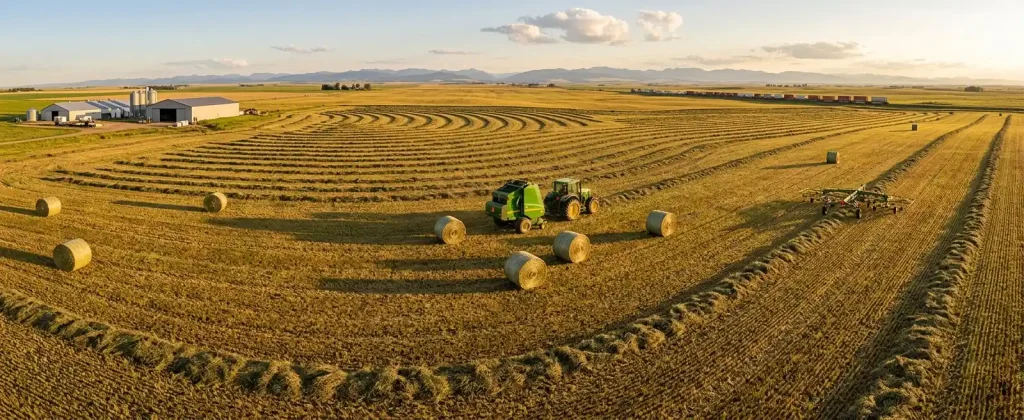
Not every baling operation is running 500 acres behind a 120-HP tractor. Across Canada, the United States, and much of Northern Europe, hundreds of thousands of small farms, hobby homesteads, and part-time livestock operations need to put up hay every summer — but on a scale that makes a full-commercial round baler completely impractical. Too much machine, too much tractor, too much capital, and too much complexity for fields that might be 10, 20, or 50 acres.
For these operations, the question is not whether to buy a baler — it’s which compact baler makes the most economic sense given their tractor HP, acreage, livestock headcount, and crop mix. This article covers everything a small farm operator or homesteader needs to know before purchasing a compact round baler: what machine features actually matter at small scale, how to calculate whether baling is economically justified versus custom hiring, and how to get the most productivity out of a low-horsepower PTO-driven setup.
Who Actually Needs a Small Farm Baler — and Who Should Custom Hire
The first question to answer before any equipment purchase is whether owning a baler makes financial sense for your operation. The break-even comparison between owning a compact baler and hiring a custom baling contractor is simpler than most people think:
| Factor | Own a Compact Baler | Custom Hire |
|---|---|---|
| Annual bale volume needed | 100+ bales/year — ownership justified | <100 bales/year — custom hire typically cheaper |
| Timing flexibility | Bale on your own schedule — critical for quality | Contractor’s schedule — risk of quality loss waiting |
| Multi-cut hay fields | 3–4 cuts/year — ownership ROI increases significantly | 3–4 contractor visits — cost compounds |
| Mixed crop (hay + straw + stover) | One machine covers all crop types — efficiency gain | Contractors may not offer multi-crop service |
| Custom hire cost (Prairie Canada) | N/A | CAD $5–9/bale for round baling, plus hauling |
The general rule of thumb: if you are baling more than 100 bales per year across 2+ cuts, or if hay timing is critical to your livestock nutrition program (horse owners, for example, cannot afford to wait for a contractor after the optimal cutting window), ownership of a compact baler pays for itself within 3–5 years on most small operations. If you bale fewer than 80 bales per year from a single summer cut, custom hiring is usually more economical when machine depreciation, maintenance, and storage are accounted for.
Understanding Small Farm Baler Specifications: What Really Matters
Equipment brochures list dozens of specifications. For a small farm owner buying their first baler, five parameters matter above all others:
This must match your existing tractor — not your aspirational tractor. A baler requiring 60 HP run on a 50 HP tractor will overheat the PTO shaft and produce inconsistent bales. Compact balers in the 1.0 m class typically need 40–55 HP, which aligns with the 45–60 HP utility tractors most common on small farms.
② Bale Diameter and Weight
1.0 m diameter bales weigh 100–200 kg — light enough to roll by hand or move with a front-end loader on a small tractor. Larger 1.25 m bales (200–350 kg) require mechanical handling. For homesteads and small livestock operations feeding daily, 1.0 m bales offer far better practical manageability.
③ Pickup Width
On small fields with a walk-behind or compact cut, windrows are naturally narrow. A baler pickup that’s 1,200–1,500 mm wide is appropriate; a wide commercial pickup on a narrow windrow wastes field passes and struggles to form a consistent bale.
④ Crop Versatility
Small farms often run multiple crops through one machine — hay, straw, garden residue, light corn stover. A versatile machine with interchangeable or adjustable pickup settings extends the machine’s economic life significantly beyond a single hay season.
⑤ Maintenance Simplicity
A small farm operator typically does their own maintenance. A machine with accessible grease points, a clear operator’s manual, and straightforward roller/tine replacement procedures will be maintained correctly. Complex hydraulic tie systems may be under-maintained on small farms, leading to premature wear.
Canada Hay-Balers Co. Compact Baler Lineup: Which Model Fits Your Farm
Canada Hay-Balers Co. offers two compact round balers designed expressly for small farms, homesteads, and operations where a utility-class tractor is the workhorse. Here is a detailed comparison:
| Specification | 9YG-1.0 Round Baler | YG-1.0C Straw Baler |
|---|---|---|
| Bale Diameter | 1.0 m | 1.0 m |
| PTO Requirement | 40–55 HP | 40–55 HP |
| Bale Weight Range | 100–200 kg | 100–180 kg |
| Pickup Type | Spring-tooth (axial-flow) | Hammer-claw |
| Best Crops | Hay, grass, alfalfa, clean straw | Straw, corn stover, mixed residue |
| Wrap System | Twine / Net wrap | Twine / Net wrap |
| Best Fit For | Hay-primary small livestock farms | Mixed-crop, grain + livestock farms |
Small Farm Baling Tips: Getting Maximum Efficiency from a Compact Baler
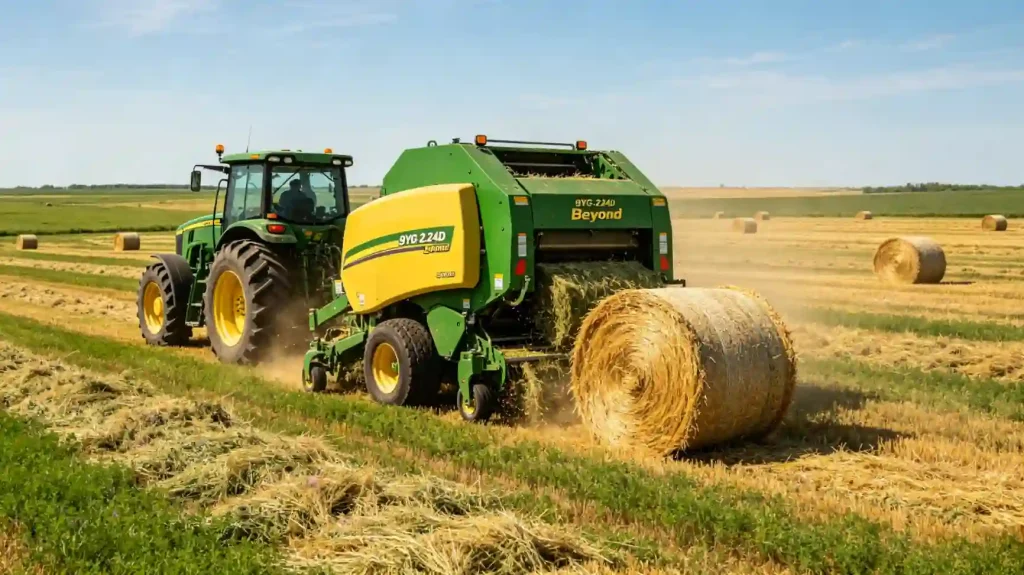
Small farm baling presents logistical challenges that large commercial operations rarely face — small, irregularly shaped fields; mixed windrow conditions; limited labor; and equipment that must double as a daily-use tractor for other farm tasks. These field-proven practices help small operators maximize both bale quality and machine longevity:
- Merge narrow windrows before baling. Small tractors and walk-behind mowers create narrow, inconsistent windrows. Merging two windrows with a simple hay rake before baling produces more consistent feed into the bale chamber and reduces the number of field passes the baler must make.
- Check PTO speed against baler spec. Compact balers like the 9YG-1.0 and YG-1.0C require 540 RPM PTO — the standard for smaller tractors. Do not run at higher RPM to compensate for slow field speed; this increases wear without improving bale density.
- Bale in the afternoon, not the morning. On small hay fields, morning dew can add 3–5% surface moisture to an otherwise well-dried windrow. Waiting until mid-afternoon allows solar drying to peak, reducing the risk of hot bales and internal mold.
- Do not overfill the bale chamber. On compact machines, the temptation is to keep feeding to get maximum bale weight. Overfilling at the chamber limit results in irregular bale shape and increased wrap failures. Respect the audible or indicator signal and eject when the machine indicates ready.
- Grease all fittings every 8 operating hours. This is the single most impactful maintenance action for compact balers. PTO driveline, pickup shaft bearings, and roller bearings are wear-sensitive on machines working in dusty field conditions. Most compact baler repairs trace to inadequate lubrication.
- Store bales off the ground. Even on a homestead with just 30–50 bales, storing on gravel or wooden pallets reduces ground-contact moisture losses by 20–30% compared with bales placed directly on soil — an easily avoidable loss.
Annual Cost Modelling: Small Farm Baler ROI in Real Numbers
For a typical small farm baling approximately 150–200 round bales per year across two hay crops and one straw harvest, the following simplified model illustrates the economics of compact baler ownership versus custom hiring:
ILLUSTRATIVE COST MODEL — 175 Bales/Year
OWN a compact baler (10-year horizon)
- Machine purchase (amortized 10 yrs): ~$850/yr
- Twine / net wrap: ~$350/yr
- Fuel (tractor): ~$220/yr
- Maintenance & parts: ~$180/yr
- Total: ~$1,600/yr → $9.14/bale
CUSTOM HIRE (175 bales/year)
- Contractor rate: $6.50/bale
- 175 bales × $6.50: $1,138/yr
- Wait time / quality loss risk: unquantified
- No flexibility for extra cuts
- Total: ~$1,140/yr → $6.50/bale (apparent)
Note: At 175 bales/year, custom hiring appears marginally cheaper on a per-bale basis. However, when you add a third hay cut (reaching 230+ bales) and count the quality premium from baling at optimal timing, ownership economics improve significantly. At 300+ bales/year, ownership is consistently cheaper and more profitable.
Frequently Asked Questions — Small Farm & Homestead Baling
Q: What is the minimum tractor HP to run a compact round baler?
The 9YG-1.0 and YG-1.0C both require 40–55 HP at the PTO. A 45 HP utility tractor running a standard 540 RPM PTO is the minimum practical setup. Do not attempt to run a compact baler on a sub-compact tractor below 35 HP — you risk PTO overload and inconsistent bale formation.
Q: How many acres of hay does a small farm need to justify buying a baler?
As a general guideline, 15–25 acres of productive hay producing 3+ cuts per year generates enough bale volume (120–200+ bales) to justify a compact baler purchase. Below 15 acres and one cut per year, custom hiring is typically more economical unless hay quality timing is critical.
Q: Can I bale with my existing utility tractor, or do I need a new one?
Check two things: your tractor’s PTO HP rating (must be 40+ HP) and whether it has a Category 1 or Category 2 three-point hitch. Compact round balers are trailed (pulled from the drawbar), not three-point mounted, so hitch category is less critical than having a suitable drawbar and functional PTO shaft.
Q: Can one baler handle both hay and straw on a small mixed farm?
Yes — the YG-1.0C is specifically designed for multi-crop use on mixed farms. Its hammer-claw pickup performs well on both hay windrows and cereal straw. If your primary crop is hay with only occasional straw, the 9YG-1.0 with its spring-tooth pickup also handles clean straw adequately in most Prairie conditions.
Q: How many bales per hour does a small farm baler produce?
On well-formed windrows in good conditions, compact 1.0 m round balers typically produce 15–30 bales/hour. Throughput depends heavily on windrow consistency, field shape (turning time), and operator experience. On small, irregular fields, 12–18 bales/hour is a realistic planning figure.
Q: Do compact round balers come with net wrap, or do I need to add it?
Both the 9YG-1.0 and YG-1.0C support twine and net wrap. Net wrap is generally recommended for bales stored outdoors, even on homestead scale. Confirm wrap system configuration with Canada Hay-Balers Co. at time of quote, as options may vary by order specification.
Find the Right Compact Baler for Your Small Farm
Canada Hay-Balers Co. supplies ISO 9001-certified compact round balers suited to farms of all sizes. Tell us your tractor HP, acreage, and crop mix — our team will recommend the right machine and help you calculate your payback period before you commit.
Email us at [email protected] · 10055 Hogarth Dr, Richmond, BC, Canada · Free Quote — No Obligation
editor:WM