
Large round balers dominate the imagery of cattle country, and for good reason — on operations running hundreds of head across thousands of acres, the throughput and labour savings of a 500 kg round bale are decisive. But that picture describes one segment of cattle farming. For the majority of cow-calf operations, small dairy herds, backgrounding lots, and mixed-species farms across Canada, the small square baler remains not just relevant but often the more practical choice.
The threshold where large-bale economics become compelling is typically somewhere around 80–100 head on a dedicated beef operation with its own bale-handling machinery. Below that scale, the cost of a front-end loader, the space requirements for round bale storage, and the wastage from open-access feeding often tip the balance back toward small squares.
Feeding Flexibility That Small Cattle Operations Actually Need
A mixed cattle operation — say, a 30-cow herd with calves plus a handful of yearlings in a separate pen — has genuinely different feeding requirements across its animal groups at any given time. Fresh-calved cows need higher-energy forage than dry cows. Yearlings being pushed for growth get more feed per head than mature animals on maintenance. A round bale opened in a shared paddock cannot accommodate those differences.
Small square bales distribute by group. You carry six bales to the high-needs pen and two to the dry cow paddock. The total time difference compared to moving a round bale with a tractor is smaller than it sounds — especially in winter when frozen ground or deep snow makes tractor operation slow and rough on equipment.
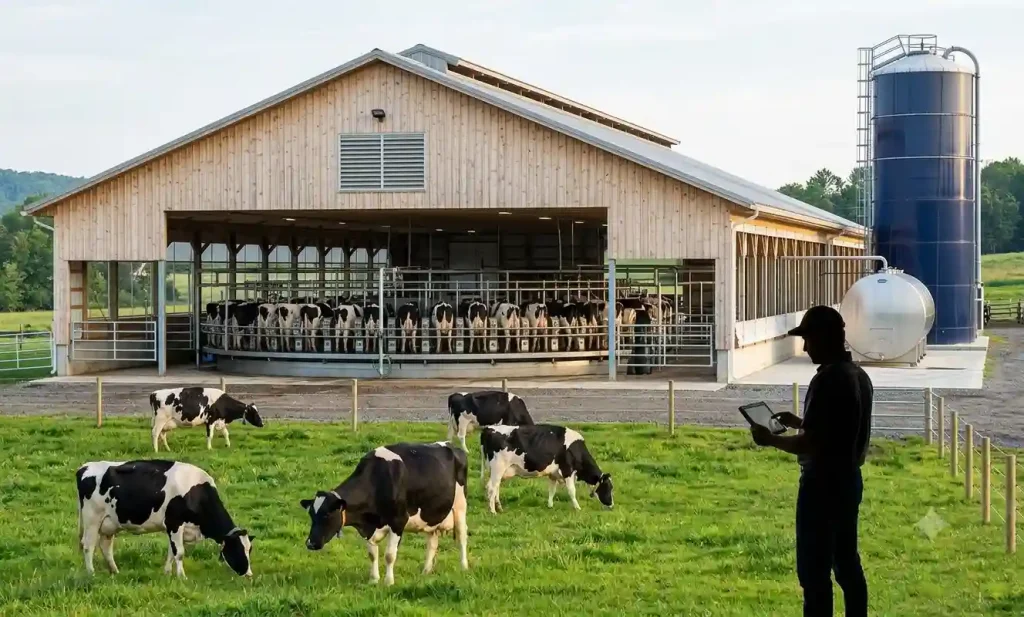
Feed bunk feeding with small squares also produces measurably less wastage than round bale ring feeders. University of Minnesota research consistently shows round bale ring feeders at 11–14% hay waste; hay fed in bunks from square bales comes in under 5%. On a 30-cow operation feeding through a 180-day winter, that difference adds up to real tonnage.
Waste Adds Up Fast
A 30-cow herd consuming 8 kg of hay per head per day through a 180-day feeding period uses approximately 43 tonnes of hay. At 14% round bale ring feeder waste versus 5% bunk waste, the difference is over 3.8 tonnes of hay lost per season — roughly the equivalent of 200+ small square bales.
Dairy Herd Applications: Consistency Is Everything
Dairy cows are sensitive to feed changes in a way that beef cattle generally are not. Abrupt shifts in forage quality — moisture content, protein level, stem-to-leaf ratio — trigger drops in milk production that take days to recover from. For a dairy operation, consistent forage quality from one bale to the next is not a luxury; it’s a production management requirement.
Small square bales, produced from a single field and cutting with well-calibrated equipment, deliver that consistency. Each bale is structurally similar to the next. Density, moisture, and crop composition are uniform across the batch. Compare this to round bales, where the outer layers of a field-stored bale degrade significantly relative to the core — meaning a single round bale actually represents a gradient of quality from outside to inside.
For Total Mixed Ration (TMR) operations, square bales also load more easily into bale processors and mixer wagons without the core/outer variability issue. The chopped hay fraction of a TMR benefits from uniform bale composition.
Crop Types for Cattle Hay Production
Cattle are considerably less selective than horses about forage type. This opens up more crop options for cattle-focused hay production:
Timothy & Grass Mix
Reliable for beef cattle maintenance rations. Lower protein than legumes but high fibre — good for dry cow programmes and backgrounding.
Alfalfa
High-protein dairy cow forage. Requires precision baling — correct moisture and pickup technique critical for leaf retention and protein preservation.
Clover Mixes
Economical for beef operations in BC and Ontario. Monitor baling moisture carefully — clover holds water longer in the stem than grass species.
Straw (Supplemental)
Wheat and barley straw baled square works well as a low-cost dry matter source in cattle TMR or as a winter bedding supplement in deep litter systems.
Equipment Matching for Cattle Farm Scale
Most family-scale cattle operations in Canada run tractors in the 50–80 HP range — sized for the farm’s general workload rather than a baler specifically. The good news is this range is well-matched to our 9YF series balers, which operate from 45 HP PTO upward and run on standard 540 RPM PTO at Category II hitch.
Our 9YF-2200 / 1900 / 1700 Square Hay Baler covers the main production needs of a small-to-medium cattle operation — it handles grass, legume, and mixed forages, adjusts bale density for different feed uses, and produces uniform bales at a rate that matches what one operator with a bale wagon or accumulator can handle efficiently. The double-chain drive system handles the denser windrows common in high-yielding grass-legume mixes without the feed irregularities that single-chain systems produce under load.
For cattle operations that also bale straw after grain harvest — a common secondary use on Prairie mixed farms — the same machine handles both crops without reconfiguration beyond adjusting bale density and pickup height.
Winter Feeding Management in Cold Canadian Climates
Prairie winters create practical feeding challenges that shape equipment decisions in ways that producers in milder regions don’t encounter. A few considerations specific to cattle operations in cold climates:
- Frozen bales: Round bales freeze to the ground and to each other in extended cold. Moving a frozen 500 kg bale with a cold-soaked tractor at −25°C is a maintenance event. Small square bales stored inside require no thawing and no machinery to distribute.
- Feeding frequency: Cattle in cold conditions have higher maintenance energy requirements — they eat more and need more frequent access to forage. Small squares allow top-up feeding twice daily without equipment — an important consideration for operations without dedicated feeding staff.
- Bedding integration: On deep litter systems, straw bales are added to the pack regularly through winter. Square bales break open cleanly by hand and distribute evenly without a bale processor — reducing equipment dependency in the coldest months.

When to Consider Scaling Up to a Twin-Chamber Model
If your cattle operation has grown to the point where you’re also selling surplus hay — to neighbouring farms, feed stores, or at auction — daily bale output becomes a constraint. A single-chamber machine running at 100–120 bales per hour is adequate for on-farm use, but falls short when you need to clear 50 acres in a narrow weather window and still have product ready for a buyer pickup.
The 9YFS-2.2 Twin Chamber Square Baler doubles per-pass output without a second machine or second operator. For farms at the intersection of own-use production and commercial sales, it’s the step up that makes larger volumes viable within existing labour constraints.
If you’re unsure which configuration suits your current scale and future plans, our team can help you work through the numbers. Reach us at [email protected] or visit our square hay baler product page for full specifications.
Canada Hay-Balers Co., Ltd
10055 Hogarth Dr, Richmond, BC V7E 3Z9 | [email protected]
Editor:WM